French critic Pierre Bergé said that you have to bring a belief to Diary of a Country Priest, in either heaven or in the cinema. Like the atheistic Pier Paolo Pasolini's The Gospel According to St. Matthew, Robert Bresson's film is evidence to a collective spirituality that exists far outside the labels imposed by our creaky systems of belief; the film itself evokes the act of worshiping. This intense spiritual inquiry doesn't cater to any religious persuasion, but instead speaks to the universal need for personal foundation in pursuing fulfillment and meaning in one's life.
2.24.2011
2.18.2011
Moments of the Decade, #35-31
As usual, spoilers ahead.
35. The Fountain (Darren Aronofsky, 2006) How much you groove on this kookily sincere existential sci-fi romance might just depend on your own willingness to suspend disbelief. It's a film of astonishing spiritual inquiry and emotional nakedness, rendered with fearless precision; thematically and creatively, this is God complex material, and if Aronofsky pulls it off (which I think he does), it's because he doesn't give a shit who thinks it's silly. The images often evoke the breathtaking wonder of silent films, but to these eyes, the height of earned creative audacity comes in a seamlessly included homage to what may be the greatest film ever made about death: Akira Kurosawa's Ikiru. If you've seen The Fountain and didn't know that reference already, you should be putting that classic at the top of your queue in three, two, one...
34. The Cove (Louis Psihoyos, 2009) Endangered dolphins -- a race arguably superior to ours, and frankly, I hope they rule the planet in my lifetime -- continue to be slaughtered in parts of Japan, where a natural niche in the land is employed to gather and massacre the creatures en masse, away from the eye of the media. The Cove gives due consideration to various political and cultural issues at work here, but it's the carefully plotted and executed act of infiltration (to install hidden cameras) that gives the film it's dramatic axis. Rare is the documentary where the work behind the camera is so palpable on the screen, both figuratively and literally. The hard-earned results are some five minutes of searing animal brutality, at once unspeakably tragic and -- for their potential to end the monstrosity (can we get a witness?) -- searingly triumphant.
33. Five Dedicated to Ozu (Abbas Kiarostami, 2003) Like a mental net one experiences with the same half-asleep verve as when watching clouds roll by, the plotless, five-shot Five Dedicated to Ozu is an acquired taste to say the least (it was never officially released theatrically; its five scenes were played as part of a museum exhibit, independently of each other). Easily the most accessible, the fourth of these shots -- a straightforward view of the ocean with the beach framed in the lower foreground, through which some hundreds of ducks waddle only to waddle right back where they came from -- is also certainly the most fun. Call me a hippy (I wish), but nature is more entertaining than most movies, and these birds are pure bliss.
32. The Wrestler (Darren Aronofsky, 2008) A heartbreaking look at the failure of the American dream, Aronofsky's old school underdog tale is as expert an exercise in archetypal purity as it was perfect a vehicle for the rekindled talent of Mickey Rourke (whose true comeback started at least as early as Sin City). Even some who hated the film remarked on the poetic beauty of the climax, a brutal end after many brutal roads, which sees Rourke's down-and-out Randy (once a celebrity, now a has-been, and a failed father to boot) choose to go out as a legend rather than endure a life where more hurt may be just around the corner. (The worst fact here is that death wasn't his only out.) If there aren't tears on your cheeks by the time The Boss begins strumming over the end credits, I fear that something may be broken inside.
31. Anchorman: The Legend of Ron Burgundy (Adam McKay, 2004) This was my proverbial oasis in the desert for the summer of '04. Amidst Kerry vs. Bush idiocy and other usual suspects, Will Ferrell and company gave us a nearly transcendent act of tomfoolery; they embrace the absurd and point out our foibles. The film is endlessly quotable (“I'm in a glass case of emotion!”), but arguably no moment lands with as much detonation as that of a scene-stealing Steve Carell, who – as the mentally handicapped weatherman Brick Tamland, responding to the latest round of office trauma – leaps into frame, face virtually frozen, bolting with fervor that he does not, in fact, know what they are yelling about. His next contribution seals the deal. It's an exclamation point writ large, and a wry response to a decade's worth of asinine media.
Hattips to Keith Uhlich and DVD Beaver for caps of Five and The Wrestler, respectively.
[Comments can be posted on the main list page available here.]
35. The Fountain (Darren Aronofsky, 2006) How much you groove on this kookily sincere existential sci-fi romance might just depend on your own willingness to suspend disbelief. It's a film of astonishing spiritual inquiry and emotional nakedness, rendered with fearless precision; thematically and creatively, this is God complex material, and if Aronofsky pulls it off (which I think he does), it's because he doesn't give a shit who thinks it's silly. The images often evoke the breathtaking wonder of silent films, but to these eyes, the height of earned creative audacity comes in a seamlessly included homage to what may be the greatest film ever made about death: Akira Kurosawa's Ikiru. If you've seen The Fountain and didn't know that reference already, you should be putting that classic at the top of your queue in three, two, one...
34. The Cove (Louis Psihoyos, 2009) Endangered dolphins -- a race arguably superior to ours, and frankly, I hope they rule the planet in my lifetime -- continue to be slaughtered in parts of Japan, where a natural niche in the land is employed to gather and massacre the creatures en masse, away from the eye of the media. The Cove gives due consideration to various political and cultural issues at work here, but it's the carefully plotted and executed act of infiltration (to install hidden cameras) that gives the film it's dramatic axis. Rare is the documentary where the work behind the camera is so palpable on the screen, both figuratively and literally. The hard-earned results are some five minutes of searing animal brutality, at once unspeakably tragic and -- for their potential to end the monstrosity (can we get a witness?) -- searingly triumphant.
33. Five Dedicated to Ozu (Abbas Kiarostami, 2003) Like a mental net one experiences with the same half-asleep verve as when watching clouds roll by, the plotless, five-shot Five Dedicated to Ozu is an acquired taste to say the least (it was never officially released theatrically; its five scenes were played as part of a museum exhibit, independently of each other). Easily the most accessible, the fourth of these shots -- a straightforward view of the ocean with the beach framed in the lower foreground, through which some hundreds of ducks waddle only to waddle right back where they came from -- is also certainly the most fun. Call me a hippy (I wish), but nature is more entertaining than most movies, and these birds are pure bliss.
32. The Wrestler (Darren Aronofsky, 2008) A heartbreaking look at the failure of the American dream, Aronofsky's old school underdog tale is as expert an exercise in archetypal purity as it was perfect a vehicle for the rekindled talent of Mickey Rourke (whose true comeback started at least as early as Sin City). Even some who hated the film remarked on the poetic beauty of the climax, a brutal end after many brutal roads, which sees Rourke's down-and-out Randy (once a celebrity, now a has-been, and a failed father to boot) choose to go out as a legend rather than endure a life where more hurt may be just around the corner. (The worst fact here is that death wasn't his only out.) If there aren't tears on your cheeks by the time The Boss begins strumming over the end credits, I fear that something may be broken inside.
31. Anchorman: The Legend of Ron Burgundy (Adam McKay, 2004) This was my proverbial oasis in the desert for the summer of '04. Amidst Kerry vs. Bush idiocy and other usual suspects, Will Ferrell and company gave us a nearly transcendent act of tomfoolery; they embrace the absurd and point out our foibles. The film is endlessly quotable (“I'm in a glass case of emotion!”), but arguably no moment lands with as much detonation as that of a scene-stealing Steve Carell, who – as the mentally handicapped weatherman Brick Tamland, responding to the latest round of office trauma – leaps into frame, face virtually frozen, bolting with fervor that he does not, in fact, know what they are yelling about. His next contribution seals the deal. It's an exclamation point writ large, and a wry response to a decade's worth of asinine media.
Hattips to Keith Uhlich and DVD Beaver for caps of Five and The Wrestler, respectively.
[Comments can be posted on the main list page available here.]
Labels:
lists,
screenshots
2.17.2011
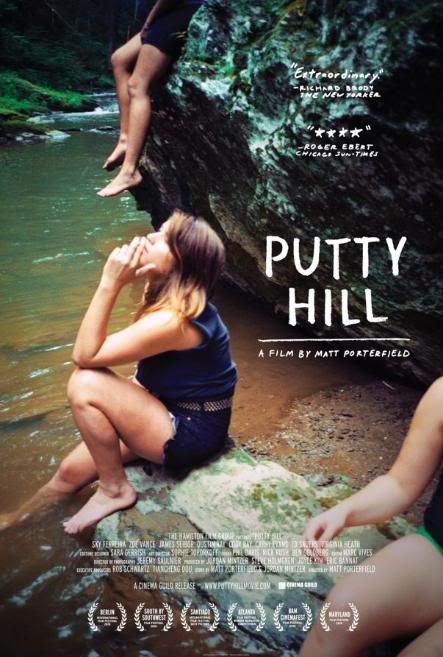
Putty Hill

Few films are capable of evoking the tumultuous feelings that accompany life's tragedies -- most of them compartmentalize them for tidy drama, or ignore/forget them outright -- so it's a genuine breath of fresh air to find one that gives voice to the many conflicting, uncertain, and even regressive ways with which people deal with life's harsher blows. At the center of Putty Hill is Cory, a young man who just recently died of a drug overdose, an event that ripples throughout his suburban community as friends and family congregate (some of them from out of town) for the impending funeral. To some, like the young James (James Siebor), Cory's brother, seen playing paintball in the opening scenes, these events might seem to barely register; I was reminded of the almost pleasant numbness I felt the afternoon of September 11th, 2001, which I take it was essentially an overload of emotional input, triggering a total loss of responsive ability. Writer/director Matthew Porterfield keenly measures the pulse of these emotions and the manner in which people absorb them (or choose not to) into their routines and future plans. Like Rachel Getting Married, the loose ends with which Putty Hill chooses to leave its character are among its many assets; anything purporting conclusion would be a lie.
I haven't seen Porterfield's first film, Hamilton, but Putty Hill would appear to be a respectable evolution of his laid-back, peripatetic approach. Plot-wise, not much happens here (the film abstains from including the funeral itself, in a tasteful bit of privacy), all the better to focus on the drama that exists between the lines. Though obviously shaken by Cory's death, life goes on with a semblance of normality for the local residents: teenagers get high by the creek, skaters kill time at the park, a tattoo artist continues his trade, etc. In ways unspoken, the film speaks to the larger economic rifts that affect these people: with little in the way of educational opportunities, many have turned to dealing drugs in hopes of securing the wealth promised to them by the American dream, and the mind reels at the long-term damage being wrought today by greedy Wall Street employees, corrupt politicians and their sinful kind. Justice is hard to come by here, but that's just an accepted, however mourned, facet of life for these souls.
This refreshingly chill approach, alas, is disrupted via a sporadic series of well-intended "interviews", in which an off-camera voice (presumably Porterfield's) talks to the characters one-on-one, asking them personal basics and letting them vent emotional steam. Unto themselves, these scenes work, as they highlight Porterfield's knack for how real people talk and his excellent use of amateur performers, but they ultimately feel like an overt reassessment of everything else the film has already observed. Putty Hill works best, then, when it simply lets these people be who and what they are, unprompted and always without judgment. The wake scene, in which a delightful motley of characters sing and dance their way through their collective grief, achieves something of a quotidian transcendence. Whether it's the joyously impromptu screech of a surprised girl or the dead-end escape that concludes the film, Putty Hill's slice of life is bittersweet indeed.
Directed by: Matthew Porterfield Screenplay by: Matthew Porterfield Starring: Sky Ferreira, Zoe Vance, James Siebor, Dustin Ray, Cody Ray, Charles Sauers, Catherine Evans, Virginia Heath, Casey Weibust, Drew Harris, Marina Siebor 2010, NR, 87 minutes
Labels:
blog reviews
2.11.2011
The Green Hornet

To these eyes, The Green Hornet falls into a general category of moderately successful films I tend to enjoy for one unifying reason: they may not be of any particular forte or quality, but they don't front their intentions and make for a pleasant and smooth, if perhaps a bit unmemorable, bit of distraction. I feel no need to ever again watch this glib adaptation of the popular superhero radio play and television series (neither of which I'm familiar with outside a broad cultural lexicon), unless perhaps I'm with friends and inebriated; I saw the film in sensible 2D, and I imagine that the kooky, frantic, and sometimes incoherent (especially during nighttime scenes) visuals would lose all magic and become sheer headache in the 3D format (with Jäger, it'd probably be a blast, so here's rescinding my former statement).
Director Michel Gondy's idiosyncratic flair is fairly restrained here, which is probably a very good thing given his lack of experience with action kinetics. He keeps things light on their proverbial feet, and lets the chemistry of the leads do most of the work; the two makeshift heroes, Britt (Seth Rogen) and Kato (Jay Chou) are so effectively relaxed together that when the script demands they be at odds, it rarely works (Rogen's character is frequently a prick, yet he's far too likable to be convincing). In the end, the streamlined approach and frayed ends make it all that much more snappy and glibly entertaining, and though roughly a quarter to a third of the material falls flat, the stream of energy being generated is swift enough that the negative effects never linger. Rogen's extensive creative involvement may be to blame for these rifts, but the only real tragedy here is Christoph Waltz's near-total under utilization; his self-consciously witty verbosity, though skillfully delivered, is too cutesy, lacks distinguishable flair and seems to have been hurriedly rewritten for the man who was Hans Landa.
Directed by: Michel Gondry Screenplay by: Seth Rogen, Evan Goldberg Starring: Seth Rogen, Jay Chou, Christoph Waltz, Cameron Diaz, Tom Wilkinson, Edward James Olmos, Edward Furlong, Analeigh Tipton, David Harbour, James Franco 2011, Rated PG-13, 119 minutes
Labels:
blog reviews
2.08.2011
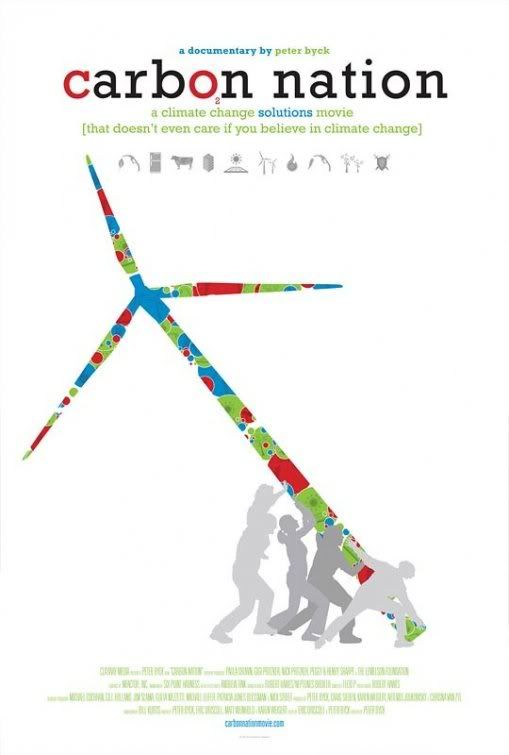
Carbon Nation

There's really no honest way for me to attempt a fully "objective" review of Carbon Nation, what with environmental conservation being one of my long time pet passions. In fact, despite anything in the way of aesthetic shortcomings (the movie surely isn't art, and nor does it try to be), what is perhaps most impressive about this nifty doc isn't how chock full of information it is (even if you're up on climate change and pollution, it's a great refresher course), but the imparted feeling of common empowerment. Having recently watched it, I feel guilty, and not because of my typically Woody Allen-esque liberal white guilt, but because I know I could be doing more than I already am, and with little effort.
Make no mistake: since the dawn of the industrial revolution, the rate at which we've been burning through our fossil fuels should be more than enough to give pause to every worldly cognizant man, woman, and child. Not only are we (in this review, "we" refers to the larger western civilization this American resides in) approaching a point of diminishing resources without sufficiently dependable alternatives (how soon is soon enough to act responsibly?; if oil deprivation hits us unprepared, the survivors might end up living through The Road Warrior), but we're also seriously disrupting the tenuous natural environment we depend on to survive. It doesn't matter that cancers abound from our indulgent and wasteful technologies and lifestyle choices; caught up in the cycles of a capitalistic society, many of those who don't already oppose a less naturally exploitative lifestyle (what better way to feed lies to the masses than to wrap them in a national symbol) are simply too apathetic to do much about it.
As is detailed in Carbon Nation, the world requires 16 terawatts of energy to go round, and that includes everything from the subways to your microwave. Hundreds and hundreds of terawatts of energy are ripe for harvesting from our natural wind currents and received solar energy, but retrofitting our technologies requires foresight, money (up front, that is; the long-term savings should be enough to sway even the most environmentally disinterested for sheer income value), and the kind of leadership that is at best hard to come by in this financially corrupt society. Carbon Nation doesn't get conspiratorial -- it spends most of its time interviewing a plethora of individuals who, through all walks of life, have worked to reduce pollution and make a difference, however small -- but methinks enough wealthy oil pigs line the pockets of Washington to perpetuate this long-gestating atrocity indefinitely, until we pull our collective head out of you know where and realize that the profit motive rights of the few aren't so sacred and holy to the ideals of America as to usurp the quality of life of everyone else.
Carbon Nation isn't entirely my cup of tea, but it's slickly made and almost mathematically calculated as for wide appeal (everyone from the liberal choir to South Park Republicans), and never patronizes in the vein of Michael Moore or Morgan Spurlock. If it is to be a significant work, it will only be because it was actively used as a tool for enlightenment, which begs the question: will we mend our evil ways? Earth doesn't stand to lose much in the long run-- if we poison her enough, she'll wipe us off and regenerate her lost tissue over some thousands of years, and we'll become a boring footnote in the archeological history of some future race. Will we let the short-term greed of a few threaten our collective existence, or will the grandchildren of our grandchildren cherish our memory because we rose as one and did the right thing?
Directed by: Peter Byck Narrated by: Bill Kurtis 2011, Not Rated, 86 minutes
Labels:
blog reviews
2.06.2011
Inception

It is with a heavy heart that I have to report that Christopher Nolan's latest exhibits one of the great schisms between grand intentions and inept executions to be seen at the movies in recent years. Only someone who never saw (or appreciated) Dark City would be able to call it visionary (or Paprika, or Heat, or Blade Runner, or 2001: A Space Odyssey, or Solaris [either one], or, uhm, The Matrix... should I go on?), as Nolan's long-gestating science fiction opus (he first conceived of it as a teenager) rarely rises above its own apparent reliance on these influences. Visually, they're the only thing that stands out from the film's enslavement to one of the more redundant and unmelodious scripts to ever grace a big budget film. In the year of The Social Network's dialectic melodies, Inception is even more blatantly like nails on chalkboard. By distilling the film to its key money shots, the preview was a rush. The movie entire is mostly a snooze.
Nolan's core concept -- that a synthetic dreamland might give way to the raging subconscious of a tortured man -- is as conceptually appetizing as those similarly mind-fucky plots of the aforementioned films. It is tragic, then, that about 90%+ of Inception's running time feels like flight preparation; the stewardess, as she is, never shuts up. And here, she's every single one of the characters, a term I use loosely; mostly, they're ciphers for information, nothing more. Nolan's script seems scared shitless of letting the audience wonder about much of anything, less they get "bored." And so, it spends most of the time bending over backwards telling you things it might have far more creatively shown to you, or when it shows them to you, it usually tells you anyway, etc. The aforementioned Matrix might paint in similarly obvious strokes at times ("Trinity" is a blatant metaphor, sure, but "Mal" should make cringe anyone who holds language sacred), but it's also beautifully stylized, consistently visually inventive, and presented as a great genre tease; it peels away the layers with titillating ease. In contrast, Inception talks at you ad nausea for nearly three hours, expects food market and architectural farts to blow your mind (the lame M.C. Escher shout-outs are the real kicker for me; one man's paradox is another's retarded staircase), and holds your hand as it walks with you through supposed dreamscapes (droll city skylines that are at best casually surreal; where's Lynch when you need him?). I can only speak for myself, but this is exactly the kind of movie where I'd rather be lost, at least for a bit. That would be interesting.
The heist sequences, when they come, are something close to exciting, but that's mostly the attention-demanding score at work, and although a zero gravity Joseph Gordon-Levitt kicking ass is surely a beautiful thing, the overwhelmingly realistic presentation of the dreamland would seem to counter the reason for taking us into the dreamland in the first place (I'll take Neveldine/Taylor's Gamer, thank you, or David Cronenberg's eXistenZ). Otherwise, only a handful of shots transcend this leaden, literal approach into something sensual and poetic, and about half of those include a van in slow motion, turning corners and such. I've seen the film three times now; the first, on opening weekend, benefited of being fresh, though it still ultimately gave me blue balls; the second, at a drive-in, from the rule that any movie is enjoyable at a drive-in; the third, on a home system, was a suffocating slog. Even Oscar should feel disgraced by this fraud (the last shot might not be such a cheat if the preceding psychobabble wasn't such meaningless lip service). Leonardo DiCaprio starred in two "big" movies in 2010. Forget Inception; Shutter Island is actually worth a damn, and then some.
Directed by: Christopher Nolan Screenplay by: Christopher Nolan Starring: Leonardo DiCaprio, Ken Watanabe, Joseph Gordon-Levitt, Marion Cotillard, Ellen Page, Cillian Murphy, Tom Hardy, Dileep Rao, Tom Berenger, Michael Caine 2010, Rated PG-13, 142 minutes
Labels:
blog reviews
2.03.2011
The Killer

It's no misuse of hyperbole to say that violence has never appeared as operatic as it does in John Woo's The Killer -- one of the few films to hold a legitimate claim to the title of Greatest Action Movie of All Time. It's title suggests archetypal purity and existential singularity, and whether deliberately or not (the typically humble Woo thinks of his film as commercial, not art), the many pieces of this seminal work come together with such precision as to suggest something of divine inspiration. The title refers to Chow Yun-fat's Ah Jong (referred to in English dubs and subs as John or Jeff), a professional hitman with a conscience; when he accidentally blinds a female bystander whilst eliminating a club full of gangsters, he vows to secure the money needed for the necessary surgery to restore her sight. One last job should do the trick, but a snafu sees his position compromised, and before long, loyalties are tested and honor becomes the only thing left in a temporary world of masculine claims to power.
Romantic to its core, The Killer stages its many bombastic set pieces with gloriously poetic flourishes, the off-the-cuff verve stemming at least in part from Woo's infamously improvisational approach. As transfixing as it is, however, death is not something glorified here, but bemoaned as a necessary evil in an evil world; every expended bullet and flailing body of dead meat is shot as if an aching expression of a corrupted soul. Woo's impulsive editing choices (freeze frames abound for practically Wagnerian effect) compliment his rigorously framed thematic devices; men on both sides of the law become dual sides of the same coin when true justice is at stake. The blinded Jennie (Sally Yeh) is the equally melodramatic purity of essence in this world, but all does not give way to a better tomorrow. Sins must be paid for, and what separates The Killer from the commercial is Woo's ultimate refusal to give in to basic audience expectations. Like all true artists, he bites the bullet and gives us what we need instead.
Directed by: John Woo Screenplay by: John Woo Starring: Chow Yun-Fat, Danny Lee, Sally Yeh, Kenneth Tsang, Chu Kong, Shing Fui-On, Lam Chung, Yi Fanwei, Huang Guangliang, Ye Rongzu, Barry Wong and Parkman Wong 1989, Rated R, 110 minutes
Labels:
blog reviews
2.01.2011
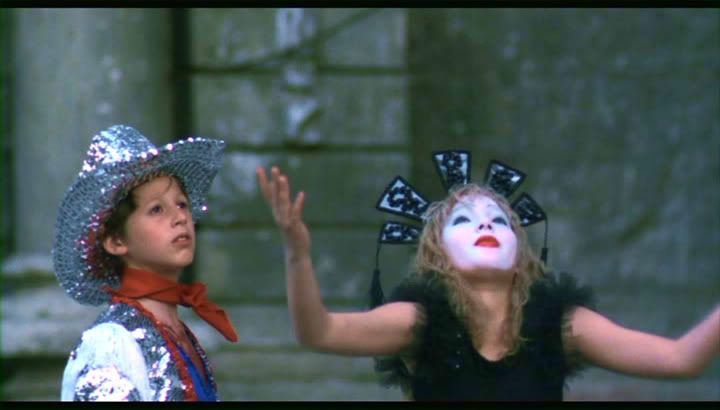
Santa Sangre
On paper, Alejandro Jodorowsky's vision seems drawn equally from the works of Buñuel, Hitchcock, and perhaps incidentally, Tod Browning's Freaks, but the effect of his kaleidoscopic vision never feels culled from any cloths not of his own making. For as random and free associative as his images strike one as being at any given moment, the consistency with which Santa Sangre doles out madness suggests a most assured and carefully plotted creative process.
Subscribe to:
Posts (Atom)