Jun 22, 2007

The Fountain (2006): A

Call me a sucker, but I have a taste for ambition than knows no bounds. This is the case in all human endeavors, but particularly in the artistic realm, and given my interests, particularly in film. In some cases, these are films that I recognize as outright failures, or, at the very least, wobbly creations that barely manage to carry their own weight. I have tremendous respect for Alexander even though it spends most of its three hours crashing down in flames. Others I simply adore through and through, despite their having earned the label of “failure” from friends and peers. I’ve seen it five or six times, and I still adore Paul Thomas Anderson’s Magnolia, and consider its overblown bravura the very life blood of its canvas.

It should be obvious to just about everyone, then, that what is and is not a “failure” is an incredibly subjective designation. A necessity in any form of criticism or opinion-exchanging is the ability to recognize - and appreciate - the coexistence of conflicting opinions and taste; were more people be able to do this simple task, the world as we know it would be a much nicer place to live in. With this in mind, I've chosen The Fountain as my subject on this topic. I think that there are far better and more important films I could write about for this topic, but it was a film that left a deep impression on me that I've not yet found the time to adequately examine or write about. Six months later, having now seen it three times and come to better understand my feelings towards it, I feel far more prepared for the task.

At a recent party in Brooklyn, drinks in hand, myself and some fellow Slant writers came around to Aronofsky’s film in our conversation. Ed Gonzalez hated it (though he loved Clint Mansell's score), Keith Uhlich “didn’t mind it” (though he likes it when "the tree eats Hugh Jackman"), Paul Schrodt thought it was interesting but pretentious, and the absent Nick Schager – like me – included it on his original top ten list at the end of last year, readily admitting its many flaws in the process.

I bring up these individuals not to criticize or take on their opinions, but to remark at how many of their specific (and largely negative) observations I actually agree with; despite many of the same observations, we've reached strikingly different conclusions. Yes, The Fountain is ridiculous, arguably pretentious, pining for your attention like a sixth grade emo kid. Its premise is a silly and all-too-literal manifestation of man’s grappling with his own mortality. Its multi-layered narrative web is highlighted at every intersection, and Rachel Weisz is always standing by to repeat the film's philosophies for those who didn’t hear them the first time. Despite all that, I love it to pieces.

Admittedly, I recognize that at least some of these feelings come from an internal bias on my part, but what opinions aren’t biased by our own experiences, feelings, thoughts, dreams and passions? Two near-death experiences in the past three years have placed mortality at the front of my mind in almost all matters. While The Fountain’s blatant themes of death and immortality should ring true with any being aware of its own finite existence, its motivations and ambition speak to me even more so, and I believe it is this strength of intent that holds it together even as its many pieces threaten to fly off like some out-of-control amusement park ride.

To some extent, one could argue that The Fountain remains less than fully formed, although to an extent I feel that such perceived shortcomings actually add to the experience. This is a film – or at least a theme and subject – that Aronofsky should have arguably left in the drawing room for some time, until life’s experiences had given him greater insight into the passages of the soul. But at the same time, the film is what it is because of its creator's youthful vigor, the passion that stems from eagerly exploring the unknown. It is a naïve work by a soul aware of its own limitations, its honesty like a pulpy, bleeding heart longing for the experiences of the world and the wisdom of the ages.

It is unfortunate for the film that it has elicited such a distinctly divided reaction amongst both audiences and critics alike, it being thematically ambitious but aesthetically traditional enough to arouse similar vigor on both sides of the aisle (it is telling that the film's Rotten Tomatoes score is an even 50%). Many love the film for something it isn't, while many hate it for failing to be something it never tried to be in the first place. Only a fool would liken it to 2001: A Space Odyssey – hold Kubrick’s masterpiece up to Aronofsky’s work, and it will expose the film’s flaws tenfold. Similarly, it is foolish to disregard any work simply for not being something other than itself, to leave it despite any potentially independent merits of its own. The Fountain has its own beautiful, worthwhile heart, a desire to reach for greatness despite knowing full well that it is out of its league.

Silliness is a key word in describing Aronofsky’s film, whether in addressing its multi-pronged narrative, religious overtones, or trippy sci-fi imagery. Hugh Jackman floating in a bubble with a dying tree through the reaches of space to some dying star that an ancient civilization worshipped as their underworld? Recurring circular imagery likening the human experience to the rings of a tree's life cycle? Many people have bemoaned the film as being "incomprehensible," but if anything, it is a work far too obvious in its execution. However, this all-or-nothing, pull-out-all-the-stops approach is a befitting one I quite adore under the circumstances - what the film loses through this "flaw", it gains back triplefold by forsaking the limitations otherwise imposed on it.

Aronofsky has laid out his intentions like a heart on his sleeve, tying together his epic love story through a fairly obvious storytelling device that allows him to cover a 1,000-year canvas with relative ease. Like M. Night Shayamalan's misunderstood Lady in the Water (possibly 2007's greatest "failure"), The Fountain is a daring act of creation open for all to see without the slightest of pretenses. Internet critic Steve Rhodes calls it “preposterous,” and he is right (keep in mind that many people think the same thing about the virgin birth, too). What it comes down to is the human need to tell stories – stories that uncover deeper emotional truths, no matter what path is taken to find them. If film criticism boiled down to pure technical analysis - from basic filmmaking practices to the usual suspects of plot, acting, dialogue, etc. - then I’d be unable to even give The Fountain the time of day. But, as is the case in all art, there is an immaterial force guiding the proceedings, and even though The Fountain is routinely absurd in ways seemingly unforgivable, it works through its own messy ambitions to find its own sacred emotional truths.

I’d never much liked Rachel Weisz in the film, but it dawned on me during my third viewing that she may very well be the key to accepting or leaving the entire work. Her performance is one of shameless attention grubbing, and though she looks heavenly through husband Aronofsky’s lens, she comes off as impatient when forced to pontificate about the script’s Big Themes. It's a dissatisfying in-the-moment impression that improves almost immediately in retrospect; while her enthusiasm is a bit too much to swallow, it is also infectious, a purifying force to be submitted to. Like the film as a whole, she bypasses all that is considered proper for the sake of art and philosophy, instead going straight to the gooey gut of the matter, and those who are turned off by such brazen romanticism will just have to be left behind. In theory, The Fountain seems to have been an impossible film to make, and in cases such as this, ignorance is possibly the greatest tool a filmmaker could have at their disposal. How else to attempt the impossible than to disregard the odds you face?

In this way, my adoration for The Fountain stems largely from the fact that it even exists in the first place. This is not to say I dislike watching it – it is a rocky experience that has elicited groans, chuckles, and eye-rolls from yours truly, and one that I can wholly understand others loathing. It can't begin to hold a candle to its many predecessors and will likely be surpassed by its own creator as his body of work builds - it might not even make my top ten of the year should I ever recompile the list. Still, with all this standing against it, it has also managed to make me wide-eyed with wonder; not in the staring-into-the-face-of-God way that 2001 manages to redefine my life every single time I watch it, but in the way that one is inspired by watching another do the same, without flinching. If this is but a folly of youth – both Aronofsky’s and mine - then so be it.

This my contribution to William Speruzzi's Ambitious Failure Blog-a-Thon, hosted at This Savage Art.

Jun 9, 2007

Hostel: Part II (2007): F

Eli Roth’s latest is a nauseating vehicle of slasher B-movie parts that might have actually risen to the level of “exploitative” had it an ounce of material actually worth exploiting. Many will decry the film for its wanton bloodlust (quite literally, in one particularly off-putting sequence), misogyny and anti-human posturing, and while these are all legitimate claims given this immoral beast of a movie, they ultimately serve to further empower a film that aims to provoke by the most superficial means possible. Like a schoolyard bully, it’s best to simply ignore it outright, although this is a near impossibility given the in-your-face attitude of the onscreen carnage. The film is cruel and sadistic, but so were The Devil’s Rejects and Wolf Creek, two modern horror classics that knew something about tension, suspense, and tongue-in-cheek restraint as a means of illumination into the recesses of the human experience. Entire portions of Hostel: Part II are so over-the-top that it begs a satirical reading, yet such camp hardly seems intentional in a film so completely bereft of irony.

Like the best modern horror films, Hostel: Part II’s chosen subject matter is ripe with parallels to worldwide human conflicts; Roth’s script gives lip service to the immorality and chaos that often comes out of a society on the brink of anarchy, but lip service it remains. The Texas Chainsaw Massacre savagely evoked the American experience in Vietnam through it’s slice-and-dice mayhem. Here, Roth wants desperately to have his cake and eat it too. Hostel: Part II shuns such implicit social examinations in favor of a proudly perfunctory series of unfortunate events, so as to flex it’s Grand Guignol muscles without any un-cool claims to higher legitimacy. Yet, much like it’s equally bullshit-laden predecessor Cannibal Holocaust, this film ultimately gives way to a faux-artsy commentary on its depicted human torture by means of a shallow and unjustified swapping of character motivations. Roth condescends to his characters at virtually every turn, their every action and line of dialogue in service to his superficially provokative bullshit.

Such poseur imitations are certainly depressing, but Hostel: Part II is most reprehensible in its proudly disclaiming any connection to morality. That the film’s most bloodthirsty character ultimately sees the error of his ways when the carnage finally begins is of no redemptive value here, as the film is simply going through prefabricated plot mechanisms without spirit or joy, served up only to legitimate its cowardly torture sequences with the cover of a plot. Roth wants to be as brutal to his audience as possible, but by divorcing his film from any anchor in the complexities of its human roots, the end results are surprisingly tame - there's virtually nothing here that hasn't been done before, better, and with more substance, even if only of the incidental kind. That someone would pay to kill a fellow human being isn't nearly as disturbing as why someone might do such a thing, yet this is a reality lost on such surface-oriented filmmakers, and for a film built so heavily on such strangely motivated characters, such a stunning lack of characterization is a most damning attribute. The film doesn't want to acknowledge the banality of evil, only to exploit it for immediate and increasingly desensitized shocks. One may as well watch a marathon of American beheadings at the hands of Iraqi insurgents with popcorn in hand – the entertainment value is surprisingly comparable. You can add fans of this movie to the list of people I’ll never date.

Jun 8, 2007

Ocean's Thirteen (2007): C-

The cast of Steven Soderbergh's Ocean's films are truly irreplaceable, mainly in that his plethora of iconic celebrity faces exist for little purpose other than to play themselves as the exclusive members of some ridiculous pop culture phantasmagoria. George Clooney and Brad Pitt aren't Danny Ocean and Rusty Ryan - they're George Clooney and Brad Pitt sporting pseudonyms so as to justify having taken $8-11 of your dollars rather than the mere $2 needed to acquire the latest celebrity gossip magazine. Willie Bank (Al Pacino) is this threequel's lead newcomer, a hotel manager elitist who screws series veteran Reuben Tishkoff (Elliott Gould) out of his rightful half of a new casino to be built in Vegas, leaving him not only ruined but with a near-fatal heart attack as a result. Enter Danny Ocean and company to right this wrong by means of upsetting the opening night of Bank's casino by whatever means necessary (at its most extreme, the crew seeks to simulate an earthquake beneath the precarious Vegas location). In this way, the film stands as little more than a feature-length rendition of Home Alone's booby trap sequences, although missing here is the payoff otherwise so precariously built up to. This isn't so much offensive as it is monotonous and boring, as little about Soderbergh's wobbly construction seeks to exist out of the moment of its own self-designed superficiality, ultimately adding up to less than the sum of its parts. Invoking everything from Zapata revolution to Oprah's "Favorite Things" with only passing acknowledgment of a world beyond its star power circle-jerk, the film is a cocky and condescending indulgence test for anyone who hasn't automatically bought into its faux-cool suave. Part of me would like to say that the focus on the minutiae details of this third heist's orchestration falls into the realm of entertainment (and certainly, there are sporadic humorous moments), but Ocean's Thirteen remains a film more intent on amusing itself than in ever throwing the audience a bone. An auteuristic nightmare, the film encapsulates God knows how many elements of self-proclaimed "indie" cinema and smug retro stylistics; Soderbergh coheres these elements that have inspired him, but to what extent, save for an continuously incessant visual clash that rubs our faces in primary color hell? This is a film without a dream, without virtue, without love for anything other than itself. Forget replacing the cast - like Julia Roberts and Catherine Zeta-Jones from the previous installment, you can lose them altogether and call it a day.

May 27, 2007

Bug (2007): B+

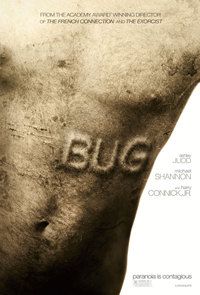
Bug is a freakishly metaphorical look at the self-destructive implications of paranoia gone awry. Two people – Agnes (Ashley Judd), a divorcee who quells her pain over a long-lost child with drugs and alcohol, and her newfound drifter friend Peter (Michael Shannon), who has a knack for picking up on the unspoken qualities of others – share a hotel room that comes to represent their self-erected cave of psychological seclusion. (spoilers herein) Peter claims to be an escapee of a government testing program which has seen him injected with egg sacks of miniscule insects as part of a vast conspiracy program, his bodily wounds and mounting fervor compelling Agnes to believe him; together, their delusions multiply not unlike the very invisible insects they so vigorously try to rid themselves of, their conspiracy theories encompassing everything they've ever suspected in a self-reinforcing web of intricate anti-logic. This admittedly (and intentionally) ridiculous scenario is made compelling not only through the stellar performances of the two leads, but the script’s refusal to confirm or deny the validity of anything they’re saying, the blurred line between truth and reality upping the queasy sense of unease; exactly how much of a unlucky third party’s contributions to the unfolding madness are confirmations of fact? William Friedkin directs this adaptation of the hit off-Broadway play as if it were restrained to the confines of a theater space, here thrusting the mounting madness onto the viewer like the steady potency IV drip bag. His creepy compositions work best when they emphasize the character’s tenuous psychological relationship to their environment, which is thankfully most of the time (unfortunately, in the thirty years since his near-masterpiece The Exorcist, he still hasn’t quite figured out how to shoot a seizure without making it look utterly ridiculous). The film’s breakneck final act is a revelatory fury of alien madness, the hotel room transformed into a tinfoil-lined bug trap that radiates eerie blues and silvers off the character’s oily, scarred bodies. A climactic shot - seemingly taken from the point of view of a spinning ceiling fan - channels the final scene of Aguirre: The Wrath of God, the swirling unease suggesting the final moments of dwindling sanity, like water circling a drain. The slippery line between sanity and madness is driven home here by how frighteningly convincing their delusions appear not only to them, but to us as well.

Grindhouse Revisited

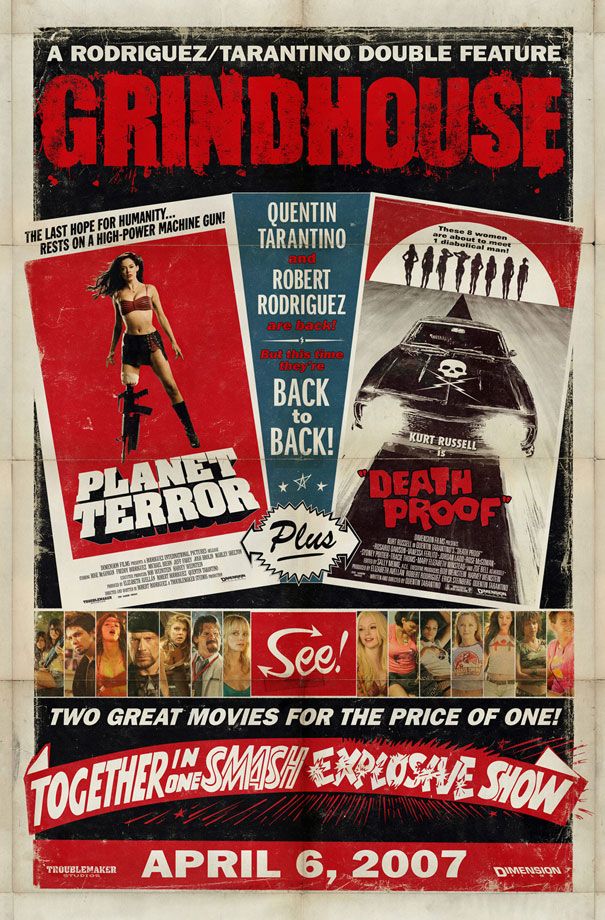
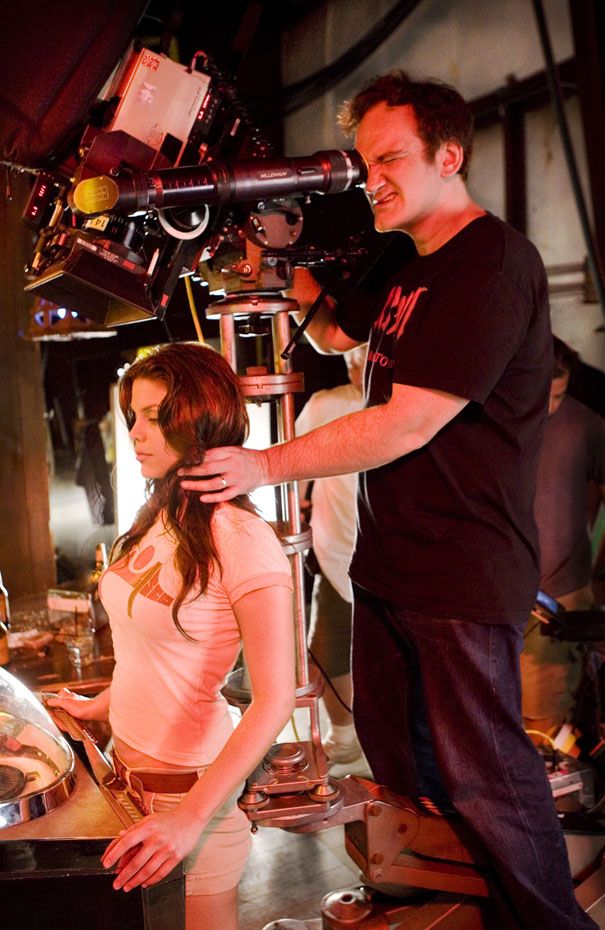
A much-needed second go-around with the double-feature mishmash Grindhouse has been both affirming and reaffirming; the latter in that I still think that Planet Terror is a heluva lotta fun, and the former in that my initial - yet untrusted - skepticism towards Death Proof has been unseated. I walked out of the screening feeling without closure, and were it not for the constraints of time and money, I'd have been back in line for the very next showing.

I enjoyed Planet Terror more than Tarantino's contribution on my initial viewing (more on that later), and while I am an admittedly unabashed fan of many things with the zombie genre (a late night Sci-Fi channel viewing of Night of the Living Dead at age eight can be blamed/thanked for that), it is no unreasonable amount of fanboy bias that swayed my opinion. In my eyes, Rodriguez has crafted a loving homage to the down-and-dirty sleaze and gore of Carpenter, Romero, Fulci, and even a little bit of Cameron, guileless in its execution and aiming only to please a carnal cinematic instinct that hungers for visceral satisfaction. Some have called it postmodern but I disagree; frankly, it gives the film too much credit in the wrong ways, as it is a feature proud of and forward about its largely superficial fun.

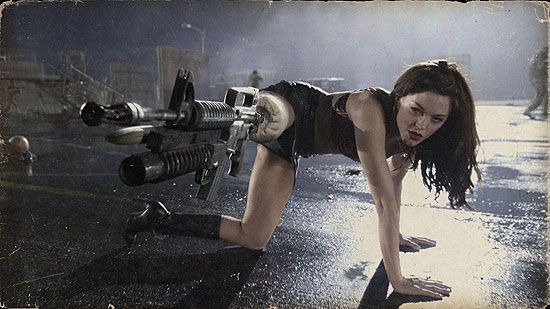
Many have derided the film for the very qualities it aims to fulfill: stupid, overblown, corny entertainment. The phallic imagery of Rose McGowan's machine-gun leg is so deliberately imbedded in fanboy iconography that it seems impossible to take it seriously and, subsequently, impossible to be disappointed by its lack of seriousness. Nary a moment of the proceedings isn't tinged with exaggeration, and while I believe Tarantino to be a far greater artist when it comes to lining his cinematic and pop culture channelings with profundity, Rodriguez is something of a master at to-the-point entertainment. He knows his genre conventions like the back of his hand, and plows through them with a knowing and learned efficiency, tapping into the set-up/payoff narrative structures that guides so much B-movie fare whilst also pairing archetypal characters with the actors most capable of imbuing them with humanistic traits. The movie winks, we wink back, and everyone wins. Granted, some will ultimately see this as bullshit - a view that I don't agree with but I recognize as stemming from personal preferences. Still, while many critics regularly lap up both the serious and the stupid (think Dawn of the Dead and its remake, respectively), why, then, not the seriously stupid as well?

Death Proof is as complimentary as companion piece as I think could have been devised for this double feature, an even more surprising trait because it stands entirely on its own so well. Attentive viewers (here is another way in which repeated viewings help) will notice more than a few instances of cross-over between this and Planet Terror, just as at least one character therein has previously appeared in one of Tarantino's former works. To me, this speaks to cinema as being a self-constructed world unto itself, one as teeming with possibilities and chance encounters not unlike our own reality, the individual movies we see representing but a fraction of the events that take place within its own portrayed reality - they're just what happened to unfold while the camera was rolling.

Since my initial, mind-blowing first viewing of Pulp Fiction four years ago, I've always found Tarantino's films to be unabashedly serious and, yes, moral, even as they partake in cartoonish violence, bloodshed, and rape (among other pleasantries). Tarantino's primal entertainment instincts feel driven by a serious code of morality and honor regarding how we go about our lives with others, even if he himself isn't fully aware of its guiding hand. Sin is the key word here - his film's criminally-driven underpinnings generally serve to expose some character flaw that comes back to haunt their initial perpetrators. The necessity of (and harm caused by) violence, the need for redemption, and paying comeuppance for past deeds are all primary themes throughout his work, and I believe Quentin truly, utterly cares about each and every one of his characters and the paths they work out for themselves in his pop culture carnival, recognizing the inherent humor, sadness, and excitement that blossoms out of the many ways in which we routinely manage to fuck ourselves sideways. Maybe he has learned everything from the movies - a quality that certainly adds to his geekiness, for sure, but it's not as if he's trying to convince us otherwise.

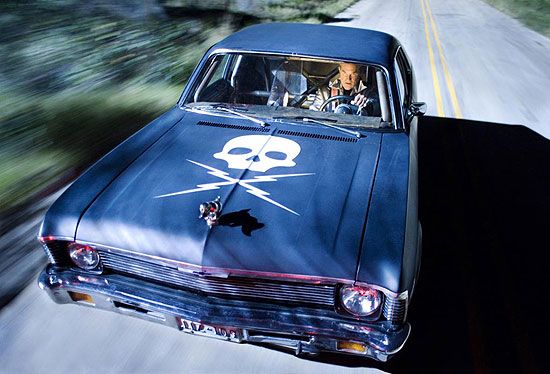
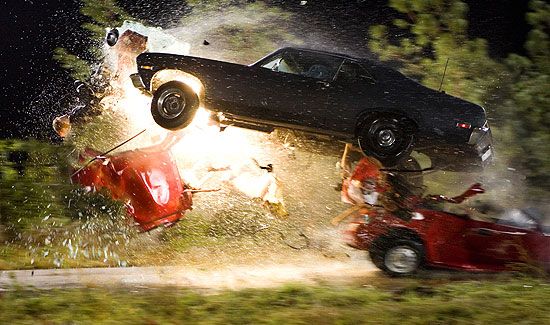
Death Proof confronts us with the subjectivity of violence, internal versus external natures, and the very role the audience plays in legitimizing these elements of cinema. Kurt Russell's villianous Stuntman Mike is like Hannibal Lector jacked up on Cronenberg's Crash - twisted metal, broken glass, and the broken bodies of beautiful women get him off. Seemingly nice enough to the unknowing observer, and it is only when he satiates the internal craving of his libido that he exposes his true self. Likewise, we the audience bear part of the burden in this staged bloodletting: during the build-up to the film's spectacular centerpiece of vehicular homicide, we want to see the wreckage, we're excited to see the mayhem unfold, we crave the visceral rush of watching death happen - specifically, death from a distance, with us safe on the sidelines. But only then does the film repeat the collision four times, each focusing on the death of one of the innocent young women inside. What was once "them" has now become "us," as we're confronted with the familiar faces we've come to know and the utter brutality of their expiration. This is the first half of the film's brilliant genre subversion.

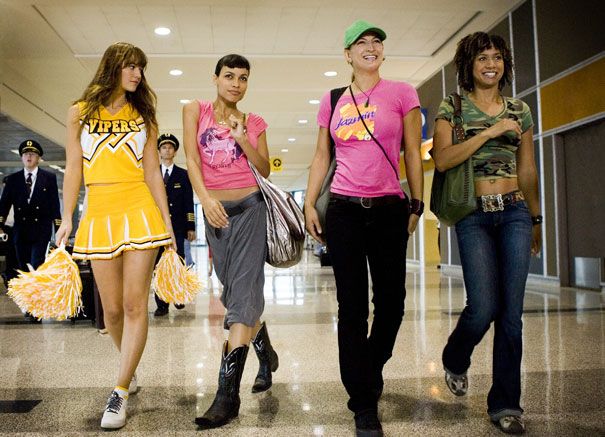
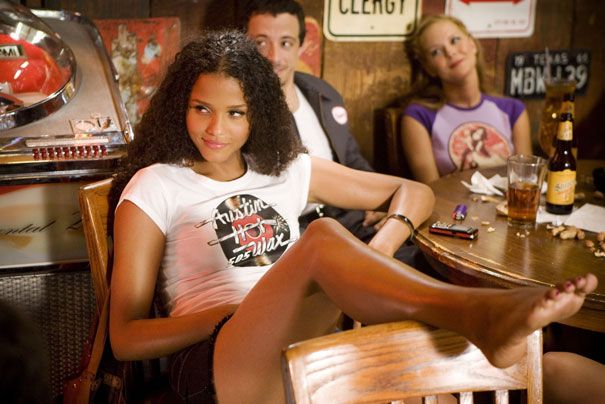
Also key here is an understanding of Quentin's fine female cast and their binary, structured roles. Jungle Julia's posse's faux, bitchy attitudes are an affront to deeper emotional currents and genuine humanistic feelings - feelings we see silently bruised throughout the evening leading up to their death (in short, they're tough cookies, but sweet nonetheless). Zoe Bell's Vanishing Point-obsessed movie crew gang, on the other hand, are greedily self-centered, and while it's certainly no stretch that anyone might want revenge on a speeding, psychopathic motorist who attempts to run them off the road, one gets the sense that this gang has been waiting for a legitimate reason to straight up kick someone's ass - and after having already shot Stuntman Mike, no less (it also doesn't help their case that they left one of their own behind with a creepy fellow who seems to have stepped straight out of Wolf Creek, a film specifically referenced in the climactic car chase).

When Stuntman Mike finally succumbs to the revenge-thirsty rampage, the film has reached an apex of self-criticism. Mike may or may not be crazy, yet we pity his (apparent) demise because of the film's intended role reversal, his humanity having been emphasized in contrast to his would-be victim's superficial indulgences at the cost of others. Mike lies in the vein of a great many movie monsters, as he is only aiming to satisfy his inherent needs in an unaccepting and, for him, incompatible world; he is evil, but he is honest and self-aware of his role, whereas his would-be victims are in denial of their true nature, an untrue to their own when the going gets tough. Amidst all this, the film asks us to develop our own moral opinions on the portrayed events while it emulates the basic genre means of manipulating our moral perceptions, successfully working within the genre without falling to its perceived shortcomings.

That I borderline disliked Death Proof on first viewing can be chalked up to, very simply, a bad first viewing. Perhaps it was the dissimilarity from Planet Terror that threw me off, perhaps it was a jarring bathroom break between the two films, or Jeremiah Kipp's astute pan in his review at Slant Magazine. Dialogue scenes that initially felt drawn out revealed themselves as brilliantly deliberate in staging character traits and digging out a specific narrative groove, while Tarantino's apparent indulgences (examples coming to mind include a thirty-second shot of Jungle Julia whipping her hair to "Baby, It's You", as well as the camera's routine ogling of her feet) became finely woven elements of his synaptic plot devices. Whatever the reason for my initially "not getting it," it is a frequency I am happy to have finally tuned in to. Planet Terror kicks ass, but its skimpy emotional staying power is a necessary trade-off considering its intentions; Death Proof might be a masterpiece, and is possibly my second-favorite of Tarantino's entire catalog after Pulp Fiction.

Planet Terror: B+
Death Proof: A 

May 9, 2007

Night of the Living Dead (1990): C-

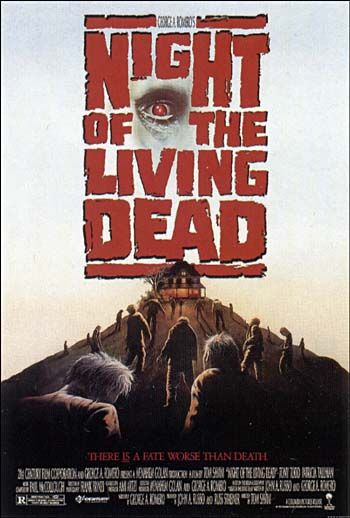
Further evincing the fact that direction is pivotal to the success of even a proven screenplay, Tom Savini’s remake of the 1968 classic Night of the Living Dead (the sequel to which - 1978’s Dawn of the Dead - he provided the iconic makeup special effects) is a worn-out-from-the-beginning affair that only furthers the argument against remakes. Its script is virtually identical to that of its predecessor, the only notable change being the character of Barbara, who in the original become introverted and catatonic, here a fierce warrior woman who strives to survive the oncoming hell on earth. This makes for some interesting elements inviting feminist readings, but ultimately the film fails to translate its source material to its new form of storytelling. Romero’s Night of the Living Dead was a zombie movie that knew nothing of the genre, its mysteriously unfolding events inviting speculation and fear purely out of the unknown. This remake cranks up the quota to eleven, removing any doubt as to what's happening from the initial stages, further destroying the subtleties of its human interactions as well as the allegory inherent in its walking dead, via a dunderhead explanatory monologue. Romero knew how to communicate his themes with wit and subversion (“this was an important place in their lives”), but for all of its loving nods to indebted source material, this Night barely musters the energy to pass for a rank special effects showcasing.

Apr 3, 2007

Zombi 3 (1988): B-

Lucio Fucli’s long-delayed, sequel-in-name-only Zombi 3 is not without its joys, but the film, sadly, never reaches the same depths of poor taste that made Zombi 2 (a film I initially hated before developing a palate for such bottom-of-the-barrel B-movie fare) such a wretchedly good time. Whereas the first unofficial sequel to Romero’s Dawn of the Dead (released under the moniker Zombi in Fulci’s homeland) shunned character, logic, and even narrative cohesion for the sake of stunning makeup work and revolutionary zombie action (three words: zombie versus shark), Zombi 3 spends more than half of its running time going through rudimentary plot tactics, rendering its grindhouse goodies nearly stale by the time it gets around to them. That being said, the grisly camerawork (often changing stocks within a single scene) and deliriously bad acting (complimented further by barely decipherable vocal dubbing) give the film something of an otherworldly vigor, no matter how ridiculous its relentlessly popping-up zombies become by the end. Here, the undead foreshadow those in Danny Boyle’s genre-reinventing 28 Days Later...; infected by a radioactive and mutated virus, the living become berserk monsters who not only eat human flesh, but attack with maniacal persistence. That all of this is practically unwatchable is a given and should only be approached by seasoned veterans of bad taste, for whom a handful of completely illogical (but startlingly effective) scares and all-out ridiculous zombie attacks will redeem the proceedings, if only just. Among them, a piss-your-pants hilarious bird attack and a sequence that should have (by all means) provided the film with its title: Attack of the Flying Disembodied Head!