Dec 28, 2007

Commando (1985): B+

It dawned on me while watching Commando, Arnold Schwarzenegger's 1985 follow-up to his massive surprise stardom in The Terminator, that the man has become far more than the sum of his parts in our culture, a admittedly apparent fact nonetheless growing increasingly more relevant with the passage of time and the man's increased involvement in our turgid political world. Most people pray that they leave their mark on this earth in some substantial way before they die, whether they donate something to science or leave behind their genetic makeup in the form of an offspring. Arnold has nothing to worry about, though; he's become a Paul Bunyan in his own time and the guy still has his hairline. Watching his performances now - especially those from his earlier feature films (to say nothing of Pumping Iron) - it's almost impossible to watch him as simply a performer. As an actor and politician in addition to inimitable cultural icon, his presence has become such that the man and the myth can't be separated. His influence bubbles up everywhere like an unseen reservoir beneath the framework of our society, his most famous character a now long-cliched association with virtually anything having to do with death en mass, and he now the ruler of one of the U.S.'s most prominent states (seriously, when California breaks off into the ocean, Arnold will declare himself high ruler and proceed to take over the world with his self-sustained army). In that vein of larger-than-life celebrity, Commando is an almost-masterpiece with its deadpan satire of Arnold's archetypal human role, the good-guy renegade who'll kill thousands of faceless villains (mostly rent-a-cops and barely-paid mercenaries) just so he can save his little girl (in other words, a perfectly caricatured encapsulation of the Reagan values on the rise at the time).

Even as one of Schwarzenegger's earliest roles, the film's approximation of action convention within a specific cultural and social context (present mostly for show and in a diluted form, but present nevertheless) is potent without effort, a straighter (and arguably greater) example than Edgar Writer and Simon Pegg's Hot Fuzz. A rapid-fire sequence of Arnold suiting up with knives, grenades and makeup that makes him look like a freshly cooked steak whips onto the screen with more macho intensity (not to mention unspoken homo-erotic undertones) than the combined entirety of 300 combined, while Arnold's goofy face - an unlikely combination of convincingly vacant emotions and chiseled muscle intimidating to the point of absurdity (the film itself opens with a ridiculous montage of Schwarzenegger's biceps and abs), here made the comical antithesis to The Terminator's ruthless and truly terrifying killing machine a la Arnold's batty eye motions and calculated, machine-like gestures (these side thoughts interrupt the flow of the sentence too much) - provides the entirety of the film's nth-degree action conventions with the perfect point of illogical comedic contrast. Played with pitch-perfect intensity and unwavering solemnity (like a Sacha Baron Coen performance, the humor is never actually acknowledged to the viewer, just as Borat wouldn't be funny if he were winking to the audience), Commando is an extraordinary representation and send-up of its chosen genre all at once, thrillingly silly in its action sequences (which never want for unreasonable and wholly impossible feats of strength; seriously, Arnold stops just short of throwing tanks at the enemy) and obviously subtle in its clumsy emotional touches. Most heroic protagonists (James Bond or John McClaine) would first attempt to break into a building through a window or an unlocked door so as to go unnoticed; Arnold, never one for fucking around, rips off the side of a wall for easy and immediate access, and similarly tears a seat out of a vehicle so his bulky form can ride relatively out of sight. That the film may have stumbled onto this self-degrading effectiveness wholly by accident - rendering it not so much a brilliant satire but a piece of lazy hackwork brilliantly oblivious to itself - could theoretically make it an even more legitimate success. Actuality over intention reigns, nevertheless, and Commando - as far as representing a rather slim sub-genre of 80's exploitation flicks - represents one of the finest. That the film so precisely captured Arnold's iconography so early in his career speaks to its inbred understanding of cinematic celebrity culture, and, in doing so, seems to have guided everything that has followed since. You're welcome, California!

Dec 7, 2007

The King of Kong: A Fistful of Quarters (2007): A-

As tremendous an act in empathy as anything Werner Herzog has ever committed to the documentary screen, The King of Kong: A Fistful of Quarters elevates a particular niche interest - that of the hardcore videogamer - to exquisitely existential heights, carving out the determination and passion exhibited by those who are drawn to the medium of classic arcade games for purposes beyond that of mere pastime enjoyment. The film's incredibly watchable aesthetic is due in part to the subject matter, as seemingly light and breezy a topic as one could imagine in the midst of so many Inconvenient Truths and No End in Sights dominating the circuit, but more important here is the manner in which the filmmakers explore these gamers' passions as an extension of their self-defined roles in a world full of judgment and confrontation, acting not only as an incredibly humane exercise in cinema but also as an antidote to the ridicule-laden representations such persons have generally suffered on the silver screen. A single competition forms the dramatic crux of the narrative, that between the official named Gamer of the Century Billy Mitchell, world record holder for the original Donkey Kong and fierce perfectionist wary of anyone encroaching on his high scores, and the reserved, somewhat insecure Steve Wiebe, a family man from Washington determined to prove himself the best at something after suffering so many undeserving letdowns over the course of his life. The look that follows at the gamer culture may as well be an offshoot of the Corleone family: questionable high score records, allegiances to particular gamers (and stances against others), and paranoid territoriality all play a role in the unfolding events that go beyond mere scores and enter the realm of personal integrity for all those involved. Though effectively streamlined for maximized entertainment, Seth Gordon's condensation of these months-long events never takes the route of simplicity, quickly summarizing videogame history and ideology (though I suspect many of the films viewers, myself included, will already be familiar enough with the territory as to be able to enjoy the recap purely for its aesthetic virtues) before dovetailing into the techno-infused insanity of it all. Despite the fact that the central Steve vs. Billy conflict is so well rendered as to make the minor subplots feel like excess fat by comparison, The King of Kong remains a breathless act of investigation, as admirable for its craft as for its objective consideration, and one of the finest documentaries in recent years.

Atonement (2007): C

The Oscars have long been losing their worth, and it might appear that the final stake was driven in the heart of it all when the indulgent awards extravaganza stopped being a means and started being an end. Films like Atonement are made (largely, if not entirely) to win awards, carefully pampered and stylized so as to appear ravishing at a surface glance, their carefully manicured posturing frequently lauded practically sight unseen thanks to reinforced obsession with superficial hoopla (the razzle dazzle the two-faced Chicago both criticized and drank deeply from). Far be it from me to lambast convention, an oft-used and wholly inadequate critical take down that mistakes commonality for mediocrity (suggesting that normality by definition has nothing to offer). Atonement, however, exists outside both artistic convention and mediocrity, more closely resembling a fashion show in the guise of a literary classic than an actual living, breathing film. Such a pity that a story so compelling in the details and a production so effortlessly lavished with technical mastery is put to such dullard ends, a cinematic fellatio for anyone easily impressed by set and costume design. In the years preceding World War II, the rich and naïve 13-year-old Briony (Saoirse Ronan) mistakes a series of events involving her elder sister Cecilia (Kiera Knightley) and Robbie (James McAvoy) for sexual malice on the part of the latter. (Spoilers ahead.) When Briony discovers her older cousin being raped on the property surrounding their mansion, she insists the attacker to be Robbie (despite having not seen his face), believing him to be a dangerous sexual predator after inadvertently reading one of his more strongly worded love letters to Cecilia. The schism she thrusts between he and her sisters romance carries into the wartime era, during which time her growing maturity allows her to realize not only the extent of her actions, but Robbie's innocent from the very start of the matter. Say what you will, director Joe Wright is obviously respectful of his material, and it is in this aghast formalism that he misguidedly reduces the richness of Ian McEwan's literary work to its lowest common denominator. His previously overrated Pride & Prejudice sacrificed complexity for narrative compactness, and so too does Atonement seek to streamline all aspects of its narrative (be they character relationships or the presentation of the social climate of the time) in the name of palatability. Even a prolonged single take navigating the war-torn beaches of France is stripped of all feeling, despite being an absolute triumph of technical direction. That's Atonement in a nutshell: compulsively watchable but scared at the thought of alienating audiences with emotions of the truly ugly kind.

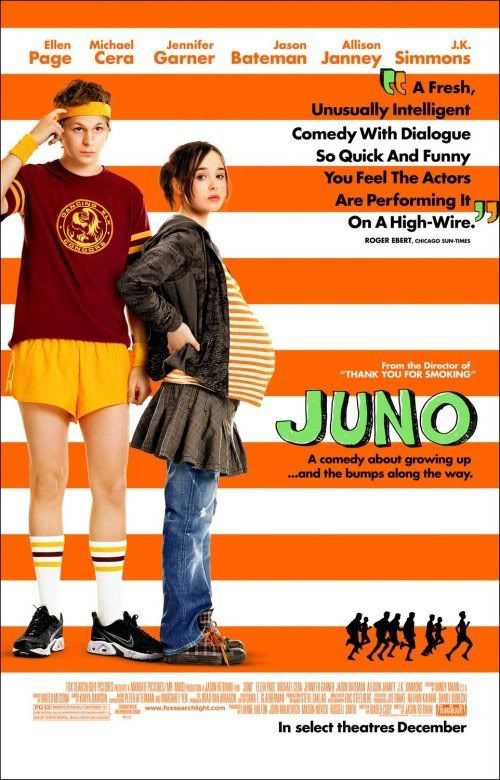
Juno (2007): B+

Juno gives me hope for emo culture. The film oozes earnestness out its ears, a quality that is likely to win or repulse different viewers right off the bat given its loose wielding of quirky teenage culture, snarky attitudes that front deeper emotions whose possessors are often unable to articulate them beyond a wall of angst. The film has already been compared to last years non-indie Little Miss Sunshine, although their similarities barely register beyond superficial classifications of the cinema. Concerning Juno MacGuff (Ellen Page), a 16-year-old girl who finds herself an expecting mother after some sexual discovery with her long-time best friend Paulie (Michael Cera), the film is like one prolonged and totally uninterrupted mental doodle, at first scattershot and clumsy but ultimately finding an appropriate groove for its storyline. Like this years similarly plotted (and more blatantly titled) Knocked Up, Juno uses its preggo-centric storyline as a jumping point for more extensive character studies, and it is in this manner that the titular character becomes most interesting. Far from a typical 16-year-old, Juno has seemingly absorbed the entirety of three decades worth of pop culture into her vernacular (at one point arguing over Dario Argento's status as the master of gore): rambunctious, cool, smug and totally unprepared for reality all at the same time. The character first smacks of screenwriting laziness, as if her surreal complexity were but a shorthand to avoid dealing with the usual ramifications of an unplanned teenage pregnancy, but through both the conviction of Ellen Page's performance and the ultimate steadiness of director Jason Reitma's sleight of hand, the film sells the character as a penultimate outcast with far more to learn about herself than she realizes. Occasionally spilled over into manipulative treacle, the film's wit is not unlike the defensive personality of its lead protagonist: a cover easily pulled aside to reveal genuine tenderness inside wanting for acceptance.

Dec 2, 2007

Aqua Teen Hunger Force Colon Movie Film For Theaters (2007): A+

Aqua Teen Hunger Force Colon Movie Film For Theaters may be the most scathing deconstruction of Hollywood (and the culture at large) this side of Robert Altman's The Player. The suburbs of New Jersey echo the end of the universe as envisioned by Douglas Adams in this feature length version of the series popularized by Cartoon Network's Adult Swim, a place at once everywhere and nowhere, where anything can happen at any given time, no questions asked. Essentially a Molotov cocktail lobbed at both conventionalized artistry and anyone who's ever taken their cinematic consumption (or life) for granted, the film works primarily through its own constantly reinforced audience deception, perpetually distracting the viewer with the utterly bizarre nature of it all as it pulls one rug out from under their feet after another. Naysayers cry "stoner!" as if a good toke were the death toll of all intelligence or worth, an almost willful misreading that not only denies the profundities of anti-logic but also the near-impossibility of articulating such thoughts in accessible terms during the waking life. Though not all fans made the transition from ten-minute episodes to ninety-minute extravaganza, it's telling how the irreverence of the film has managed to ruffle feathers amidst those who don't get it (similarly telling is the ease with which many fall back on the 2007 Boston bomb scare as an easy point of derision, a critical cop-out that reveals less about the film than the person addressing it). The film acts as its own litmus test, defying all conventional readings and thus confirming its own significance in the process. To condemn the film for its incoherence is like blaming water for being wet.

Few features of the new millennium have been as viciously and consistently funny, given both the objective nature of comedy and the Airplane!-like rapidity with which the film fires off its endless stream of sight gags and insanity-infused dialogue. Pop culture personality has been condensed into the form of several anthropomorphic fast food items and other assorted personalities (among them, a Plutonian alien sporting a faux German accent and digitized, stoner residents of the Moon) whose collective misadventures are at once about everything and completely pointless, as if every conceivable cliché from Hollywood's junk drawer were assembling into as coherent a form as possible and given a story to match, here revealing the many absurdities of life we invest ourselves in from moment to moment, generally without thought or question.

At its simplest, the film concerns the efforts of our heroes - a milkshake named Master Shake (Dana Snyder), meatball Meatwad (Dave Willis), and French fry packet Frylock (Carey Means) - to save the world from the rampage of a deadly exercise machine (but one of the many mashed-together plot lines), with a talking watermelon, mad scientists, time travel, roller coasters, Space Ghost and Neal Peart of Rush all figuring prominently in the mix. Not a minute goes by that some nugget of our collective consciousness isn't put on the chopping block, although Aqua Teen is a far cry from the ironic cynicism of Seinfeld in its dealing with the minutiae of daily life. Taking nothing for granted, the film explores the underbelly of our modern world as one would the remnants of a building destroyed by a tornado, its unrestrained jambalaya of pop culture parts bordering on Warholian sans the passive voyeurism. The ultra-surrealist tones all but defy serious readings, and it is in the vacuum of expectation or form that the film's satirical bite becomes most potent; its rejection of typical claims to importance is so encompassing that it enters into the realm of the profound. The opening musical number - possibly the single funniest piece of cinema since The Producer's "Springtime For Hitler" - isn't just a brilliant re-imagining of "Let's All Go to the Lobby," but a brutal "fuck you" to all who pride themselves better than the movies or their fellow audience members, leveling the barrier between artist and audience and expressing in no uncertain terms virtually everything that need be said in a fierce act of movie film revolution. "Do not explain the plot, if you don't understand, you should not be here." Amen.

Nov 23, 2007

The Mist (2007): B

If I may risk incurring the wrath of countless Shawshank lovers everywhere: The Mist is the best of Frank Darabont's three Stephen King adaptations to date. Although myself unfamiliar with the source material in each of these cases, the reason for this has less to do with the abrupt change in genre than with The Mist's relatively minimalist plot, one focusing more on the behavior of a particularly epoch of humanity than on larger dramatics and thus less likely to attract the kind of superficial, syrupy direction that rendered the director's preceding works so vanilla in their effect. The Mist uses similar touches but to appropriately B movie effect; although only incidentally similar to John Carpenter's underrated The Fog, the film knows its influences, homaging the director in an early reference to his own remake of The Thing. After a torrential thunderstorm the likes of which is rarely seen, a small, seemingly typical American town is cut off from its basic utilities. David Drayton (Thomas Jane) and his son Billy (Nathan Gamble) travel to the local supermarket to pick up food and supplies, and it is during that a strange mist engulfs the town, reducing visibility to near zero and bringing with it a substantial level of dread. A bloody man runs into the store as the fog encroaches screaming of "something in the mist," and one customer who attempts to flee via his parked car can be heard screaming in the distance. After a back-room encounter with monstrous tentacles that kills one of the employees (an event seen by only a handful of people), the refugees slowly split into three factions: those who believe nothing is truly wrong, those who know something monstrous - even supernatural - lurks beyond their vision, and those who believe the mist is the wrath of God upon them, the final judgment day.

Although likely to appeal more to some than others based purely on their ideological particulars, King's nihilistic tale of how people respond to one another after the safeguards of society have been removed is alternately appropriate and disheartening in its nihilism, the former for its accuracy and the latter for its repeated use of shortcuts to make its points. As the totally bonkers Mrs. Carmody, Marcia Gay Harden lends enough conviction to the religious zealot to make the character believable in the moment, if only just; her hatred-in-the-name-of-love self-righteousness so one-note and extreme that it exists less as a character trait than as a plot justification. Fortunately, then, the film makes up for its sometimes-skimpy allegory with all-and-all physical terror, transcending traditional B movie trappings in its presentation of its various creepy-crawly monstrosities as a literal plague. The special effects are wanting in only a technical sense, their kinda-cheesy guilelessness making them something of a modern equivalent to King Kong: easy to dismiss at first but downright terrifying if you buy into their charms. Darabont showcases the film's horrific elements not with any sort of traditional build-up and climax, but with a more casual sense of montaged unease, with scoreless sequences of many things happening at once, none of them pleasant and most of them downright terrifying for the squeamish (one moment in particular - in which a seemingly tiny insect reveals its true size - momentarily induced me with something akin to turrets syndrome, much to the amusement of my surrounding audience). The Mist culminates with a harrowing look at what may as well be the end of the world - entrenched in the titular smoke, it's as if the surviving characters have found their way to heaven only to discover it a hell in sheep's clothing - and though one gets the sense that it may be taking the path of nihilism purely for the sake of wrenching our guts into a knot, its effectiveness is altogether impossible to shake.

Nov 4, 2007

American Gangster (2007): C-

American Gangster shares more than a passing structural resemblance with Malcolm X, another epic length Denzel Washington headliner. Like Spike Lee's hugely ambitious biography, Ridley Scott's much lavished period piece is a work that - like its antagonistic main character - wants it all, only to get very little in the end. The film is impressive only in technical, superficial ways; the recreations of 1970's Vietnam and New York City never want for believability but the whole of Scott's undertaking threatens to topple over from the sheer narrative and stylistic unruliness of it all. In an attempt at self-validation, the film proudly states its based-on-a-true-story status right out of the gate, only for the following 150 minutes to suggest a pretentious, all too self-conscious attempt at one-upping the cinematic mythology of Scarface and Heat all rolled into one. Denzel Washington is Frank Lucas, an NYC-based heroine dealer who upsets the market when he decides to eliminate the middleman from his business, traveling to the Vietnam jungles in person to acquire the raw goods, untouched and undiluted. Flipside is Russel Crowe's do-good narcotics cop Richie Roberts, who struggles to remain straight amidst both a crooked police force and the strains of an ensuing child custody battle. American Gangster explores the labyrinthine connections - personal, political, professional - that connect these two individuals in their respective paths, with Roberts looking to bust Lucas and the many (both criminals and cops) to whom he bears ties, but its expositional meanderings never rise above a sense of both tedium and emptiness. Scott seems convinced of his material's irrevocable importance, an angle that dogs every pseudo-pretentious swipe at elevating such into the realm of American myth. American Gangster loads up the screen with all the goods from any Grand Theft Auto game but it fails to find any deeper meaning, relevance, or even excitement amidst it all; it would be unfair to compare the film to Scarface (their stylistic aims are on opposing ends of the spectrum), but one can't help but think of Brian De Palma's great work of pop art during American Gangster's more testing stretches. Perhaps most disappointing, though, is Washington himself, who, while masterful even during Malcolm X's most overbearing moments of indulgence, brings next to nothing to his character here aside from that required by the script - basically, a lot of faux-macho, gentlemanly posturing punctuated by angry staring, shouting, and brow-furrowing. (Frank Lucas is angry. You won't like him when he's angry.) Crowe isn't much better off, although given the skimpy material at hand it's difficult to blame either actor. The film's best scene, then, comes when the two confront each other one-on-one. Its quality could be the result of the two actors finally being allowed to play off one another, or it could be the fact that it comes near the tail-end of this lifeless stretch of empty craftsmanship. Take your pick.