]]>

Friday, June 26, 2009 

Transformers: Revenge of the Fallen

Photo Sharing and Video Hosting at Photobucket
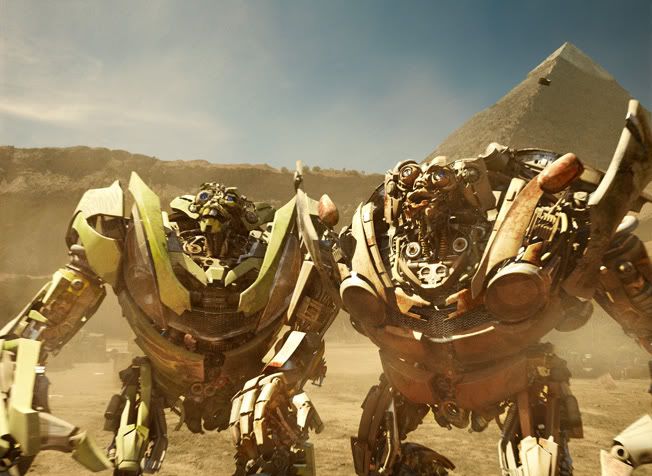
I’m sick of this notion that movie critics don’t like to have fun. Like any broad accusation, it's pure cop-out, especially when founded on the basis of but a handful of films, as is usually the case. Though a minority opinion in my circles, I liked the first Transformers. It was big, loud, and dumb in that manner that recalls the childhood ambition of instilling life in one’s toys. More importantly, it stayed just behind the line of headache-inducing excess that stands as the starting point of this new film. Transformers: Revenge of the Fallen is to its predecessor like a medieval torture chamber to a playground, but that won’t keep many from swallowing it hook, line and sinker, quickly and indiscriminately. I can only hope that my feelings here are the general consensus – not just for critics, but for human beings. Few elements of Fallen are completely odious unto themselves, but rolled together it becomes a wave of inescapable proportions – a literal tsunami of shit.

Labels: ,


Thursday, June 25, 2009 

On Things Fresh and Rotten

Photo Sharing and Video Hosting at Photobucket
Recently, some disputes (i.e. comments from people with nothing better to do) have arisen regarding some of my designations at Rotten Tomatoes. How dare I change my "fresh" status of Up to "rotten" - the nerve! I won't deny the satisfaction that comes from a much-commented upon post (34 and counting), and surely, being only one of five green splotches out of 200 does make one stand out. But whereas I left the screening of Up feeling a bit let down (deflated?), it wasn't until a few days later that the overall distaste became more apparent. It was at this point that I decided to let my less-than-pleased voice be heard. Admittedly, I prefer to leave reviews untouched once they've been published, but when so very little is required to tip the scales, methinks a short amount of hindsight should be allowed to creep its way in. (I hope to see Up again, and soon. It is not lightly I say the film disappointed me, and what was good was so good that I sincerely hope the rest of it goes down smoother next time.)

Which leads me to the thought of how ridiculously silly the whole fresh/rotten concept is when taken to the extreme, however necessary it may be to the marketability of criticism (even Roger Ebert, who patented the thumbs up/thumbs down system, has lamented the constrictions it imposes). Anyone to have even somewhat frequently visited this site beyond the recent past will surely have noticed the complete visual overhaul (thank you, Ryan), part of which includes the removal of assigned ratings on individual reviews. This has undoubtedly been the greatest of several anxiety-reducing reliefs I've enjoyed as a result of this process (for the record, though, I've retained high and low ratings on RT for the sake of my best- and worst-reviewed film pages, which I consider excellent resources). What better way to kill a discussion of the arts than to flatten a numeric or alphabetical key and call it a day?

Recently I met a girl who told me their boyfriend only saw those films with an 85% or higher Tomatometer score (best pronounced tohm-muh-tom-me-ter); it took every ounce of sociability in my being to not rag on that hideous bit of flawed logic. Sure, something that appeals to almost everybody stands a chance at actually being good, but even though I enjoy The King, the cliche is true: 50 million Elvis fans can be wrong. Such attitudes speak volumes about the diminished role of opinion diversity in today's culture, both for movies and at large. They also ignore the fact that a movie that everyone only kind of likes will easily score higher than a movie that divides audiences into categories of equal love and hate; so much for challenging ourselves or that adventurous virtue of trying new things. More often than not, I'd rather see what's sparked conflicting discussions than mere praise, and it's no surprise that some of my favorite films from recent years are all of rotten status, or nearly so.

Anymore, it means more to simply like or dislike something than to express why one feels the way they do - a surface-bound approach that is superficial at best, aggressively regressive at worst (as Medfly Quarantine's Ryan Kelly aptly puts it, "this ADD wave of film criticism"). Just look at what pigeonhole-obsessed modes of thought have done to our political health: if you're not with us, you're against us, red state/blue state, rightwing nutjob or baby-killing liberal. It's a form of logic I can't stand because it forgoes progress for pride and perpetuates the notion that it's better to "be right" in the moment than to work together in order to approach a long-term solution. Quotes Roger Ebert, "It is not enough to like a film. One must like it for the right reasons." The same applies to all aspects and walks of life. Of course, I will still use Rotten Tomatoes, as both a critic and user; the problem here is not the tool, but how it has been wielded. Some might be happy with the red and green offered by that titular fruit. I want the whole god damn rainbow.

Labels:


Monday, June 22, 2009 

Land of the Lost (2009)

Photo Sharing and Video Hosting at Photobucket


I hate mankind, for I think myself one of the best of them, and I know how bad I am.
- Joseph Baretti

Labels:


Sunday, June 21, 2009 

His Soul is Still Dancing

Because, for this teaser, there's no such thing as too much circulation.

Labels: ,


Saturday, June 20, 2009 

The Shawshank Redemption (1994)

Photo Sharing and Video Hosting at Photobucket
As of this writing, The Shawshank Redemption rests loftily at the top spot of IMDb’s user-voted Top 250 list (previously number two, the film only graduated to the top spot when asinine Dark Knight enthusiasts deemed The Godfather an enemy to be overcome and systematically voted it down). Saying this makes it the greatest of all films would imply that McDonald’s is the greatest of all restaurants; clearly, popularity means zilch in the long run. This isn’t to say that Shawshank is comprised entirely of empty calories, though its audience-pleasing profundities tend to lean towards the processed side of things. Frank Darabont, in his feature length debut, undoubtedly proved a skilled and keen filmmaker (he served as both writer and director, and in fact accepted a lower pay cut in order to shoot his own script). His biggest flaw, ironically, is a relative lack of confidence. A little of his dramatic affections go a long way, and too often does The Shawshank Redemption bend over backwards to elicit emotion when such is already tangible – the effect being not unlike that of an overripe fruit. Shawshank's best moments are its least-exemplified; more abundant, unfortunately, are those that seem poised to vacuum the tears straight from your ducts.

Though clearly knowledgeable of classic American cinema, Darabont’s approximation of 40s prison drama mistakes easily encapsulated emotions for stylistic sincerity. Dramatically, Morgan Freeman’s inmate character Red occupies a supporting position, but it’s fitting that the actor’s career-defining role landing him an Oscar nomination for leading actor. He’s the vertebrae of the film, its moral compass and dramatic guide, and this proves a double edged sword indicative of the film’s greater strengths and weaknesses. Even in his most capable of hands (it’s unlikely anyone else was more fitting for the part), Freeman’s narration proves equally scintillating and stultifying; otherwise touching moments become examples of overwrought blatancy, passing the line from heartfelt pontification to mushy, borderline-condescending drivel. Rather than simply expressing emotion, the film demands Red spell out the hows and whys, and so intent is Darabont’s script on crossing every T and dotting every I that only a handful of the intended emotional waves escape unscathed; even these are diminished significantly by the muted effect had on their fellows. The sincerity behind it all only serves to make the plasticine coating that much more lamentable.

If Shawshank fears anything getting lost in translation between the screen and the audience, an even greater source of paranoia is anything in the way of long-term unpleasantness. Suffice to say, this view of prison life is downright romantic, with the harsher elements – the monotonous passage of time, endless months spent in solitude, abusive guards, beatings, rape, etc. – largely averted from the audience and sequestered off from the whole. No moment may be more telling than the convenient zoom out/pan away from Andy’s first attack at the hands of the “sisters” (in the DVD commentary, Darabont admits to the desired effect of a “Victorian woman averting her gaze”). Shawshank only implies the anguish that should be at its core, skewing closer to whitewashed fantasy than calloused, hard life trauma; ultimately, there’s less to have been overcome than intended.

It’s no surprise that the film’s greatest scene is also its simplest: Red and Dufresne’s wallside chat prior to the latter’s escape relies wholly on the not-insubstantial skill and charisma of the actors. Composed entirely of close-ups and an establishing long shot in which the outer prison wall serves to bisect the frame, it proves one of the few instances in which the film conveys true spiritual isolation without knocking it over the edge, sledgehammer style. In contrast is the climactic, largely masterful escape scene: an aerial shot of Andy basking the cleansing rain serves as an unholy exclamation point to an otherwise gritty and wholly earned bit of sentiment – a choice handed down from numerous preceding elements of similar excess (antagonist characterizations, Brooks' post-prison side story, et. al.). In a way, The Shawshank Redemption has more to love than hate, and might’ve been close to great had it simply toned it all down a few notches. Such as it is, though, it rarely rises above the overbearing, obnoxious and trite.

Photo Sharing and Video Hosting at Photobucket

Labels:


Friday, June 19, 2009 

Under Our Skin (2009)

Photo Sharing and Video Hosting at Photobucket
The best thing I can say about Under Our Skin is that I never for a moment doubted the sincerity of its intentions. Director Andy Abrahams Wilson comes to the material - the much-overlooked (and largely deliberately ignored) epidemic of Lyme disease - with personal experience in the matter (his sister was diagnosed). His stake shows in the film's unflinching intimacy with its subjects, which is to say, perhaps altogether too much. So unwaveringly focused is Under Our Skin on human suffering that it only intermittently rises above the worth of pure information; the film intends to elicit empathy via a series of paralleling biographies illustrating various patients' battles with the disease, but instead - perhaps expecting audience callousness - achieves overkill (the incessantly somnambulistic score alone trumps the sorrow on display with trite, arty manipulation). The effect is that of a dramatic stranglehold, inadvertently weighing down the doc's aspirations to civic change; by the time it touches on the hows and whys of Lyme's silent spread, the film (and audience) is far too drained to work up the appropriate levels of anger in response to the government and medical corruption at work. The disease - similar in symptoms to syphilis and AIDS, among others - remains largely a mystery, and the medical community remains fiercely divided over both its overall severity and the effectiveness of varying methods of treatment; numerous doctors have lost their licenses over the attempted treatment of Lyme patients (some even persist in suggesting that most incarnations of the disease don't really exist; a Simpsons clip illustrates how society has swept the danger under the rug). Suffice to say, many who stand against further research bear financial conflicts of interest (many of those representing the self-declared authority on Lyme bear ties to stricken insurance companies), having sacrificed public safety and quality of life in the name of private sector profit. Only in its investigation into these downright evil motives does Under Our Skin take on the necessary role of activist, and for the sake of those sorrowful faces (and, undoubtedly, many more to come), I wish it had gone further and deeper.

More information on Lyme disease can be found at the links provided here.

Labels:


Thursday, June 18, 2009 

Screening Log: Dirty Harry, Godzilla vs. Hedorah, Godzilla vs. Gigan and The Limits of Control

Photo Sharing and Video Hosting at Photobucket
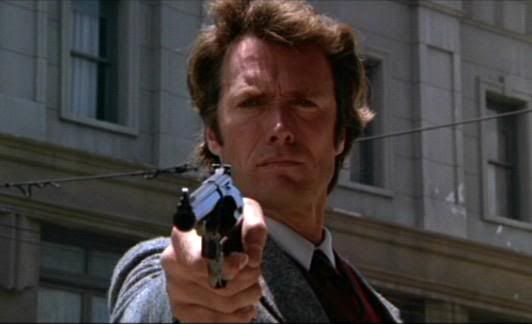
Seeing classics like Dirty Harry makes me wish that I’d been born earlier, to have been able to call it out from day one on its complete lack of merit. Even if you’re able to look past its flimsy support of fascism (more on that later), this is as sloppily constructed a genre film as those that are unfortunately typical to today’s multiplexes. The film’s lone must-see benefit is its pivotal status in the ascent of Clint Eastwood to stardom, yet even as an isolated element, it’s hard to conceive that such an awkward performance ever came to hold such sway in the culture. Harry Callahan’s signature “Do you feel lucky?” line works neither as a roll-of-the-dice gamble (as initially suggested in the film’s early bank robbery shoot-out) or tried-and-true, grizzled menace (as we come to know it through repetition). Here, Eastwood lacks nihilistic sincerity, and his my-way-or-the-highway bravado comes off as cheap posturing in a film desperate to seem like the authority on justice, nay, morality. Frankly, the guy’s an idiot (Callahan, not Eastwood), and so is any filmmaker that expects even reasonably intelligent audiences to believe that a hard-boiled San Francisco officer would lack even a rudimentary understanding of civil rights as pertaining to the acquisition of evidence – a inanity upon which the propagandistic plot hinges. Then again, little in Dirty Harry aims above the barely cognizant; the central villain – who goes by the pseudo-ominous moniker Scorpio (Andrew Robinson) – is a hilarious amalgamation of the 70s counterculture – good (sports a peace symbol), bad (deliberately gives cops a bad name) and ugly (rapist, sniper, kidnapper of children, etc.) – upon which viewers can project all their negative feelings about dem der longhair hippie sonovabitches. Dirty Harry – as Callahan is known, for always taking the ugliest of jobs – might embody some ultra-fascist fantasy, but the straw-man arguments made here skew closer to us-versus-them conservative idiocy.

Photo Sharing and Video Hosting at Photobucket
Godzilla vs. Hedorah (aka Godzilla vs. the Smog Monster) was always my least favorite of the numerous monster-mashing sequels as a child; rewatching it these years later, there’s something reassuring in having my then-budding tastes confirmed. Though more stylistically distinct than most of its counterparts – dabbling in 70s psychedelics, surreal animated divergences, and jazzy introductions for the titular lizard – this entry is also among the most lifeless of the series, a not insubstantial designation given the central conflict of two high-rise monsters duking it out with life on Earth as we know it hanging in the balance. The opening images of untold tons of garbage collected in the ocean sets an appropriately queasy tone; soon, multiple tadpole-like Hedorah monsters are born of the mineral waste, laying waste to ships at sea before merging together into a creature capable of coming ashore and, eventually, flight (the parallels to basic evolutionary theory are amusing, but, alas, go relatively untapped). Enter Godzilla to save the day, here cast as something of a wrestling icon; the glove, suffice to say, doesn’t fit, thanks in no small part to the lacking fight choreography on display. The image of the massive smog beast sucking fumes off of pollutant factory pipes proves almost indelible, but little else registers in this awkwardly overt forerunner to An Inconvenient Truth’s cautionary environmental warnings.

It especially pales in comparison to the similarly themed Godzilla vs. Gigan (aka Godzilla on Monster Island, released stateside in 1977), itself among the most efficient and exciting of the series since the 1954 original; in it, cockroach-like aliens attempt to wipe out humanity so as to clear the Earth for themselves, their home planet now a lifeless wasteland after years of abuse. Jun Fukuda’s imaginative set pieces dwarf the poorly staged, drawn-out confrontations between Godzilla and Hedorah; mounting tensions between the monsters and military have an almost musical rhythm, while the montages of assembling infantry (comprised of both real military vehicles and blatant model stand-ins) building up to the monster’s attack exemplify the childlike wonder implicit in the latter-day Godzilla. As a newcomer, Gigan isn’t as creatively conceived a villain as the film would have you think (outside of close encounters, the buzz-saw in his belly seems a remarkably useless weapon), and Ghidorah has always struck me as somewhat flippant, with little to no apparent coordination or cooperation between the three heads. Nevertheless, such is of little consequence given Godzilla and the spiky Anguirus’ cheeky, one-two displays of badassitude. Inner eight-year-old, you may now commence having a blast.

Photo Sharing and Video Hosting at Photobucket
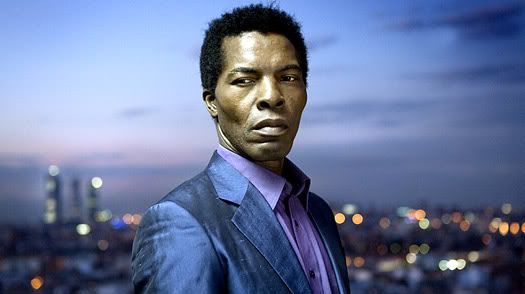
The Limits of Control may be the best movie I haven’t enjoyed in recent memory. Seen under just about the least conducive of circumstances, Jim Jarmusch’s polarizing exercise in stylized minimalism struck me as accomplished, intoxicating, and ultimately, infuriating; was it the film that got under my skin, or was it the horrendous day I’d been having up until that point? Had it been screening in any New York City theater besides the Angelika Film Center (a location at which, I am now convinced, no quality cinematic experience can be had), I’d have resubmitted myself to it’s super-cool suave for another go around, but until the DVD release, I’m willing to give it the benefit of the doubt. Following the hyper-methodical activities of a character known only as Lone Man (Isaach De Bankolé), The Limits of Control seems to exist neither in complete reality or complete fantasy, what with its own audio/visual signifiers occasionally spilling over the lines we rely on to define our realities. Many reviews spilled on plot details not actually revealed until well into the picture (thus, I found, diminishing the impact of their reveal), proving how few among our critical establishment can actually discern between those films in which hard story is primary versus secondary; perhaps more worryingly, how many even care to? Here, repetition takes on an ethereal quality, though I’m not entirely convinced that the oft-repeated philosophies and sound bytes work any better when taken as emotional manipulators instead of intellectual stimulators. More so than any 2009 release to date, I anxiously await a second viewing.

Labels: ,


Tuesday, June 16, 2009 

Terminator: Salvation

Photo Sharing and Video Hosting at Photobucket
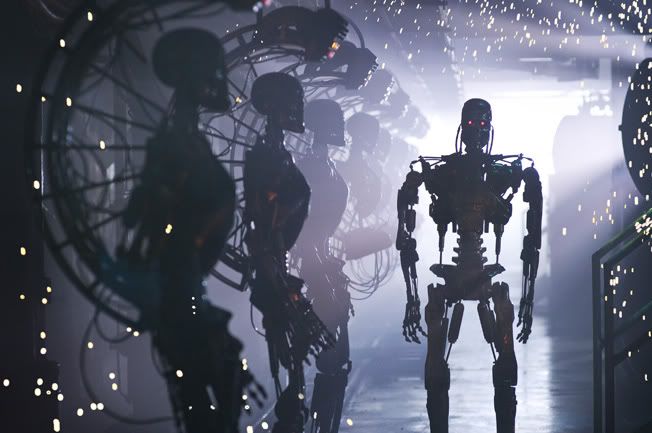
Let’s cut to the chase: is McG to blame for the semi-smoldering wreck that is Terminator Salvation? For whatever it’s worth, not in the eyes of this died-in-the-wool fan of the series—not enough, that is, to warrant making him a scapegoat for the entire mess. Surely this is, at the very least, a problematic film. I’ve half a mind to call it an outright bad one, and I’ll admit bias enough that it might simply be beyond my critical lexicon to put the words “bad” and “Terminator” next to one another in the same sentence. (You see, Cameron’s original is half the reason, if not more, that I am the way I am now, and yes, count me as a fan of Jonathan Mostow’s Rise of the Machines.) Don’t think I’m blind, though—there are parts of Salvation that "bad" would be too good a descriptor for, and some of the sins committed here are unforgivable. But like a rodeo performer up against an angry bull, I find myself tipping my hat to McG for his sheer willingness to take on this wild beast of a movie. He gives it his all, though I can’t imagine anyone’s "all" being nearly enough to repair the damaged goods that went into this production.

Labels:


Thursday, June 11, 2009 

Drag Me to Hell (2009)

Photo Sharing and Video Hosting at PhotobucketDrag Me to Hell isn’t a masterpiece, but if one considers only horror films designated PG-13 by the MPAA, it certainly stands near – if not at – the top of the pile. A throwback of sorts to director Sam Raimi’s Evil Dead trilogy (particularly during a late, altogether showstopping sequence in which the film’s villainous spirit inhabits the bodies of several living characters), the film is appropriately nasty and unrelenting, torturing its main protagonist (and, likewise, the audience) with nerve-racking setpieces as traditional in conception (the use of shadow recalls Murnau’s Nosferatu) as they are expert in execution. With the possibility of a promotion on the line (as well as the approval of her boyfriend’s elitist parents), Christine (Alison Lohman) denies an elderly woman's (Lorna Raver) request for a third mortgage extension, despite her apparent physical ailments and last-minute resort to begging. One unforgettable parking garage encounter with the psychotic senior later, she finds herself the recipient of nightmarish experiences soon revealed to be the product of a curse laid upon her by the vindictive gypsy woman. In a time where the majority of horror films attempt impossible contrivances to elicit scares, Drag Me to Hell is a refreshing reset to simple button pushing, with Raimi’s orchestration of hellfire images, gag-inducing traumas, ominous noises and malevolent forces walking a fine line between the cheeky and the cruel; whatever the film might lack in subtlety it mostly makes up for with punchy flair, and there’s a genuine sense of spiritual turmoil encoded in the tastefully CG-enhanced compositions. A pity, though, that the film’s ultimately ironic resolution is too overtly alluded to beforehand, thus diminishing its fiery wallop, or that the financial subtext of literally selling one’s soul never bubbles up in more deliciously subversive manners. Less than perfect, Drag Me to Hell nevertheless stands as the latest in a line of occasional, much-needed reminders that the horror genre – Roths, Bousmans and other offenders notwithstanding – isn’t going completely downhill anytime soon.

Labels: ,


Paul Blart: Mall Cop (2009)

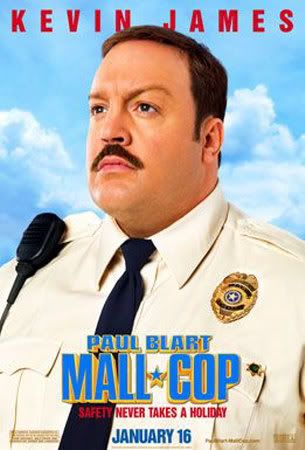
Photo Sharing and Video Hosting at PhotobucketThumbing noses at its very premise, the bulk of critics (and more than a few viewers) slammed I Now Pronounce You Chuck and Larry for the very offenses that unpretentiously progressive production sought to extinguish. (It’s no surprise that the bulk of that film’s biggest critical supporters are of the homosexual persuasion.) Following in the same vein as that gem is the similarly modest common-man comedy Paul Blart: Mall Cop, in which the titular, loveable sadsack – a single, overweight dad whose wife, having obtained citizenship through their marriage, left after giving birth to their child – finds himself in something of a Die Hard retread when thieves hold up the local shopping mall where he’s been employed as a security guard for the past decade. Though its channeling of archetypes proves less than perfectly quotidian, Paul Blart still has more to love than hate. Kevin James’ everyman deserves stronger material; rarely does the bantering dialogue proves as charming as the rapid-fire physical gags (Blart’s almost symbiotic command of his scooter has a sublime visual poignancy), which skew closer to silent film existentialism than the anti-fat stereotyping the film is regularly accused of – something that only occasionally, and misguidedly, manifested itself to these eyes. Unfortunately, whereas Chuck and Larry catapulted its premise to gonzo heights (no small thanks to Ving Rhames) and thus became something greater than the sum of its parts, Mall Cop all too quickly succumbs to genre routine, forgoing true subversion for mere surface parody. Like the opening scene, in which Blart passes out from lack of blood sugar just inches before the finish line in a career-defining fitness test, it’s only almost the making of a comedy classic.

Labels:


Tuesday, June 09, 2009 

Fired Up (2009)

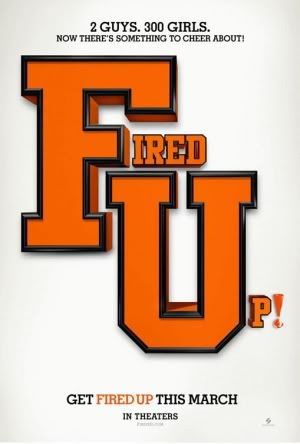
Photo Sharing and Video Hosting at PhotobucketAll the more so after the heartfelt, witty raunch of Sex Drive, the banality of Fired Up is unacceptable. Seemingly conceived of and crafted without the slightest trace of discernment (which is to say, the movie feels like a stretched effort so as it is), this American Pie-Animal House-Bring It On retread functions like an amalgamation of dozens of other, mostly bad movies, going through preordained motions with a zombie-like lifelessness, the dearth of originality confirmed further by the self-defeating adherence to PG-13 standards amidst implicitly R-rated material. Here, two jocks ditch football practice for cheerleading camp in hopes of scoring with the female populace; terrible sports jokes and gay riffs ensue, complete with snippets of rock anthems (“Tubthumping”, et al.) more memorable and distinctive than a single solitary frame of the film itself. Two worthwhile gags stand in this steaming pile, and I came up with one of them: as the squad first arrives at camp, having chanted “We, are driving!” for the entirety of the bus ride there, imagine the driver drawing a pistol to his forehead (masochism being the only reasonable response to such torture, this faceless character would have served beautifully as a surrogate for the audience). For the second, stay through/fast forward to the end credits to see the greatest dragon pratfall in cinematic history.

Labels:


Monday, June 08, 2009 

Up (2009)

Photo Sharing and Video Hosting at PhotobucketUp is quintessential Pixar, which is to say, it bears witness to both the accomplished artistry one comes to expect from a studio now enjoying its tenth (and tenth consecutive) critical and box office hit, as well as the well-worn formulas apparent in most bodies of mainstream cinema. To these eyes, Pixar hasn’t made an outright bad film to date (although Cars treads awfully close at times), and has in fact been a paragon of virtue as regards the telling of tried-and-true tales with a genuine sense of urgency. Nevertheless, while expertly rendered, the last third of Up is schematic and bland compared to the assured and breathtaking first hour. An opening sequence, in which elderly protagonist Carl Fredricksen's (Edward Asner) life story is told (and, implicitly, that of his wife, Ellie), ranks with WALL-E’s first half as Pixar’s finest moment to date. Rather than give up his dreams in old age and enter assisted living, Carl—an accomplished balloon salesman in his time—ties some thousands of balloons (echoes of Herzog’s The White Diamond) to his home and makes way for Paradise Falls, South America, the wish-fulfilling journey he and Ellie never made in her lifetime. En route, Carl discovers an inadvertent stowaway: Russell (Jordan Nagai), an eager Wilderness Scout trying to complete a merit badge when he mistakenly boarded the soon-to-be airship. The vignettes that follow in their adventure are inflective and revealing, touching on the film’s themes of spiritual comfort via the tenuous interactions of the films eclectic characters. Alas (spoilers ahead), the late addition of an antagonistic feels disingenuously like a studio machine clicking into place where a beautiful, wild organism once roamed, and the incurred tonal disjunction proves enough to damage the film’s very foundation as well as the genuinely bittersweet ending. Far more lopsided than WALL-E, Up fails to reach the stratosphere.

Labels: ,


Contact