Feb 6, 2010

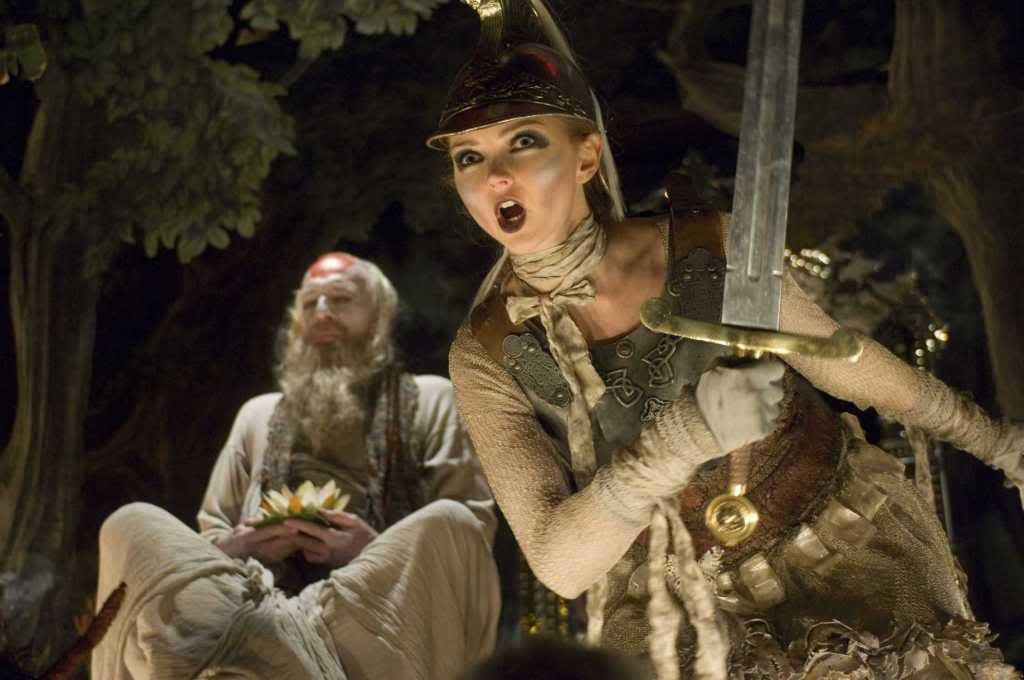
The Imaginarium of Dr. Parnassus

Photo Sharing and Video Hosting at Photobucket


Directed by:
Terry Gilliam
Screenplay by: Terry Gilliam, Charles McKeown
Starring: Christopher Plummer, Heath Ledger, Lily Cole, Andrew Garfield, Tom Waits, Verne Troyer, Johnny Depp, Colin Farrell, Jude Law
2009, Rated PG-13, 122 minutes

Far from being as off-the-cuff mad as most early reviewers insinuated, The Imaginarium of Dr. Parnassus, while certainly the antonym of all things normal in its many imaginative flourishes, represents something far more conventional from a storytelling level. Beat to beat, the rhythms of the film are prone to tangents and distractions, and could easily provide the basis for a semester or two of classes in editing theory, but as a plot with a basic few components, there's really not that much to puzzle over. Of course, this is coming from the guy for whom Brazil and Aqua Teen Hunger Force Colon Movie Film for Theaters represent the best from their respective years. How one appreciates (or doesn't) a film like this often highlights core interests in the medium, and messy personal confessions are frequently my sort of thing (versus, say, stuffy, technically exact cinema with a message of the week). Here, Gilliam is being as obviously personal as Bob Fosse in All That Jazz (double feature!), touching on concerns of mortality, fatherhood and truth in expression with a sometimes maniacal, always light-hearted cinematic freestyle.

Heath Ledger is the elephant in the room, his death mid-shoot creating a daunting creative obstacle wittily surmounted via a semi-genius plot device so consistent with the surrounding fabric (if you're lucky enough to not know it, yet, I won't spoil it here) that it could easily have been the planned course of action from day one. His doppelgängers – Johnny Depp, Jude Law and Colin Farrell – seem creatively placed throughout according to their varying personas, a small way of countering the inherent unevenness in placing four into a single role (I recall an adaptation of Hamlet in which each act featured a new lead). Seriously weird – which is to say the film is free of ironic detachment – Parnassus walks a thin line between the convenient and the absurd (the latter mostly confined to the numerous scenes inside the imaginarium, cobbled together with inspired threadbare digitry), sort-of parallel to the depicted conflict of its aging title character (Plummer), who made a deal with the devil and is rapidly approaching his requisite date of payment. On the occasions where Parnassus fails to reach all-out levels of delirium (in its drop-you-in-the-moment intensity, the opening mirror sequence might be the high point, although Law's segment is at least a close second), the touching and immersive commitment to the creative spirit more than carries the weight.

Feb 5, 2010

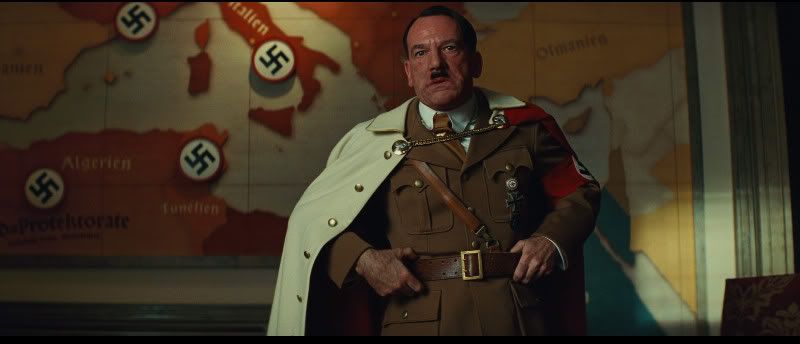
Inglourious Basterds

Photo Sharing and Video Hosting at Photobucket
Amidst the discussion surrounding Inglourious Basterds, the one point that seemed both most vital and most frequently lost on detractors was one of simple designation: this movie is not (primarily) about World War II. Like the titular vessel of the now-dethroned BO king Titanic (if you actually believe it ever really was to begin with), the war is merely a setting, a player in the story, a catalyst. Here, history is filtered through the mythic cultural lens of film (a priceless early scene juxtaposing Hitler against a still-unfinished mural of the Nazi leader sets the tone), rendering Inglourious Basterds with a loopy, ouroboros quality. Always figuratively throughout his career, Basterds is the first Quentin Tarantino film to be literally about itself.

Such qualities and more preclude me from sharing the you-can't-touch-that! attitudes of Jonathan Rosenbaum and others, who take offense to the less-than-solemn vision of war and apparent arrogance implicit in historical revision, who see only deliberately courted controversy and "adolescent snicker". Basterds is not entirely relevant when divorced from actual historical understanding, but in Rosenbaum's defense, he's probably had more exposure to historically ignorant upstarts than I, something I'm sure could over-fuel anyone's bullshit detector. (In the same fashion, I'm sure some still fault The Producers' treatment of Hitler; great comedy - which, in its moments of choosing, Inglourious Basterds is - must always offend some.)

But I've read (and adored) Hannah Arendt and studied the Holocaust at length, and both are as hip as the next thing (intellectually speaking, I groove on them). What makes it worth more than callous teenage sneer? Sure, it's partly true that Basterds is a revenge-fantasy (and a comedy and a guys-on-a-mission movie and a feature-length Looney Tune and...), but it's also incredibly self-critical about the feelings that genre intends to conjure, deliberately conjuring its own imagery in the vein of well-known WWII atrocities. Call it a brilliantly (and morally) played bait-and-switch. Such shock-and-awe poses are struck like falling dominoes for specific reactions in a specific order -- to see only the rage at the surface of the script is to ignore the deeper inner workings.

By engages with historical legend and eschewing cliche via empathetic characterizations, Inglourious Basterds directly counters reductive expectations and becomes a work of moral weight and worth, most directly in the plot thread in which Jewish refugee Shoshanna (Laurent) must deflect the courting of German soldier Frederick Zoller (Brühl). Says Slant's Ed Gonzalez, "A lushly intriguing grappling with morality, ideology, nepotism, and authorship, the entire chapter may be the deepest Tarantino has ever gotten." His words mean more than mine, but I'll go one further and call it the base of Tarantino's latest summit.

Mounting such, the film takes an obvious stance against Nazi evils, even imparts "be intolerant of intolerance" virtues in what seems to me a passive approval of the Basterds' no-mercy war tactics. Nevertheless, it doesn't stop the camera from pulling back at the sight of the bat-wielding Bear Jew in action (a shrill-free equivalent to turning one's head). The only character the film makes a point in gleefully repudiating is Hans Landa (Oscar spotlight Christoph Waltz), who is swayed not by love or revenge of country, but the prospect of personal gain over all else. Basterds condemns evil through banality, but more ruthless is its treatment of the greedy, the root of all evil.

Drunk from frame one on its own movie-ness, Basterds is a slow-ticking bomb that sporadically explodes with streaks of glorious, tangible violence, the punctuation marks in what amounts to a deliberate and precise arrangement of cinematic chess pieces. (On paper, Tarantino's revelations are as obvious as anything in Shyamalan's canon, but where his impress more surprise is in his reveling of storytelling details -- we're too intoxicated to see the strings.) Several jerks of the rug later, and WHAM!, the movie has hauled you down an unprecedentedly complex path, complicating assumed notions of good and evil, scrutinizing itself (and the viewer) via a deceptively brilliant, self-devouring plot device (maybe the best movie-within-a-movie, ever), and yes, affirming the righteous social power of cinema. Only a work so personal and dependent on love for the medium could actually get away with it. Inglourious Basterds is worthy of Dr. Strangelove, which is to say, it's an inflammatory masterpiece. [A]

[Screencap thanks to DVD Beaver.]

Feb 2, 2010

2009: The Year in Film

SPOILER WARNING IN EFFECT!

Photo Sharing and Video Hosting at Photobucket

Photo Sharing and Video Hosting at Photobucket

Photo Sharing and Video Hosting at Photobucket

Photo Sharing and Video Hosting at Photobucket

Photo Sharing and Video Hosting at Photobucket

Photo Sharing and Video Hosting at Photobucket

Photo Sharing and Video Hosting at Photobucket

Photo Sharing and Video Hosting at Photobucket

Photo Sharing and Video Hosting at Photobucket

Photo Sharing and Video Hosting at Photobucket

Full list:
10. Julia
9. Public Enemies
8. The Cove
7. Liverpool
6. Adventureland
5. Fantastic Mr. Fox
4. A Serious Man
3. 35 Shots of Rum
2. Inglourious Basterds
1. Two Lovers

Honorable Mentions: The Sun, The Hurt Locker, Treeless Mountain, Moon, Surrogates, Coraline, Land of the Lost, Trucker, Oblivion, Pontypool

Ten Offenders: Friday the 13th, Wolverine, Trick 'r Treat, Night at the Museum: Battle of the Smithsonian, Who Does She Think She Is?, Horsemen, Up in the Air, The Proposal, The Class, Bride Wars

'Til next time, au revoir!
Photo Sharing and Video Hosting at Photobucket

Jan 7, 2010

150: Anvil! The Story of Anvil, Capitalism: A Love Story

Photo Sharing and Video Hosting at Photobucket ANVIL! THE STORY OF ANVIL (Sacha Gervasi, 2009): Seemingly poised to go down as the true-doc equivalent to This is Spinal Tap, Anvil! chronicles the herculean efforts of the still-kicking, mostly forgotten titular rock band to once again make their mark on music culture. What follows transcends thrash metal culture and becomes a working class tale of doing what you love at all costs, as the band slogs through modest day jobs to pay bills and raise families, all the while having churned out a dozen albums and occasionally touring abroad since the mid-80's, now striving to raise the not-insubstantial production fees to record the aptly titled This is Thirteen. Anvil never condescends to its subjects - two best friends for life whose passion knows no bounds, even as it steeps itself in potential delusions of grandeur without a place in the "real world" (an interview in which a family member calls them out for being overgrown boys is practically heartbreaking in its insensitivity, even if it is true from a common sense perspective). If the band seems on the verge of rediscovery by the film's end, such is a development director Sacha Gervasi seems acutely aware of, framing their (spoilers ahoy) climactic appearance at a Tokyo rock festival less as an arrival at a long-awaited destination than as a triumphantly new beginning. B

Photo Sharing and Video Hosting at Photobucket CAPITALISM: A LOVE STORY (Michael Moore, 2009): Moore's heart is in the right place, but Capitalism ultimately proves too half-assed a cine-essay to bear any substantial impact outside the choir it eagerly preaches to. From an emotional standpoint, this excavation of the decaying capitalist values further widening the gap between the American rich and poor fails to stoke the flames of moral atrocity high enough to qualify as expertly rendered propaganda, instead shifting focus too quickly from the tragic and unjust (the powerful gorging themselves on the losses of others; the "dead peasants" section is a must-see) to the tritely sentimental (a trip to his father's former place of employ in Flint, Michigan) and meekly scabrous (his usual gadfly-esque demonstrations come off as limp-dick here). Capitalism ultimately hopes to suggest a dawning sense of empowerment in the American people via a strike sequence in which factory workers barricade themselves inside their workplace. The real tragedy here, however, is that it more or less lets off the hook the greedy fuckers responsible for exploiting the lower classes, effectively tossing pebbles at its targets when it should be heaving boulders. C+

Jan 6, 2010

OFCS Awards: Winners

I guess it's a good thing I gave Melanie Laurent those extra five points with my second-place vote. Here is the full list of winners. Respectable, even if I'm already sick to death of Anvil (not a bad film, but dammit if it isn't relatively meaningless in comparison to The Cove).

Best Picture: The Hurt Locker
Best Director: Kathryn Bigelow, The Hurt Locker
Best Actor: Jeremy Renner, The Hurt Locker
Best Actress: Melanie Laurent, Inglourious Basterds
Best Supporting Actor: Christoph Waltz, Inglourious Basterds
Best Supporting Actress: Mo'Nique, Precious
Best Original Screenplay: Quentin Tarantino, Inglourious Basterds
Best Adapted Screenplay: Wes Anderson and Noah Baumbach, Fantastic Mr. Fox, based on a book by Roald Dahl
Best Documentary: Anvil!: The Story of Anvil
Best Picture Not in the English Language: The White Ribbon
Best Animated Feature: Up
Best Cinematography: Robert Richardson, Inglourious Basterds
Best Score: Michael Giacchino, Up
Best Editing: Chris Innis and Bob Murawski, The Hurt Locker

Voted: 5 (36%)
Predicted: 8 (57%)

Photo Sharing and Video Hosting at Photobucket
UPDATE 1/7/10: Here's something new: the OFCS has prepared via webcam their own Awards ceremony of sorts, replicated here for your viewing pleasure. I haven't actually looked at these yet myself; I tend to find this sort of thing embarrassing, even when it's not me on display (and yes, I have found myself as the proverbial deer in the headlights once before in such a manner, but I'll be damned if I'm going to say when, how, or where).


Jan 4, 2010

150: (500) Days of Summer, The Princess and the Frog

Photo Sharing and Video Hosting at Photobucket (500) DAYS OF SUMMER (Marc Web, 2009): Bearing a degree of emotional sincerity atypical to its indie-approved brand of self-identifying quirk, the gimmicky (500) Days of Summer can be said to succeed in spite of itself. Honesty is key here, as the central conceit - the roughly year-and-a-half long emotional rollercoaster the main character, Tom Hansen (the always superb Joseph Gordot-Levitt), experiences as a result of his relationship with Summer Finn (Zooey Deschanel) - is explicitly titular, explored in bits and pieces shuffled back and forth in time. Many have compared the film to Annie Hall (which also begins post-breakup looking back), but more appropriate to these eyes is Scenes from a Marriage, albeit through a far inferior, twee lens. Abound conventions (the supporting characters en masse) and the occasional nugget of overwrought wit (the final "gotcha" moment) threaten, but fail, to cripple the leads' revelatory sincerity, best marked by two scenes, both transcendent, one an upper (bluebird), the other a heartbreaker (park bench). B

Photo Sharing and Video Hosting at Photobucket THE PRINCESS AND THE FROG (Ron Clements and John Musker, 2009): While at times suggesting a manic greatest-hits package of Disney's modern catalogue - complete with ready-for-Broadway musical numbers and supporting characters bordering on racial stereotypes - the emotionally earnest The Princess and the Frog more routinely reminds one of the Mouse House's original golden days. Much has been touted about the utilization of an African American character - the first among the Disney line of "princesses" (to say nothing of other ethnic backgrounds already represented) - but advertising campaigns be damned, the film is most progressive in its decision to not emphasize the color of its hard-working heroine's skin, but rather the cultural and economic roots that drive her desires and passions (see an interesting angle on the film's purported race card here, and then here). The New Orleans setting is surely an olive branch apology of sorts for Katrina and its portrayal of history a bit idealistic, but as far as instilling humanistic values across class boundaries (far and away more substantial than the racial kind, argues the film), The Princess and the Frog is nearly unparalleled. B+

Jan 2, 2010

OFCS Awards: Ballot

Kept things simple this year, voting for only one movie per category (as opposed to ranking all five), two at most when the competition was close enough. Last year my selections proved 75% accurate; I seriously doubt I'll be that elated come the announced results this year. Full roster of nominees can be found here. When different, I've included my predicted winners in parenthesis.

Picture - Inglourious Basterds (The Hurt Locker)
Director - Quentin Tarantino (Kathryn Bigelow)
Actor - Joaquin Phoenix (Jeff Bridges)
Actress - Tilda Swinton, Mélanie Laurent (Gabourey Sidibe)
Supporting Actor - Christoph Waltz
Supporting Actress - Diane Kruger (Mo'Nique)
Original Screenplay - Inglourious Basterds (The Hurt Locker)
Adapted Screenplay - Fantastic Mr. Fox (Up in the Air)
Documentary - The Cove (Anvil! The Story of Anvil)
Non-English - Abstained, haven't seen enough (Summer Hours)
Animated - Fantastic Mr. Fox (Up)
Cinematography - Inglourious Basterds (The Hurt Locker)
Score - Fantastic Mr. Fox (Up)
Editing - Inglourious Basterds (The Hurt Locker)