Apr 25, 2008

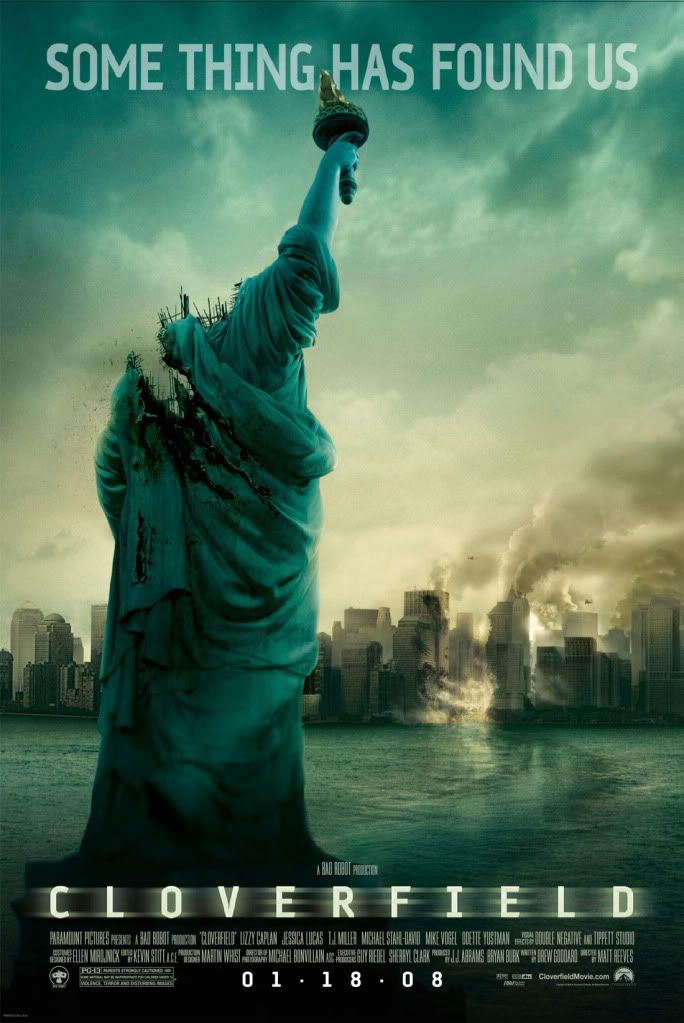
Cloverfield (2008): B-

A second viewing of Cloverfield confirms that this experimental pop feature has more to it than I initially recognized; the impact of hype on my initial impressions notwithstanding, I think it a telling fact that my gut response was far more embracing when viewing the film on a comparatively small television, as opposed to the epic cavern of the classic single-screen theater just down the road from my Alma mater. Like Brian De Palma's similarly conceived Redacted, it is a work rooted in the aesthetic of a non-cinematic visual form, a fact that doesn't make theatrical exhibition wrong, per se, but one that significantly impacts the ways its imaged are consumed under various means of presentation, the reduction in size carrying with it a reduction in its apparent "entertainment" qualities, regardless of whether or not Cloverfield wants us to be thrilled by or fearful of the events onscreen. General thematic limpness being chief among its weaknesses, the film fails to beckon its chosen medium, instead subject to the whims of the form it unsuccessfully attempts to dominate.

The aesthetic of the first time camera operator is one we all know well, unless, that is, we've never been forced to either (a) document a party or event as our cinematographer Hud (the very good sport T.J. Miller) has, or (b) watched such almost-nauseating recordings after the fact (for the record, the style, both real and feigned, has never bothered mine eyes, so get the deal about it I do not), and as such it is one more appropriately at home on the small screen, especially given the straightforward manner in which producer J.J. Abrams and director Matt Reeves has conceived their baby. The Blair Witch Project still owns, not the least because its supposed "makers" were, in fact, filmmakers, and as such utilized their talents in a way that, by the very nature of their recordings and their relationship to them, transcended mere technical artifice. (Spoilers ahead.) Cloverfield similarly bears witness to the long-gestating deaths of its incidental protagonists at the hands of some mysterious force, but the film never aspires to subvert the home video genre, merely utilizing it to tell a Godzilla-type story (or rather, a story with a Godzilla-type creature in it) in a different way than its genre has traditionally embraced.

To be clear, I still find it wanting in too many ways to champion, but - and it is possible that my initial impressions were unawaringly swayed by gorging media hype, among other things - Cloverfield emerges now not as a hollow shell, but as some kind of brilliant conception, albeit one more than a bit too caught up in its calculated form to effectively indulge in the emotional undercurrents that made The Blair Witch Project one hell of a character study in addition to a representation of the moving image as point-of-view documentarianism. More apparent now is Cloverfield's humane side, less seemingly exploitative than on the big screen and more implicitly self-critical in its representations of death if only because its maker chose to document them. Spectacle-hungry viewers who want more "monster for their money" needn't apply: Cloverfield is only incidentally about a giant creature wreaking havoc. Rather, it's about Hud's own mental processes amidst such disaster, the burgeoning love between its subjects Rob (Michael Stahl-David) and Beth (Odette Yustman), and our own relationships to recording technology.

After an effectively prolonged set-up at a surprise going-away party in Manhattan, something big rocks the city and, before we know it, the night has already seen fire and brimstone. When a dozen or so spectators almost instinctively raise their cell phones to the head of the Statue of Liberty after the iconic face crashes in the street, hurled into Manhattan by God knows what, it's not only as if they're worshipping some unspoken deity, but we realize that Hud's perspective is just one of many. Unfortunately, these are the brilliant nuggets that are scattered about what is otherwise a very straightforward melodrama, not quite as impeccably acted as it would like to think it is and carrying with it a framing devise that even Frank Capra would consider schmaltzy in its obviousness. Cloverfield respectably feigns randomosity, whereas Blair Witch was actually shot off the cuff, the actors here rendering their characters as flesh-and-blood but only in the first dimension; whether it's just another day at the convenience store or the possible end of days, their deliberately casual feel remains a hair too close to that timid land of movie extras to be truly realistic. I, for one, would be using the F-bomb far more gratuitously if faced with a possible encounter with a creature that could well swallow me whole.

Throughout the film - which, for the idiots of the world (I'm sorry, but really, can we maybe walk on our own some day?), is actually a digital home movie that has been recorded on several times, hence the inconsistency of the events being shown - scenes preceding the central night of havoc pop up, but their presence smacks time and again of calculated cutesiness, a wink from the film to remind the audience of its own nifty conception. Cloverfield suffers from this compulsion to refer back to itself, forgoing a more genuinely (i.e. challenging) inconsistent texture that would have rendered its events all that more punchy as they unfold. Such as it is, the scenes in which our protagonists stop for news updates are among the most effective, and even more so for their lack of attention mongering; the frames within frames demand a reexamination of our viewing portal, both the way we gather information and how we function in the world. Morons may wonder why no third-person perspectives are offered up but Cloverfield's relative thrills - that of the unprotected, in-your-face kind - only work as well as they do because of the film's absolutely self-contained consistency. I highly doubt the crab/alien/monster at the center of the film will ever become the American equivalent to Japan's Godzilla, but I for one prefer its nature to remain shrouded in mystery, its origins extraneous to the films very much immediate events and themes and only complained about by those who latch on to trite details lest they actually invest themselves in that subconscious manner that attunes one to currents beyond the mere physical events transpiring onscreen.

As a humanistic look at the ground-level suffering intrinsic to much genre entertainment, Cloverfield is a visual thrill, but its own cookie-cutter rigidity cuts itself off from the deeper possibilities that always remain just within arms reach. The aforementioned scene of the Liberty head remains the one truly brilliant moment of chic pop imagery therein, and though later attacks by the lead monster and its legions of man-sized fleas never fail to make one feel vulnerable to the elements, the film fails to substantially anchor its events to character in a way that effectively builds on its core gimmick; Rob and Beth's relationship, for all of its apocalyptic, one-note "I love you" tragedy, is barely enough to substantiate the plot. Hud, probably unbeknownst to the filmmakers, is the real star here, his ultimate demise seeing the film's single most mind-bending shot: his lower half having been ripped off and devoured by the monster, the camera lands next do his now-deceased upper torso, the auto-focus toggling back and forth between our fallen heroes wan face, the grass beneath him, and the smokey, smouldering ruins behind him. Whatever the nature of our obsessive kino eye, it is one lost without us.

DVD

Cloverfield comes to us half-assedly packaged like a secret government file (if they wanted to maintain the illusion, why not go all the way as did the film?), its disc fake-damaged in the same way the Borat DVD looks like an obviously fake DVD-R (in other words, expect Blockbuster customers to demand a refund, mistaking it for the real thing). The image appropriately straddles the grainy/crispy look chosen for the film while the sound is nothing short of formidable, despite the obviously illogical pitfall that no home camera yet comes equipped with its own Michael Bay sound system (had Cloverfield gone so far as to emulate muffled audio as did Blair Witch, who knows how creepy those fucking fleas might have been).

In the features department, the usual slew of making-of featurettes dominates the selection (they are, thankfully, less cutesy than the packaging), although the revelation that the monster is in fact meant to be a mere baby of its species all but demands another feature made with the creature solely in mind. A handful of appropriately deleted scenes and two minutely different endings may intrigue fans, while the commentary track sees a soft-spoken Matt Reeves detailing the aesthetic and technical nature of his film so meticulously (apparently for the benefit of the numbskulls who still don't get "why the camera shakes") that you'd think he was attempting to connect the dots on Inland Empire from the ground up. If any, skip the batch of outtakes that effectively solidify the film's party crowd as the go-to douchebags of Lower Manhattan.

Apr 21, 2008

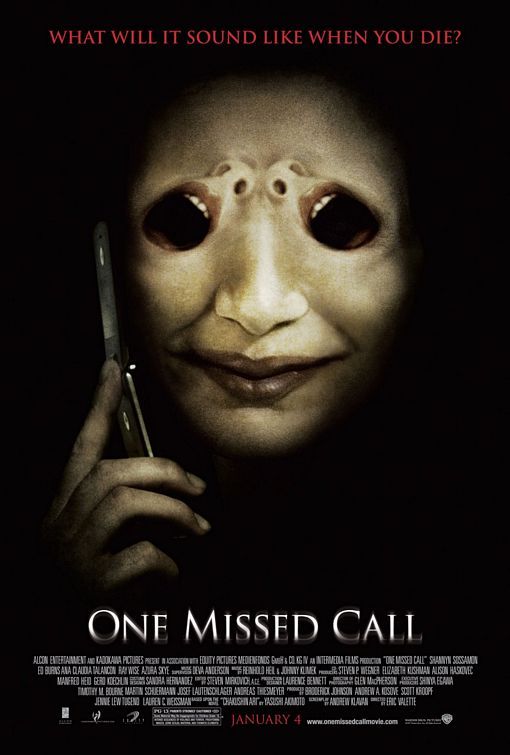
One Missed Call (2008): D

The laziest kind of horror film, One Missed Call culls up idiotic and redundant haunted house imagery in what amounts to little more than a feature-length execution of a wanting sales pitch. A mysterious ring tone precedes the voice mail recording of the recipient's future death (complete with exact date and time), while the numbers listed in each victim's phone provide the means by which the traveling curse chooses its next target. So goes this Ringu-esque cycle of violence, itself a remake from another technology-obsessed J-horror feature. Films like Kairo speak implicit volumes about our growing and disturbing relationships to technology -- not to mention our similarly turbulent and troublesome ways of understanding death -- but it can be generally understood that the majority of their English-language counterparts are less than concerned with these themes, essentially disposing of the genre's metaphorical strengths in favor of cheap manipulations, fleeting and idle shocks rather than invested scares. Turning the camera from side to side more or less encapsulates director Eric Valette's definition of eerie, while the repeated, hallucinatory images of distorted faces, blurred figures and giant centipedes amount to nothing more than the one-two-three pieces of a mystery derivative of one of the subplots from The Sixth Sense. Constantly setting up plainly false climaxes so as to purportedly pull the rug out from beneath the audience's feet, One Missed Call's offenses run deeper than mundane storytelling because of its deliberately vacant subtext, kept clean as a whistle as if anything even remotely ambiguous might reveal the ineptitude permeating this broken record scenario. The ultimate revelation as to the source of the mysterious deaths -- here, a case of child abuse gone much too far -- deliberately keeps its distance from anything remotely thematic in nature, confirming the film's total lack of concern for motivation as it lavishes obnoxious attention on each would-be terrifying Final Destination-like countdown. Never mind that the makers fail to even recognize the central paradox at hand (like the infinitely better Minority Report and its pre-cogs, the ominous messages here are a self-fulfilling prophecy); One Missed Call shovels creative bankruptcy in the name of paranoia exploitation, a market-spawned Happy Meal trinket lacking both skill and wisdom. Appropriate then, that a film in which characters' lives are so easily tossed off would be equally inconsiderate to our own.

DVD

An average transfer for a visually below-average film: effects stand out like a sore thumb in this digital forest (although I doubt it looked any different in theaters), while blacks and general detail work remain just good enough throughout. Sound is clear and, therefore, achieves the most shrill effect possible. Zero in the extras department, although it's somehow fitting for a film this hodgepodge to arrive in stores on a bare bones disc -- it's all that much closer to being nothing at all.

Apr 7, 2008

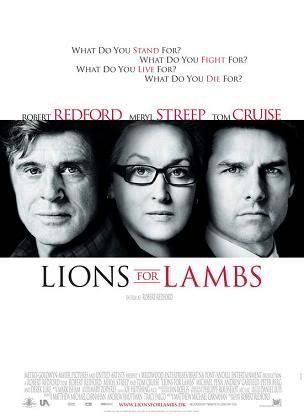
Lions for Lambs (2007): B

Are we so desensitized by the state of worldly affairs -- indeed, even the state of worldly affair-driven cinema -- that we've become unable to distinguish the illuminating and honest from purely titillating distractions? I can't speak for my fellows (whom I certainly mean not to judge), but I'll readily admit to having went into the almost universally decried Lions for Lambs all but ready to, as some of us say, rip it a new one, only to be quickly disarmed, ultimately finding myself in the curious position of agreeing with Armond White. The film is talky, preachy, and obvious, but it's also honest, to-the-point, frank, and anything but simplistic, avoiding not only the disingenuously visceral point making of the likes of United 93, but also (and more importantly) the distancing apathy of so many films that it deliberately seeks to counter. Its material is anything but fresh but its approach successfully validates the material, recalling Hal Phillip Walker's argument that we are all, like it or not, heavily involved in politics.

The film proper runs under 90 minutes, effectively encapsulating its simple truths without excessive, plot-based distractions, although such precision hasn't kept its emphasis on dialogue (read: ideas) from becoming a major point to berate (as if too little, a la 2001, or too much, is inherently bad; are our cinematic audiences now the equivalent of Goldilocks?). Redford stages his film as the verbal equivalent to a D.W. Griffith montage, relying not only on effective close-up/wide shot cuts to convey inner character workings, but pure verbal melody as an incisive razor into our current political moment. His characters -- an aging college professor (Redford), a young and voracious Republican Senator (Tom Cruise), an experienced liberal journalist (Meryl Streep), a disinterested young student (Andrew Garfield), and two foot soldiers (Peter Berg and Derek Luke) -- are decidedly and deliberately archetypal, channeling concepts and issues larger than themselves even as they remain rooted in earthly character.

The film's intentions are apparent in the bookending device of Andrew Garfield's politically disinterested Todd Hayes watching a television, the opening shot juxtaposing his passive stare with that (purported) of the audience before cutting to the image of a television screen, an image that not only one ups all of Michael Haneke's would-be commentary Funny Games, but one that also reinforces the viewer with a sense of responsibility not only as regards what they do, but what they watch. Though Lions for Lambs occasionally smacks of an elder generation attempting to convey a younger, hipper attitude (a singularly wince-inducing moment involves a lyric from The Who), most evident in the proceedings is Redford's learned means of employing celebrity power as means of public service, here avoiding condescension by not thrusting an individual viewpoint down our throats (if the film were to be given a label, moderately liberal seems appropriate) but by politely clamoring for our attention when it's needed most. While still a far cry from Steven Spielberg's prodigious 2005 output, Lions for Lambs reminds us of what Hollywood does best, when it wants to.

Apr 5, 2008

Assault on Precinct 13 (1976): A+

John Carpenter's mastery of hard-boiled genre tropes may be no more evident than in his 1976 masterwork Assault on Precinct 13, a neo-western bathed in urban decay and 70's racial tensions that packs - in 90 minutes, no less - more insight into life lessons and moral codes of honor (do unto others, etc.) than most filmmakers achieve in an entire career. Relying almost entirely on subtext of its classic action movie plot, Carpenter's film suggests cinematic poetry in its efficiency of language, with nary a shot of verbal exchanged wasted when it comes to the director's rigorous visual codes, delectably framed in the same way every line in a manifesto is agonized over prior to publication. His Los Angeles is as godforsaken and savage as that envisioned by Ridley Scott in Blade Runner, but its setting plays like the honest-to-god real thing, unlike the warped and caricatured cops and robbers playgrounds effectively satirized by the Grand Theft Auto video game series (itself and undervalued work of almost-brilliant satire).

Assault on Precinct 13 begins from above looking below, as a group of thugs (of varying races, quite importantly) navigate a hallway, guns in hand. Suddenly, the police appear and begin firing when the gang members begin to flee, ignoring orders to surrender their weapons. Next scene: a radio broadcast stresses the importance of tracking down a cache of missing weapons, the effects of which would be disastrous in the wrong hands. Ominously, M-16's and boxes of ammunition are seen in the background as additional gang members engage in a blood pact, foreshadowing what is later revealed to be a commitment to fight without fear (and without reason), to the death. Even before we meet our principle characters, Carpenter has established the uneasy, crumbling balance between the law and the rising anti-establishments. In the midst of anti-authoritarian attitudes, Carpenter seeks to cleanse one's lens of social justice, reminding us that cops aren't always crooked and sometimes the bad guys are in fact just that.

Ensuing plot developments further complicate and illuminate the issue. It's Ethan Bishop's (Austin Stoker) first day on the force, his hopes for a heroic task the first night out shot down when he's assigned to babysit the closing of Precinct 9 in Section 13 (the inconsistency with the title a potentially deliberate choice, reinforcing the film's utter lack of concern for petty and inconsequential details). Such is a unworthy job, but someone has to do it, and Carpenter effectively utilizes the location of the decrepit police station to signify the changing social order and evolution of justice. Bishop, a black man, meets cute with the secretaries and reveals his own decision (with the help of his father) to leave the gang-infested life of the ghetto at age 20, contrasting with the deliberate criminal actions of Napoleon Wilson, a white convict being transferred to death row who deliberately chose a life of crime (though not after being told as a child by a priest that he "had something to do with death"). When a fellow inmate falls ill during the transfer, their bus is forced to defer to the nearest jail house, where Bishop reluctantly agrees to house them while medical treatment can be obtained.

Converging with these characters is an L.A. everyman, noticeably distrustful of authority, who suffers a great loss to the mindless acts of violence of the newly armed Street Thunder gang. Successfully offing his daughter's killer, the man takes refuge in the nearby police station when he realizes the remainder of the gang's members are now after him. Located out of the way in a practically abandoned neighborhood, the occupants of the police station must fend off the waves of gang attacks, silenced gunfire riddling the station and, with the power deliberately taken out, no way of contacting anyone for help. A passive secretary suggests giving the gang members their newfound refugee, and is later caught in gunfire, the inherent result of not fighting back in protection of those unable to do the same.

Carpenter's social commentary juices flow most strongly when he's deconstructing the genre's racial and gender roles, the Street Thunder gang being the great evil that forces our protagonists to join as one: black cop, white cop, black convict, white convict. Fate interplays, such as when death row convict Wells (Tony Burton) complains that he's always had bad luck, not moments before a bitter death. American society remains flawed in Carpenter's eye but the strive for justice is a victory all its own, the protagonists surviving only because of their ability to set aside their purported identities (male, female, etc.), remaining individuals as they unite as equals. Carpenter's almost mathematically structured framework itself defies any sense of bias, his characters on equal footing whether they remain in defiance of one another, or, in a climactic and revealing shot, stand side by side as a single force.

Because Carpenter's observations render Assault on Precinct 13 as one of the most transcendent of all action films, it's almost easy to glance over the razor sharp narrative precision and the efficiency of its lean, mean setpieces; absorbing the space of their locations, the camera itself feels like an occupant of the police station fortress, bullets ricocheting while gangsters attack not unlike the zombies from Night of the Living Dead. Carpenter is more subtle than Romero in his evocation of social conflict but his insight is as profound as that film's Vietnam-infused anger, the hopefully optimistic ying to Romero's learnedly pessimistic yang. Points for humor, however, go to Carpenter, who achieves—through the great performance that is Tony Burton's—what may be the most hilariously titled escape plan in movie history. Although there may be no greater isolated element than Carpenter's own soulful synth score, Assault on Precint 13's powerful exercise in democracy—which appropriately ends with our two male protagonists marching together up a flight of steps—is nothing short of one for the ages.

Apr 2, 2008

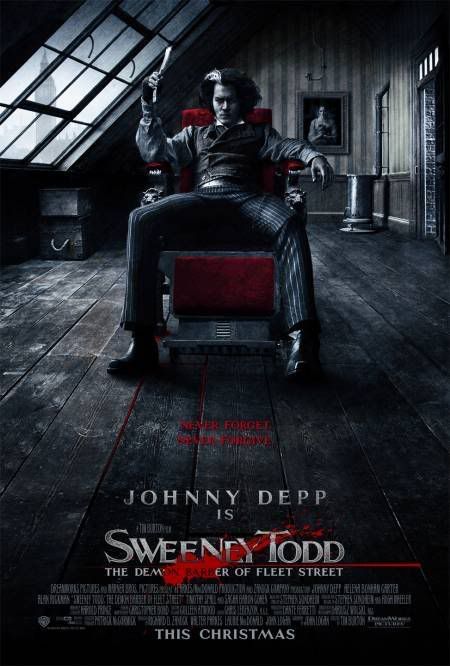
Sweeney Todd: The Demon Barber of Fleet Street (2007): B+

With the near-simultaneous release of both Charlie and the Chocolate Factory and Corpse Bride, 2005 was a financial banner year for Tim Burton even as the man's artistry sagged in the middle. Seemingly emerging from this awkward post-Big Fish transition, Sweeney Todd: The Demon Barber of Fleet Street finds the maestro of macabre on sure footing once again, deftly reworking the 1979 Stephen Sondheim musical into a recognizably cinematic form, echoing German expressionism (perhaps more strongly than any other film in his canon) by embracing its every artificiality like a full-throttle stage performance. In telling the story of Benjamin Barker—an innocent man returning home from a wrongly (and purposefully) imposed fifteen year prison sentence, robbed of his family and bent on revenge—Burton's unmistakable presence is felt everywhere, from the broad, cheeky nihilism to every exquisitely framed shot. Painterly digital mattes establish the moral rot of Sweeney's London underbelly and lush, striking primary colors punctuate the darkened scenery like ecstatic gushes of emotion, and though Burton's film lives and dies on its ravishing eye candy, it fails to reach the same powerful depths of emotion as, say, the director's underrated Batman Returns, in that it retains a smidgen of sly acknowledgment, as though Captain Jack Sparrow were on board to remind us that it's all still a game in the end. A gorgeous spectacle of bloodletting, no doubt (raindrops fall like bloody tears and jugulars gush deep crimson paint more than blood), Burton's reinforced, slightly comical distance from the material prevents it from reaching a greater transcendence, reducing what could have been an outrightly operatic tragedy into pure angst, feeling but also fleeting: one remembers the exquisite Gothic imagery but, though it all, Todd's soul never feels bared. Having never seen the source material, I cannot comment more substantially on the specifics of this adaptation: Jim Emerson breathlessly evaluates Burton's efforts and their purported failure here, and though such is a view I might share upon becoming familiar with the musical itself, Sweeney Todd would seem, quite notwithstanding, a significant step forward from the dreadfully phoned-in storytelling and songwriting of the Hot Topic-pandering Corpse Bride. If that glint of self-awareness is Sweeney Todd's damnable limitation, then at least succumb to its focused use of scenery, in what amounts to the most accomplished almost-remake of The Cabinet of Dr. Caligari since the passing of the silent era.

Mar 27, 2008

American Zombie (2008): B

After the dull (not to mention mean-spirited and largely unfunny) Behind the Mask: The Rise of Leslie Vernon, one can be forgiven for treading the genre of the horror mockumentary with more than a bit of skepticism. The fact, then, that American Zombie exceeds initial expectations is a quality more than incidental in nature, it being not only among the most spot-on examples of the genre since Rob Reiner revolutionized it with This is Spinal Tap almost a quarter century ago, but also doubling as an intelligent re-examination of its predecessors in the horror genre. For the bulk of its running time, I'd even go so far as to suggest it of near-brilliance, its failure to follow through with a consistent batting average being the only impediment to its status as something of an instant, albeit minor, zombie classic. The scenario of the film—basically, that zombies are a real and everyday presence in our society—screams of gimmickry, a lethal trait the film avoids until a piteous conclusion manifest of an already unnecessary plot conflict, one that sidesteps the film's effectively inquisitive nature in favor of more traditional (read: contrived) storytelling devices. That the film itself serves to critique media trends and cinematic pretentions as much as anything else almost allows the success of the third act turn of events, but such is a slippery slope is the film lightens up on exposition in favor of deadpan, de-contextualized humor.

Totally aware of itself, American Zombie concerns two documentarians—John Solomon and Grace Lee, playing themselves—out to tell the zombies' side of the story, they a minority group working for equal rights, suffering the same patterns of discrimination and marginalization as any number of groups throughout U.S. history. Parallels to the civil rights, feminist and LGBT movement about as we see the undead—who are presented here, quite importantly, as being able to function without a reliance on human flesh—attempt to re-integrate themselves into society. The film's ultra-cheap budget is apparent in some of the effects work—an open wound is achieved with a simple prosthetic and a handful of mealy worms—but American Zombie maintains its own suspension of disbelief in great part because of the stellar cast, which pitch-perfectly replicate the casual nature of traditional documentary subjects with almost absolute consistency. Ditto the filmmakers, who present American Zombie as being from the same cloth as countless other docs, right down to the establishing shots and still-life cutaways that serve as transitions from one segment to the next. Nonetheless, their film avoids the tedium of its non-fiction fellows by constantly doubling back on itself, self-reflective (both figuratively and literally) and staunchly non-ironic, a quality that allows the film far more humor than had it openly winked to the audience about its many first-glance absurdities.

Few aspects of modern life go untouched: labor laws are in effect to prevent slave labor abuse of the undead, for whom the official, politically correct term is a "revenant". This is just one example of many in which American Zombie intelligently and meticulously maps out the social patterns and mechanisms at work as regards any group at odds with the status quo, recollecting Romero's deconstructions of racism and sexism through an effectively no-frills lens. Hate crimes abound (a zombie rights group entitled ZAG suffers routine graffiti attacks by zombie haters) while many of both secular and sacred backgrounds work towards greater unification, arguing, respectively, that anyone currently living may one day become a zombie themselves, and (in possibly the film's finest moment), that "Jesus loves zombies. Jesus was the original zombie." More often than not, American Zombie strikes pivotal chords by simply telling it like it is, stating out loud what was on everybody's mind when The Passion of the Christ and Zack Snyder's Dawn remake shared theater space in 2004.

Such trinkets of brilliance are complimented finely by numerous, altogether effortless homages to zombie films past (from Dawn of the Dead to Blood Sucking Nazi Zombies), while an early, scientific explanation of the zombie condition serves to bathe the rest of the proceedings in a state of complete legitimacy (essentially, a virus rests dormant in the brain until the moment of death, re-activating the cells long before decomposition begins to set in). The similarly themed They Came Back was more successful in its exploration of this scenario in large part because is bypasses the easy baiting that American Zombie goes for in the end (are the zombies up to something? will they eat someone, and who?), which disappointingly skimps out on the ravishing self-criticism initially suggested by the image of our protagonists recording themselves, implying that, by making a documentary about the undead, they are effectively telling the same story about how we function while still alive. The same has been true from the early days of Night of the Living Dead on through the more recently incisive Shaun of the Dead, but Lee's film proves—along with George Romero's Diary of the Dead—that it's a genre as viable as ever, endlessly flexible and perpetually illuminating.

Confusions of an Unmarried Couple (2007): B-

The unreleased indie dramedy Confusions of an Unmarried Couple functions as coach to the titular quarreling couple, almost rigorously evenhanded and unbiased as it details the opposing viewpoints and recollections of a (possibly) former couple now separated for several months, Dan (writer and co-director Brett M. Butler) having dumbfoundedly walked out on Lisa (Naomi M. Johnson) after discovering something unexpected when arriving home early from work one day. Such tumult is experienced only in recollections, both versions meshing together factually but illuminating the opposing (and often completely incompatible) viewpoints and motivations on either end. Such is an unusually and moderately brilliant tool here, and one senses that, had the creative team of Brett and Jason Butler more experience under there belts, the premise could have been developed into something of great measure, like a second-generation channeling of Woody Allen. Though less witty or enrapturing as anything near Annie Hall (not to mention deliberately more embittered), Confusions marks a distinct voice, a quality that helps solidify it as something truly, honorably Indie. Hope yet remains for the cinematic world.

Beginning after initial shockwaves and subsequent fallout, Confusions first addresses the state of Dan, who took to his brother's apartment after leaving his own with virtually none of his belongings (the entirety of which he has yet to get back). In these opening scenes, Confusions gets the kind of emotional hang-up suffered after such an emotional blow absolutely right: waking up from yet another night on the couch, Dan downs some half dozen beers before acknowledging the world before him, absorbed in destructive and inefficient routine as a distraction from feeling and responsibility (trust me, I've been there). The look and performance are raw in a naturalistic amateur way but remain rooted in a felt reality, one that functions entirely on the muted restraint of self that denies an emotional presence and thus the pain that accompanies it. Speaking plainly to the camera (one wonders who "filmed" the solo interviews, and if they accompany the couple as they interact together), Dan conveys his inner thoughts deliberately and honestly, often hypocritical or misguided but never untrue to his developmentally arrested self: here I am, this is how I feel, and why. Ditto Lisa, who shows equal capacity for self-absorption or ignorance in her own views. In other words, they're just like you and I, and watching their respective confessions is most aggravating if only for wanting to tell them how much they're talking past each other, words flying aimlessly at targets neither seen nor felt. Confusions understands the impossibility of truly understanding the viewpoint of another (although at times the male/female communications here are so amusingly inept that one must wonder how the couple in question ever managed to live together in the first place), with just another layer of experience, emotions, and memories lying just below the surface of the last. As Kane showed us, there's always another Rosebud.

The only thing weighing down the final effect of Confusions, then, is the chemistry of the performances, which function almost astonishingly when singular but hit a wall of uneasy trepidation when interacting together. To say the least, Butler and Johnson are no Ullmann/Josephson or Hawke/Delpy, and though such comparisons would be cruel and pointless to make, a look at their differences is indicative of the former's simple but key limitation: overlapping. Achieving in its interviews a Kevin Smith-like balance of realist and verbose dialogue, Confusions wavers between projected realism and awkward would-be stage acting. Determined to get his possessions back and maybe patch things up, Dan works up the willpower to go back to Lisa and his former apartment, having to let himself in with his former key after Lisa closes the door in his face. Though the projected interplay is intriguing (details arise on what happened, why, and what has happened since) the stars of Confusions feel like anything but people once intimately familiar with each other, pausing between exchanges as if the audience itself needed a moment to catch up. We don't, and though Confusions would have never reached greatness even without the rough patches, it has a gnarly, post-sex mustiness to it that makes it almost radically legitimate in its anti-polished, necessary unpleasantries. "A feral anti-romance" would make a good selling point.