Sep 24, 2010

The Thin Red Line: A Photo Essay

Photo Sharing and Video Hosting at Photobucket
Everything a lie.

Photo Sharing and Video Hosting at Photobucket
Everything you hear, everything you see.

Photo Sharing and Video Hosting at Photobucket
So much to spew out.

Photo Sharing and Video Hosting at Photobucket
They just keep coming, one after another.

Photo Sharing and Video Hosting at Photobucket
You're in a box. A moving box.

Photo Sharing and Video Hosting at Photobucket
They want you dead... or in their lie.

Photo Sharing and Video Hosting at Photobucket
Only one thing a man can do--
find something that's his, make an island for himself.


Photo Sharing and Video Hosting at Photobucket
If I never meet you in this life, let me feel the lack.

Photo Sharing and Video Hosting at Photobucket
A glance from your eyes, and my life will be yours.

Sep 7, 2010

25th Hour

Photo Sharing and Video Hosting at PhotobucketPhoto Sharing and Video Hosting at Photobucket

25th Hour would seem to be a difficult film to love - it's central scenario bearing no happy endings, offered up with no punches pulled - but those who do love it seem to be of the gushing type (I should know, as I'm one of them). I'd argue the movie as being ultimately a hopeful one, but a pick me up it is not. God hovers over Lee's post-2001 NYC with rapturous disconnect; he's around, but he's stepped out for awhile, and whatever hope or strength people have is entirely up to them for the moment. If I “like” this movie, it's in the same way I like life, accepting its many trivialities, inanities and downright shitty aspects as a given along with the pleasures, deep and pure and whole and true, however fleeting they may be. 25th Hour is as beautiful a movie as I've ever seen, but its subject matter is one primarily of decay. Beauty here is nothing to sneeze at.

The story succeeds on even the conceptual level for its presentation of moral struggle. Monty (Edward Norton) is a touched (read: prosecuted) drug dealer going about his final day of freedom before having to report to prison (he’s a low flight risk on parole). Somebody sold him out, but he's maintained silence with the feds and so must serve a full seven years. Monty seems a great guy out of the gate, but he was still a drug dealer, and whether he was simply satiating or actively creating a market is a judgment call sidestepped here (says the movie: even good people have to reap the seeds they've sewn). Lee finds universal dread amidst Monty's crisis, and tastefully, necessarily probes collective anger, hope and fear with a one-two punch of World Trade Center imagery: the opening credits, a montage of the ghostlike light beam memorials projected from ground zero, and an early second-act view into the rotten festering hole itself. And, speaking as a man, you don't have to be homophobic to dread the thought of lifers beating you up at night just to soften your mouth up.

25th Hour is about big moments – the aforementioned sequences and two key speech montages scream of grandiose-reaching self-consciousness, but then, how couldn't they? – but it's also about the connective flow of an evening, and I simply adore the way Lee works his way through this ether of people and feelings like he's charting a spiderweb, finding truths and resolutions but never really concluding anything because, well, life goes on. The style emphasizes real time experience and a halfway naturalistic, halfway poetic palate aids in suggesting a presence of life continuing beyond the credits – that is, the 25th hour (the movie earns every ounce of its titular destination). Approaching an Altmanesque sensibility, David Benioff's script – based off his own novel – concocts a savory Freudian triangle of ego, id, and superego to help straddle the narrative line of life and larger-than-life. The most outright fun sequences are between Norton, Barry Pepper (as his high-fallutin' investor friend Xavier) and Phillip Seymour Hoffman (Jacob, an introverted English teacher; imo PSH's best performance to date), just shooting the shit. Throw Anna Paquin as a hot-for-teacher student into the mix, and, well, enough said, right?

Star casting helps to maintain a tonal balance within the films love the sinner/hate the sin worldview, with Rosario Dawson (as the angelic Naturelle, Monty's girlfriend) in particular helping to lend the story a kind of allegoric immensity. These beautiful people simultaneously embody both our best and worst tendencies, and an emphasis on perspective gives things an even richer ambivalence (a tactic declared visually via a teasing window effect used during Xavier's introduction, see video below). The easily offended may want to pass (let's get this out of the way up front: you'll be hearing the dialogue “Fuck J.C.” pretty early on), but then, so too do such chickenshits miss out on most of the real world. Emotionally cathartic and downright spiritually shattering, 25th Hour finds beauty in the silver linings and embodies the notion that we're stronger than we usually realize we can be. I love it like life.

Directed by: Spike Lee Screenplay by: David Benioff Starring: Edward Norton, Philip Seymour Hoffman, Barry Pepper, Rosario Dawson, Anna Paquin, Tony Siragusa, Brian Cox 2002, R, 134 minutes

Photo Sharing and Video Hosting at Photobucket

DVD Image/Audio/Extras

This 2002 disc amply displays the limitations of the format at the time, but it doesn't manage to bring down the buzz of Lee's joint. Colors look good (and this is a demanding array at times), dialogue and score are clear (and clearly separate), blacks and edges not so much. Who cares? Rosario Dawson still looks like a higher beings gift to mankind. A few puff pieces, deleted scenes and two listenable if unarousing commentary tracks (although Lee's is worthwhile if only for his imitation of George W. Bush) make up a respectable special features collection.


Aug 19, 2010

Viewing Log #3

Photo Sharing and Video Hosting at Photobucket
The Other Guys (2010, Adam McKay) Missed the first twenty minutes or so of this, so a full review will have to wait. But the 80+% I did catch is the makings of a comedy classic, a remarkable balance between familiar buddy cop genre trappings and sheer lunacy, people acting ridiculous just outside the lines of acceptability (which goes a long way in showcasing how ridiculously we get along most of the time). Watch your beverage intake whenever Ferrell's moderately lame-brained police accountant speaks, especially to or about his wife (the ravishing Eva Mendes). Wahlberg has also displayed some fabulous comedy chops these past few years. And that freeze frame bar sequence... The end credits are among the years high water marks in cinema. The team of McKay and Ferrell is now four for four. UPDATE 12/13: I have since watched The Other Guys twice more. Dwayne Johnson and Sam Jackson (who were already absent from the picture the first time I saw it) hold their own in a diverse and hilarious cast; this may be Ferrell's finest performance since Anchorman. Savory, like wine, but ridiculous as all hell. [Rating: 4 out of 5]

Cop Out
(2010, Kevin Smith)
As something of a Kevin Smith fan, this mostly hurt to watch. Smith's heart is certainly in the right place as far as the raucous comedy spirit is concerned (he's already made one certifiably great pure laugh-fest, Jay & Silent Bob Strike Back; Clerks., while profoundly hilarious, strikes me as a bit more seminal). That said, this, his first movie not of his own writing, is the wrong material to channel it through. Willis and Morgan go through their roles with a fairly zealous enthusiasm, salvaging scraps of humor along the way, and it seems like everyone was having fun (in front of and behind the camera) in just that way that often takes a good comedy off the ground; pity that most of the material sounds like improv misfires. Good or bad, Smith's own writing is honest (and modest) and also helps legitimize his fairly conservative (in style, not beliefs) filmmaking methods. I'm hoping I can see that again soon. [Rating: 2 out of 5]

Clash of the Titans (2010, Louis Leterrier) I might actually prefer this to the 1981 original, a tonally stilted wannabe that doesn't deserve the swansong work of Ray Harryhausen that's primarily responsible for its generally high regard (the stop-motion Medusa sequence is admittedly a masterpiece in special effects history). Backhanded compliment, yes, but such is fitting for this remake's ruthlessly basic approach to all things, which allows neither empathy with the characters nor substantive visceral engagement with the computer-generated behemoths. It's watchable and decently staged, but only occasionally cool. In other words, it's 10,000 BC's non-retarded little brother. [Rating: 2.5 out of 5]

Date Night (2010, Shawn Levy) Minus Fey and Carell's ingeniously paired charm, this is really boring stuff. Thank you, Hangover, for making overly calculated screenplay 101's posing as off-the-cuff works of uncontrolled insanity the norm for mainstream middlebrow comedy. Even more than that overrated frat fest, Date Night tries too hard to be freewheeling, and the effect is plain top-heavy (and downright embarrassing on more than one occasion). Only a fairly unique car chase involving J.B. Smoove's taxi driver really takes off, and while the end takes us to some nice places, the preceding movie hasn't earned it. Carell, Fey... you deserve better. [Rating: 1.5 out of 5]

Despicable Me (2010, Pierre Coffin, Chris Renaud and Sergio Pablos) This cute riff on spy movies is high bar stuff for kids, and pleasant enough for adults. Steve Carrel flexes his chops nicely but his work is nothing compared to what he achieved in Over the Hedge. The "minions" -- plentiful child-sized yellow critters who aid Carrel's aspiring supervillian -- offer the most plentiful sight gags, but very little here sticks after all is said and done with. [Rating: 3.5 out of 5]

The Karate Kid (2010, Harald Zwart) The original - classic status notwithstanding - is nothing great, but at least it has the assurance of a relatively singular, personal vision. I don't regret the fifteen opening minutes I missed for one second...nor the majority of the second half, as I quickly bored and took to pleasuring myself with female company ("of the opposite sex," says Meatwad). This trifle's been scrubbed clean of anything involving poetic or emotionally invested storytelling (only the strong performance of Jackie Chan keeps things grounded in real feelings); it clicks together like an overly schematic videogame. Karate Kid '10 never ends. Its time merely runs out.

Salt (2010, Phillip Noyce) This will probably remain the best pure action movie of the year, the most potent rush since Boarding Gate. Streamlining the espionage thriller to its finest essences (narrative setup and character establishment is knocked out within fifteen minutes), Salt efficiently moves its pieces into place and proceeds to knock over the dominoes for a gloriously unrelenting hour. The equally fluid and chaotic visual style tramples The Bourne Supremacy and steals its chocolate milk. Story-wise, who's who should seem obvious but isn't necessarily so amidst the present-tense immediacy of it all, and this little spitfire thrives on such classic (and classy) tricks. Confirms Jolie's goddess status; her acting strengths and capabilities (and sex appeal) have never been so perfectly utilized. Let's hope the ending doesn't open the door to a sequel; it's far better as sheer existential propulsion. [Rating: 4 out of 5]

Second Viewings: Inception went down far more smoothly the second time around (for the record, I'm done with IMAX until they re-release 2001 or something of comparable worthiness), but it's still among the most inanely contrived attempts at profundity since The Usual Suspects. Once the screenwriting dust settles and zero-g stuff kicks in, some cool images abound (not so much the city folding in on itself - yawn, says this Escher fan - as the slow-motion shots of the van turning corners, Joseph Gordon-Levitt kicking ass, etc.) and excellent parallel editing make this worthwhile in parts, but Nolan's exposition renders the majority of it a waterlogged bore. I wish the setup dovetailed more into the science at work (where are the dreamworlds stored?, and what the hell is that noise like a humidifier?); less talk, more show. For the sake of entertainment, I can buy it, but if you want to really blow my mind, make me believe it. [Rating: 3.5 out of 5]

Toy Story 3's narrative compactness is a bit less affecting once you're familiar with it (like many of its kind, this one's too brisk; the original had a pace tightened to perfection), but another look also reveals that this is one near-perfectly constructed machine, just a bit too well-oiled to let the emotions soak in to their fullest capacity. Still superior is the preceding short Day & Night (directed by Teddy Newton), a morally and politically charged look at our perception of reality (and each other) and easily the best of Pixar's shorts to date. [Rating: 4/4.5 out of 5] (TS3/D&N)

Jul 21, 2010

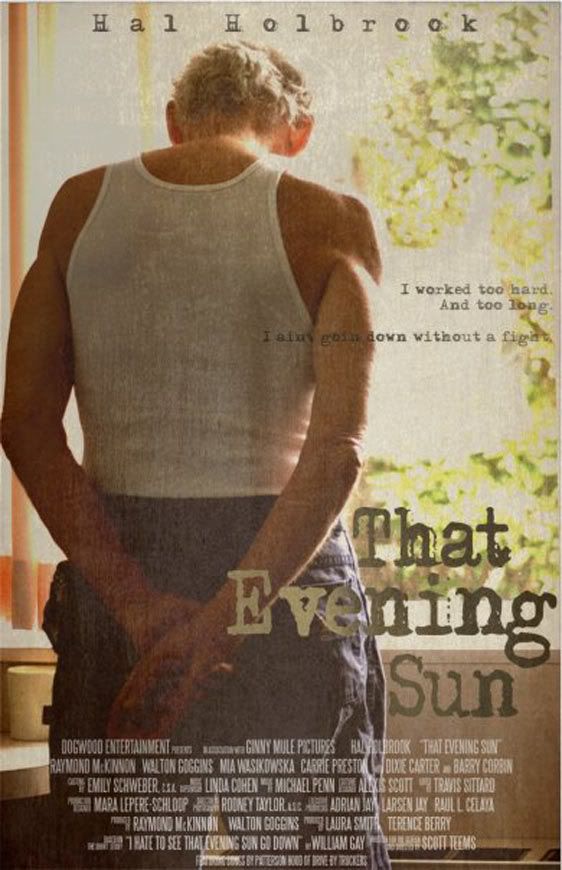
That Evening Sun

Photo Sharing and Video Hosting at Photobucket

Encapsulated by an opening shot of the elderly Abner Meecham (Hal Halbrook, one of our finest) gazing at the lush forest greenery surrounding his nursing home, That Evening Sun strikes a careful balance between no-frills naturalism and restrained poeticism. This particular example sees the reflective surface of a window juxtaposing the years of experience apparent in Abner's face with the cyclical timelessness of the natural world (add to that a touch of green-infused envy), one he damn well intends on enjoying again before shuffling off his mortal coil. Fleeing the nursing home and returning to his farm – one he owned and tended for most of his life – Abner finds his home now occupied by Lonzo Choat (Ray McKinnon), the property having been rented out by his son, legal expert and caretaker of his father's estate in the months following the broken hip – now healed – that saw his residential relocation.

As a known alcoholic with an abusive streak, Choat takes an immediate disliking to Abner, and vice-versa. If the emerging plot details sound on paper like the makings of a trite “us versus them” drama, such is a creative rut masterfully avoided by writer/director Scott Teems, who gives each character/performer full room to exist as a mass sum of qualities, many unknown, and through this recognized complexity examines the many social binaries at work – fathers and sons, husbands and wives, the gap of generations – with an assured calmness that allows even the more villainous types their moments of character-defining integrity. Unlike, say, The House of Sand and Fog, which made excuses for Jennifer Connolly's irresponsible homeowner in the name of a phony occupation metaphor, That Evening Sun forgoes absolutisms and sees that opposing interests can both, in fact, be in the right.

Such often feels like a generous stance given Choat's routinely indefensible behavior, one caught up in self-destructive tendencies (drinking, gambling) even as it's driven by a tragically sincere desire to do good and provide for his family (then again, the same can be said about the frightening nature in which he overprotects his daughter). Abner simply wants to enjoy what he worked hard for during his life, during the time he has left, a hard truth lost on his son, who insists – despite overwhelming evidence that Abner can be and is quite self-sufficient – that the nursing home is “the best option” (“For who?”, strikes back Abner, whiplash fast and twice as sharp). One could probably read parallels to current national issues – namely, the effects of the economy and social security on seniors – but the fact is that politics, like the film, are rooted in simple (not simplistic) notions of right and wrong.

Society sees Abner as little more than a nuisance, one that will – quite literally – go away if ignored long enough; such is but one of the necessary troubles of death that lurks in the film (and leave it to the brilliant character embodiment by Holbrook to turn one such outcome into one of the funniest moments of the year). That Abner can sometimes be said to go too far in his anger – really, who can blame him? Like a Greek drama, That Evening Sun is a shifting moral quandary, one in which losses are a given and – if justice should prevail – at best uncompounded. Forget Up in the Air: an incendiary portrait of rotting and displaced values-cum-Rorshach test, That Evening Sun is truly a film for our times.

Directed by: Scott Teems Screenplay by: Scott Teems Starring: Hal Holbrook, Ray McKinnon, Walton Goggins, Mia Wasikowska, Carrie Preston, Barry Corbin, Dixie Carter 2009, PG-13, 110 minutes

This review was originally published at the now-defunct site Gone Cinema Poaching.

Prodigal Sons

Photo Sharing and Video Hosting at Photobucket

Kimberly Reed's no-frills, diary-cum-documentary Prodigal Sons has already been compared to the ultra low-budget sensation Tarnation, and in terms of an autobiographical work crafted less on financial resources than sheer force of will, the parallels being drawn are apt. In terms of blistering emotional incisiveness, however, I was also reminded of Michael Apted's 21 Up, the last of the long-running Up series I've yet seen, and imcompletely at that. The titular age when I attempted to view the film, I found its directness and clarity too much to handle, and, feeling an almost inconceivable level of intimacy – as if God were staring right at me, and only me, from up on high – I decided to return to it at a later time. That was four years ago. Prodigal Sons is a similarly emotional, naked experience, and even sharing little in common with the specific trials of its maker and subjects, the experience it imparts was one difficult to surmount on the part of this viewer.

In an era of pop documentaries that reduce their subjects to gimmicky setups and patronizing lessons (I'm looking at you, Spurlock), Prodigal Sons is a near-profound palate cleanser. Director Kimbery Reed is also among the film's main subjects, she a former resident of Helena, Montana, last known to her friends and neighbors as the popular, high school quarterback Paul. Ten years later, her complete gender transformation seems to have been only half the battle in reconciling the fractures in her identity. Rather easily accepted by the bulk of her family and former classmates (though one senses that ugly, xenophobic encounters may have been deliberately left on the cutting room floor), Kim finds the most difficult person with whom to reconnect is her brother Marc, who maintains something of a grudge in response to both her former popularity as well as her new identity.

Adopted at a young age and the victim of a car crash that saw part of his brain removed, Marc is a tragic outsider not just to his family but to the bulk of humanity, well-meaning in his intentions but prone to violent outbursts and immature sibling rivalry, often falling back on Christian abboration of purported sexual deviance (both Kimbery and their little-seen brother Todd are gay) amongst more general manifestations of his emotional estrangement. The sorrow evoked by his personality disorder and reliance on medication is put to serious tests as his mental stability wanes, repeatedly threatening the safety of his loved ones in a manner that appears entirely out of his control. The sight of Marc's destructive behavior seems less exploitative (during his calmer times, he actively endorses Kim's filmmaking project, even as its most scrutinized subject) than it is not fully explored, but that's small potatoes given how intimate Reed manages to be – and how thoughtfully and patient and balanced at that – under the circumstances. The slightly awkward affectations are more than worth the up-close-and-personal benefits.

That Prodigal Sons shifts from being primarily autobiographical (Kim on Kim) to biographical (Kim on Marc) indeed creates something of a tonal schism, but it's one easily justified considering the overall transparency Reed employs in her construction of the film (rather than shying away after a violent encounter between herself and Marc, we share the deafening solitude as she drives away in the truck that caused the initial dispute), the sum of which qualifies the film as nothing less than a work of profound humanitarian worth. One almost wishes for an Up-like continuation some years down the road. Once again proving the cinematic medium's inherent empathetic power, these are characters that, once known, are difficult to live without.

All of this is to say nothing of Prodigal Sons most eye-opening revelation: that Marc is, in fact, the biological grandson of none other than Orson Welles and Rita Hayworth, a discovery that sadly proves less beneficial to the ailing Marc than we'd hope. Such embodies the notion that truth is indeed stranger than fiction, but it also allows for the soul-piercing inclusion of Welles' infamous musical recording of “I know what it means to be young (but you don't know what it means to be old).” Such wisdom is hard-won, and Prodigal Sons earns every ounce of it.

Directed by: Kimberly Reed Starring: Kimberly Reed, Marc McKerrow, Carol McKerrow, Todd McKerrow, Oja Kodar 2008, NR, 86 minutes

This review was originally published at the now-defunct site Gone Cinema Poaching.

Sweetgrass

Photo Sharing and Video Hosting at Photobucket
A borderline great film for the bulk of its length, Sweetgrass tragically falters for one very awkward portion that begins just after mid-point. It's sad how easy it is to fall from creative rapture, but let's forget that hurdle for now, as it can be addressed later. In a way flawless, Sweetgrass (named after one of the counties in which it was shot) suggests the opening chapter of 2001 by way of Au hasard Balthazar, watching with a dramatically-attuned documentary eye the final sheep herding through the Beartooth mountains of Montana in 2003. An opening shot in which a feeding sheep seemingly breaks the fourth wall (or does it?) is more alien than a combined half of Avatar, and with this movie we are forced to see the animals not as a product, but also, and firstly, as living creatures.

Modest in both its general premise and formal audaciousness, Sweetgrass's pleasures derive primarily from the rarely not breathtaking imagery abound in the Montana landscape, as well as a cinematic flair achieved via carefully selected off-the-cuff viewing angles. We see the chores, the feeding and herding methods, the daily routines, but the tendency to linger on the margins is one more revealing in whole than in part, documenting not just the processes but the larger behaviors on display. As both individuals and groups, the human and sheep are seen in a Godlike larger context (quite literally in a latter-end highlight) in which function, capabilities, and overwhelming limitations are seen with a nearly scientific clarity.

Where Sweetgrass falters, then, is in its inclusion of the humans, the cowboys and cowgirls driving the herd day in and out. At first caught only on the periphery of the action, the workers eventually cease to be observed subjects and begin, disastrously, monologuing to each other and to the camera like deer caught in the headlights of an impromptu Morgan Spurlock interrogation. The movie magic is killed, suffice to say, when this level quasi-direct interaction is introduced into what was otherwise a beautifully orchestrated web of love, death, and survival instincts, the basic components of life in this stripped-down vision.

Overall, this point of focus is a relatively minor one, but like falling into a gopher hole whilst running and breaking something in the process, it's a major misstep and an experience that takes time to recover from. The camera needs to be far off and out of the way to tell this story, and we should be thankful that the filmmakers (Ilisa Barbash and Lucien Castaing-Taylor are the uncredited directors) knew this for what feels like approximately 85% of the time.

A film of broad themes and big questions, Sweetgrass is largely calm and tonally assured tone poem that manages to nevertheless be populated by a number of nearly self-contained high points, increases and decreases in mood that suggest – and often parallel – natural shifts in the environment, implying a Herzogian understanding of the Earth itself as a single organism populated by countless smaller lifeforms. Two singularly great sequences come to mind here, the rest less easy to describe in words and better enjoyed onscreen for it. The first is the feeding drive, shout out the rear of the vehicle, which turns into a jaw-droppingly epic foreshadowing of the much-seen fact that you really do need a whole mountain to move these creatures on (or, at the least, shut down traffic on main street). The second is the aforementioned literal Gods-eye-view shot, coming during a point in which a cowboy, unprompted by the filmmakers (they must know they're being shot so “candid” doesn't quite apply), quite literally loses it at a moment of extreme disparity. Both here and in whole, Sweetgrass succeeds in the difficult-but-necessary task of examining small things to find great ones.

Directed by: Ilisa Barbash, Lucien Castaing-Taylor 2009, NR, 101 minutes

This review was originally published at the now-defunct site Gone Cinema Poaching.

Jul 17, 2010

Inception

Photo Sharing and Video Hosting at Photobucket

Christopher Nolan's filmmaking at once evolves and regresses with Inception, a theoretically impressive, purportedly mindbending undertaking that unfortunately remains surface-bound in its chosen philosophical considerations. Not entirely unlike the justified non-subtlety of The Dark Knight (in which every boiled-over emotion and exaggerated thematic exposition functioned as part of an often-exquisite metaphorical examination of crumbling morality), Inception approaches its dreamworld landscapes with the apparent assumption that we, the audience, will require constant SparkNotes updates to remain in the know on what's transpiring moment to moment. Inception lacks a beating heart to ground its conceptually loaded proceedings with something more than sometimes-cool noirish imagery. Nolan's technical expertise is a given, but for as viscerally enthralling as his films often are, they can just as easily slip into the realm of the impersonal affectations. By taking unnecessarily painstaking efforts to reiterate its labyrinthine sci-fi rules and psychological mumbo jumbo ad nausea, Inception nearly gorges itself to death on its own ambitions.

More than those of any other Nolan film, Inception's characters tend to function less like actual people than as ciphers for overwrought screenwriting, so while the cast entire stands as more than capable (DiCaprio seems to have walked right off the set of Shutter Island with but a few tweaks of character needed), one can't escape the saddening impression that they're little more than non-playable characters in a big screen videogame. The storytelling here wouldn't be out of place in Halo or Resident Evil, and while the resultant hand-holding is less outright condescending than it is narratively tiresome, it nevertheless exacerbates what is otherwise an intellectual and visceral slog punctuated only sporadically by bits of nifty storytelling and the occasional moment of eye-popping imagery. Trying his hand at the sci-fi existentialism genre with nearly unrivaled audacity (The Matrix, Dark City and even 2001 are recalled throughout Inception's hulking mass), Nolan's story concerns professional infiltrators who enter people's minds through their dreams so as to steal ("extraction") or plant ("inception") ideas, the latter being far more challenging. Briefly recalling Inland Empire, these dreamscapes give way to deeper levels of subconsciousness, but look for no rabbits here: accurately reflective of dreams or not, Inception is essentially about psychological manipulation via your own cranially implanted videogame.

When it comes to stealing ideas, corporate agent Cobb (Leonardo DiCaprio) is the best of his kind, a skill learned in part through a deep personal loss he once endured as a byproduct of such unnatural dream meanderings. The results of that tragedy now drive his efforts to plant (incept?) an anti-monopolistic motive in the head of a young business titan (Cillian Murphy), the success of which will earn his freedom to return to the life he once knew. As a character study, Inception flounders, and while its spectacle-heavy slant sometimes yields mind-blowing effects, the overwhelming effect is that of misdirected energy and lost potential. Occasionally, such as during the film's centerpiece heist sequence (a bold storytelling juggling act that revolves around a vehicle's time in freefall), Inception's many parts cohere into something both viscerally and intellectually intoxicating (the most intriguing moments concern Joseph-Gordon Levitt's attempts to induce gravity in a zero gravity environment).

Alas, the effect is enthralling in the moment but more so does it illuminate the frustratingly schematic storytelling otherwise being employed. For a film about dreams, Nolan's images play it relatively safe, avoiding surrealism like the plague and frequently neutering any accruing sense of visual wonder (an invocation of M.C. Escher's "Ascending and Descending" turns sour when the visual trick is rendered obvious for the sake of the literal-minded groundlings in the audience), while the seemingly endless scientific exposition amounts to little more than high-minded, metaphysical heavy lifting wanting for a more fitting emotional context in which to flourish. Certainly admirable for its ambition alone, Inception nevertheless only goes halfway in its aspirations of greatness, the successes routinely, tragically undercut by misguided and unnecessarily overt attempts at narrative clarity. Dead weight and needless redundancy plummets the proceedings; Nolan should've expected a bigger leap of faith from his audience.

Directed by: Christopher Nolan Screenplay by: Christopher Nolan Starring: Leonardo DiCaprio, Joseph Gordon-Levitt, Ellen Page, Tom Hardy, Ken Watanabe, Dileep Rao, Cillian Murphy, Tom Berenger, Marion Cotillard, Pete Postlethwaite, Michael Caine 2010, PG-13, 148 minutes