Showing posts with label youtube. Show all posts

Apr 8, 2013

Roger Ebert, 1942 - 2013

There isn't much I can say that hadn't already been repeated a thousandfold by this past Thursday evening. Roger was a mentor, a poet, and even though I never met or corresponded with him directly, a friend. His death comes at a crossroads in my own life and will likely be of greater influence than many live relationships I've had or will have. My first conscious awareness of Roger's presence in the world was through the Microsoft Cinemania program, and I'm grateful to have known his work and his writing as long as I have. Few others have eased the burden of existence so readily. His is a void that will never be filled; the example he gave us as a compassionate, worldly and humble man is such that it never has to be.

You will be missed.


Feb 10, 2013

Freebie Flicks: RMS Titanic Edition

In Nacht und Eis (In Night and Ice, 1912)


Atlantis (1913)


Atlantic (1929)


Titanic (1943); if you download the file, you can use these subtitles.


1958's A Night to Remember (embedding disabled).

And James Cameron's Ghosts of the Abyss, a film I cannot recommend but for the extraordinary footage it includes of the wreck. If this silly documentary ditched Bill Paxton and so much of its excessively imposed "narrative," it could've been tremendous, but silver linings notwithstanding, it's easily the weakest effort in Cameron's body of work.

Feb 3, 2013

Freebie Flicks: Jerry Maquire (1996)


The related portion of this video starts at the 2:45 mark.


Happy Superb Owl!

(With acknowledgement of the artwork of Takeshita Kenji.)

Jan 31, 2013

Freebie Flicks: Oscar Edition

Apologies for the sparse updates these past few weeks; while I've been busy at work on the blog, it's been less in the way of new content than on the exhaustive effort required to properly format and organize almost seven years' worth of material, plenty to bite off and slow to chew. In exchange for my absence, I offer five Best Picture winners* currently available on YouTube. (KeepVid dot com will allow you to download most of these in HD.)


*Named such in the obsolete category "Unique and Artistic Production," which I'm exploiting here because this remains arguably the greatest film to ever win either award.


Jan 14, 2013

Freebie Flicks: College (1927)


Because it fits my mood today, particularly the final thirty seconds. And don't be a moron and just watch the final thirty seconds if you haven't seen the movie before. KeepVid dot com for the download.

Jan 11, 2013

Freebie Flicks: Cronenberg Double Feature (& Bonus)

As I type this, I've been awake for 19 hours straight with no end of the tunnel in sight. This stretch has so far included two work shifts and one opening night viewing (wide release) of Zero Dark Thirty, and as a break, I'm posting some more free movies. Here are two very different, very important (are there any other kind?) David Cronenberg films, Scanners and Spider (the latter of which I was privileged to write some words about here), as well as the YouTube rip of his commentary track for The Fly. If you love film, maybe not even that one in particular, I'd say it's absolutely worth a listen, as you'll probably learn things you never thought of. In case you don't know this valuable resource, KeepVid.com will allow you to download these and many other online videos as any number of file types. Enjoy.


Jan 9, 2013

Freebie Flick: Videodrome (1983)


I've found myself on a Cronenberg kick recently, what with the DVD/Blu-ray release of Cosmopolis and my long-overdue acquisition of A Dangerous Method as a Christmas present (to me, from me). In perusing YouTube for some of my blind spots within his filmography, I found a surprising wealth of his films available there, and so will be having something of an anti-Oscar Cronenberg series here for the next week or two. First up, his masterpiece Videodrome. Check out KeepVid to download the file.

Jan 5, 2013

Freebie Flick: Fury (1936)


Having finally put down some of my thoughts on Lincoln, I'm feeling more politically charged than usual, so today's free movie is Fritz Lang's Fury, the director's first American film and one of my favorites of the 1930s. Don't forget to visit KeepVid to download the files for your personal viewing pleasure. I also personally recommend the VLC media player for smooth playback, especially with multi-part film downloads.


Jan 3, 2013

Freebie Flick: The Texas Chainsaw Massacre (1974)


Why pay cash money to see a retread that's probably terrible* when the classic that spawned it is readily available for home viewing? In this case, for free. (And if you go to a web site called KeepVid, you can download most any online video in almost any format for easy storage and transportation elsewhere.) Stay tuned for more free stuff, some of it timely, some random, all aspiring to awesomeness.

*If, in fact, Texas Chainsaw 3D turns out to not be garbage, I'll happily announce such. I'm always glad to be wrong when it means there's a good film to be had. I'm looking forward to the reviews, but otherwise, I'm happily protective of my preciously finite legal tender.

Nov 26, 2012

Politics, when the lights go down

Those who know me well can confirm that I'm by nature averse to conflict, and if I had to make a list of my biggest character flaws, it would be a guaranteed contender for number one. It's a reflex that roots itself in all manner of circumstance to nearly equal disastrous effect. Trying to look inside oneself and discover where one's behavioral traits come from is to get lost in the vortex of memories, nurture, and nature, and more, and through much I've learned (mostly recently, and perhaps only through negative reinforcement) that too much self-awareness is usually a bad thing and the only way to progress, sometimes, is to do exactly what you absolutely do not want to do, however you were raised be damned. Passive aggression is like a bad drug from which one only experiences withdrawal, and in my life experience, the majority of the people who are victim to it are the ones who needn't be so apologetic in the first place. Simply put, we're too fucking nice, which has a way of being cruel in the long run. I've a ways to go yet as far as my own standards and expectations are concerned, but it's already been a most empowering thing to kick obsessive self-effation to the curb.


Which is a very long-winded way of introducing the topic of dealing with rude people in movie theaters. These kinds of folks weren't unbeknownst to me growing up, when I certainly went to the movies less but still with regular frequency, but as of late (say, the past three or four years) has been reaching nearly epidemic levels. There remains guilt for a few of my offenses: the cell phone I forgot to turn off before The King's Speech, the outward mocking of films I felt deserved such intrusions, etc. Although I'm not yet old enough to be considered a worthy applicant for the title of Film Critic by a certain New York writer who himself aspires to the rank of the gadfly, I feel much older, and yet my eyes are open and I cannot simply chalk this up to the younger generations, although a significant chunk of the pie chart they almost certainly compromise.

Need I even mention the rise of cell phones, what with those evil little screens popping up during everything from Skyfall to the one-day rerelease of The Godfather. I can't pretend to have been perfect in this, or nearly any other, regard, but I make it a point to either step out if my phone beckons or reach far enough under an adjacent seat so as to extinguish the glow from patrons behind me, even if it's just a matter of checking the time. Lax theater owners who tolerate this nonsense because, well, they depend on priveledged (or financially shortsighted) kids to pay the bills and haven't thus far minded (or minded enough) their scaring away of other demographics should also be held accountable. I'm not intending on exploring this topic for ultimate causes and solutions; I'm just trying to justify the broad conclusion that there seem to be more assholes in the world now than a few years ago without seeming like one myself.

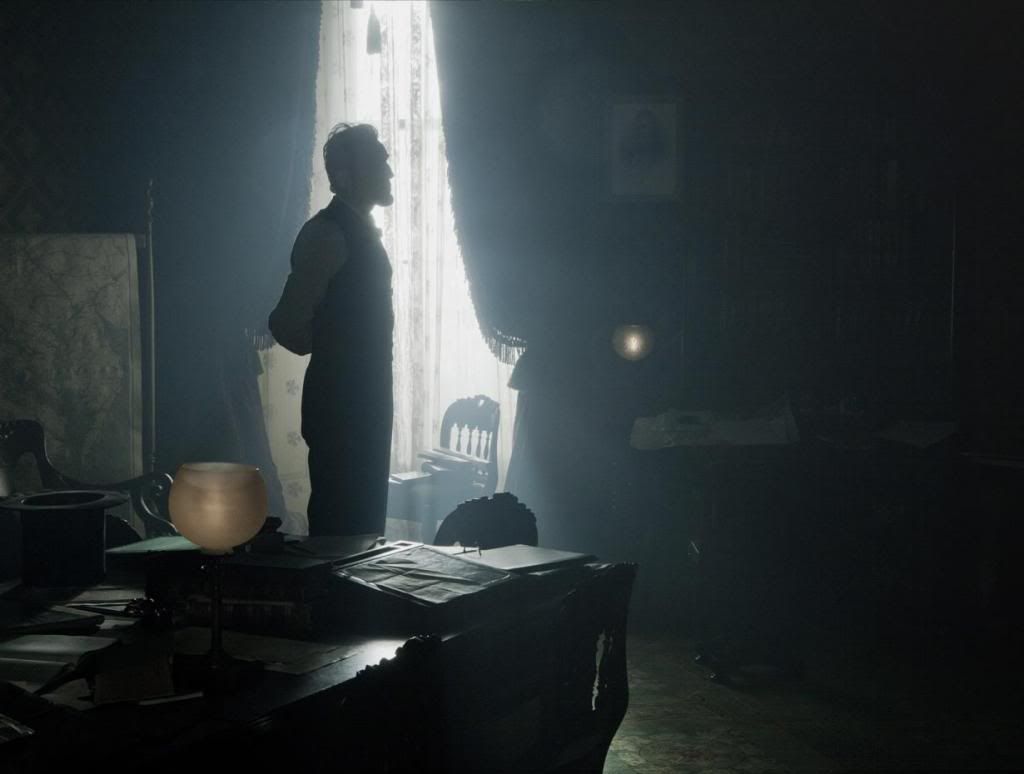
The latest example of this rampant assholism came this past Saturday evening at a 10:20 pm showing of Lincoln, my second time seeing the film, currently in the running as my favorite in a very competitive year. My brother Alex, who had not seen it yet, was along for the ride. For whatever reason, I was not excessively bothered by the frequent, semi-hushed chatters taking place a row down from us on the opposite side of the moderately sized theater, but I was rather persistently aware of them (and they effect they were having on my brother) enough to both regret not saying anything about it up front and appreciate the theater employee who came in to re-announce the no cell phone/talking policy about halfway through the film, with reassurance that offenders would be escorted out. For most of the rest of the duration of the film, they as-of-yet-unseen offenders stayed within the lines of acceptable theater behavior. Most.


As I've discussed in the past, the end of a movie is usually the best part, or most important, and especially so in a good one, and the final five or six minutes of Lincoln is already very close to my heart. And so it was with volcanic heat that my rage escalated as the same pair of ignoramuses began talking, quite constantly and almost casually and with no awareness or consideration of their surroundings whatsoever during those final five or six minutes, and during which time my brother was noticably distracted. When the film was over and the credits were rolling, we looked at each other, and then at them, like velociraptors might silently communicate whilst planning an attack. What follows is a recreation of the exchange that followed. As you read this, imagine the offenders in question as pudgy forty or fiftysomethings who might give Hobbits a bad name by mere association (the lights were still dimmed so I didn't get a closer reading on their features). Minus my initiating comments and the small chorus of praise, this series of events was relayed to me by my brother, though I overheard bits and pieces.
Me (across about fifteen feet and so the bulk of the auditorium could hear): Next time stay at home in front of the stupid box if you can't keep you mouth shut.

Several other people throughout the theater: Agreed! Yes! Thank you!

Male sub-Hobbit: Fuck you. (Or some derivative.)

Alex: Excuse me?

Male sub-Hobbit: You're excused.

Alex: No, excuse me, because I'm his brother and I feel the same way.

Male sub-Hobbit: You probably voted for Obama.
I suppose it bears mentioning that, while typing this at the public library, someone's cell phone not only went off, but they answered it, with zero response from the librarians on duty, despite it being expressly forbidden. Like the three offenders at a recent screening of Trouble with the Curve, this person was also elderly. This reinforces my developing thesis that perhaps it isn't just a greater abundance of assholes, but the greater tolerance of their behavior. I'm very much liberal (go figure), and usually willing to give people the benefit of the doubt and second and third chances and whatnot, but this is not a step in the right direction.

I'm don't even want to begin unpacking the brainless political jab this doofus managed to come up with (see the Season 1 episode of Louie, "Bully," for a similarly simpleminded partisan association), as I'll have to first get into the disgrace that is our current two party system before all manner of basic courteosy and etiquette that should smack of common sense to, I hope, the majority of people reading this. The fact that this absurd exchange took place during a film about a master of public and political relations underscores a certain elegant brutality in the whole affair.

The conscious effort to engage conflict has been a positive force in my life of late, although not always. A close friend of mine who thought I wouldn't mind her friends talking during a late-night showing of Dracula (a movie I'm not even particularly fond of) was taken aback when I essentially lost it after the screening (I'm amazed I didn't swear, although I did say that I wanted to - not that I would - punch the primary offender in the mouth), the experience not much aided by the fact that I loathed her best friend from the first time I met her and thus found her infantile quips and impatient foot tapping and scab-picking all the more infuriating for interrupting a movie that depends on silence to work at all. Similarly, I probably overreacted when I yelled at the young girl (and her enabling mother) who was on her cell phone throughout, and then constantly during the last few minutes, of Titanic (which I'd never seen theatrically before its 3D re-release), or the enabling father who allowed his daughter to use her phone throughout most of The Wizard of Oz, etc. But I remain convinced it's better than not reacting at all.


Mar 28, 2012

Cage Aeterna


And if my love for this man's brand of overexertion isn't clear enough already, know that he's on my shortlist for 2012's Best Actor in a Leading Role.

Jul 20, 2011

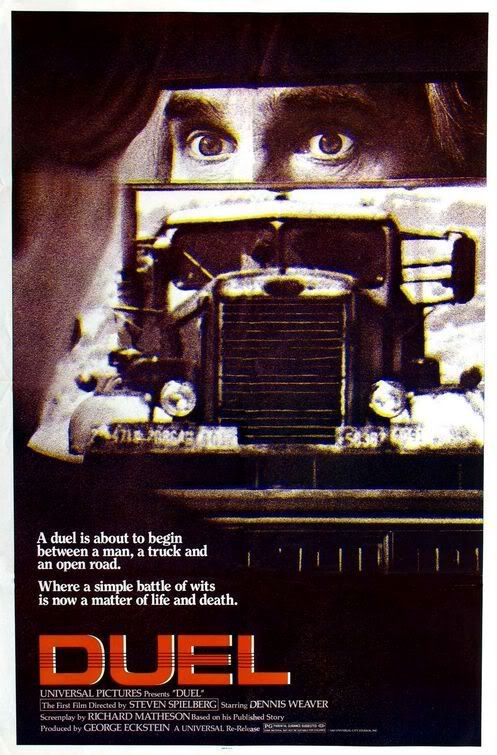
Duel (1971): B+

As the cinematic debut of Steven Spielberg (even though it was originally produced as a TV movie, this is as much of a movie as any), Duel has some undoubtedly big shoes to fill, and that's the case whether you think Spielberg is infallible or intolerable. Possibly you're aware that I'm much closer to the former camp, and if there's one thing that keeps me from loving Duel entirely, it's the knowledge that Spielberg would only improve (for many filmmakers, it would be an easy career high). On its own, it's a startlingly pure, assured piece of psychological horror indicative of a major talent with an instinctive approach to subjectivity. Adapted by Richard Matheson from his own short story, it was successful enough on television to get a theatrical re-release years later, and as a result, two primary cuts of the film exist: the 74-minute theatrical cut, and the 90-minute cut expanded for theaters (the only version I've seen, an oversight I intend to correct), and available more or less intact on DVD (some shots and voice over lines have been removed). My feelings about the film haven't changed over the years; even seeing it in theaters, there remained some pacing issues, which isn't entirely unexpected when a filmmaker - especially a young one - tackles a project of such daunting conceptual limitations (hell, even a veteran Michael Mann could only come up with so many in-vehicle camera angles in Collateral). The main (and in most ways only) character here is one David Mann (Dennis Weaver, a superior everyman), who is traveling in his Plymouth through desert country on a business trip; a tanker truck on the rode first annoys, then obstructs, then attempts to kill him, beyond any reasonable doubt. We (the audience) catch an insubstantial glimpse of the would-be killer at least once, but Mann remains entirely in the dark as to the face of his predator. One of the more nail-biting features of the latter 20th Century; it just grazes the edge of existentialism. Seen in his filmography, the film's rusted, growling tanker truck is an obvious predecessor to the man-eating Great White of Jaws, sharing in its pitilessness. And it's every bit as terrifying.

Jun 4, 2011

Viewing Log #9

Photo Sharing and Video Hosting at Photobucket
The Tree of Life is only Terrence Malick's fifth film, and while it's easily his most prone to creative - nay, intergalactic - tangents, it may also be simultaneously his most earthbound. The rumblings of a gestating universe existentially contextualize the central human drama like no other film has managed since Stanley Kubrick's cosmic 2001 (whose special effects mastermind Douglas Trumball was sought out for equally impressive work here), but Malick finds equal levels of beauty and awe in all creation: The birth of the stars, of life, of a child. 1950s Waco, Texas - Malick's hometown - is the deeply personal primary setting, home to the O'Briens (Brad Pitt, never better, and the mesmeric Jessica Chastain) and their three boys. Father and mother's opposing parenting methods emerge as less than mere human traits than conflicting instincts passed on from the primordial era (a brief dinosaur interlude goes beyond mere anthropomorphism to suggest something outside of our human capability of understanding), desires and weaknesses that will dog us until the end of time (yes, the film goes there, too, or at the least, someplace like it). It's as concerned with the eternal and intangible as it is with the sensuous and the small, hopscotching through the years (suggesting equal parts memories and present tense) in a sumptuous fantasia of life, death and the interim, utterly unconcerned with basic narrative formalities as it explodes off the screen with expressionistic euphoria. It reminds one of the vividness life held in youth, and it may very well go down as one of the great works of human art. [2011, A]


I saw Beginners the same day as The Tree of Life, and those nearly back-to-back experiences drew out numerous parallels between the two (the least of which is their likely inadvertent hat-tipping to shared cast members from Inglourious Basterds). Writer/director Mike Mills engages the ambiguous and contradictory building blocks of human existence with wisdom, wit and thoughtful humility. Ewan McGregor is Oliver, a pushing-middle-age artist whose yearn to love is outweighed by his fear of loss, not to mention the near emotional train wrecks he's been subjected to by his distinctly odd but well-meaning parents. After decades of marriage parted in death, his now single, 75-year-old father (Christopher Plummer) comes out; at the start of the film, we've learned he dies from cancer only four years later. The mourning present sees Oliver with the dreamy Anna (Mélanie Laurent), an actress similarly trapped by her own personality conflicts, but Beginners frequently, exquisitely moves back and forth in time, simulating the lasting effects of emotional trauma and the messy experiences that define life, often simulated via jarring, spare visuals, or deceptively cute devices (the talking dog subtitles are brilliant). The worst that can be said of it is that its view of the big picture borders on the overly self-aware; better to call it an audaciously tragicomic high wire act of the human spirit. [2010, A-]


I'm embarrassed to admit I've never read Charlotte Brontë's Jane Eyre, and so approached this latest film adaptation ignorant to all but the broadest sense of what material was to be covered. Suffice to say that Mia Wasikowska, who holds the title part, has quickly ascended from promising young actress to the full-fledged career she so rightly deserves; let's pray she keeps it going. Playwright and screenwriter Moira Buffini distills the narrative complexity of the novel into something only relatively formulaic; the drama ultimately pivots on a romantic triangle of sorts, but sophomore filmmaker Cary Fukunaga (after his debut Sin Nombre) directs with such assured, effortless poeticism that the narrative can't help but reflect the rich textures of its characters - ambiguous, wrenching, commanding. Michael Fassbender is unsurprisingly prodigious. Heartaching and heartbreaking, and resolute in its even-keeled feminism. If Oscar has any shame (which remains highly debatable), both leads will be in the running for nominations come next year. Prove me wrong. [2011, B+]


It's easy to see why The Red Shoes is a beloved classic. The Hans Christian Andersen fairy tale - in which a girl dons the titular footwear and proceeds to dance her life away, powerless to resist their magical urge - here inspires a story-within-a-story of delectably paralleling themes. "Why do you want to dance?" asks the talented but conceited instructor Lermontov (Anton Walbrook) of the passionate Vicky Page (Moira Shearer). To which she thoughtfully posits, "Why do you want to live?" The tension between creation and love (and those who feel personal desires must be mutually exclusive) fuels the romance-laden story, but it's Powell and Pressburger's typically ravishing use of technicolor that gives the film its acutely passionate edge, particularly in an extended, dreamlike sequence showcasing the the titular play. Deeper the layers go, forever. Pure cinema. [1948, A-]


I grew up with The Wizard of Oz, back when I consider even average TV to have been somewhat special and something could only play once a year (at least, other than the Superbowl). I liked it plenty then, but a recent 35 mm screening (thanks a lot, dadwhodoesnttellhisdaughtertoputhercellphoneaway) let about ten years added life experience enjoy it again, for the first time in its gloriously intended format, with a receptive audience no less. What boldness this film is - I really should read the book(s) - and what passion has been committed to it on every single creative level (we wouldn't believe in it if they didn't). It's telling how fully it's been absorbed by popular culture, and it's somewhat hard to imagine there ever being a time it didn't exist. It's pure life - nothing less than an life-affirming echo from the hall of mankind's eternal soul. Go, and follow the yellow brick road. [1939, A]


If I was forced to choose a favorite between Night of the Living Dead and Day of the Dead at gunpoint, I could very well be shot for lack of spontaneity. That's how much I love this somber consideration of the end of days - when the surviving people of earth could well be in only the dozens and surviving day to day is the best that can be hoped for. George Romero's once extensive vision, reduced by budget cuts (and a refusal to cater to the MPAA), remains of the emotionally epic sort - it's one of the greatest episodes never made for The Twilight Zone, in color and feature length. Judgment day has come and passed (the dead walk the earth in the millions, approximately 400,000 to every living human). Thematically, it's probably his most direct film (Dawn of the Dead is brilliant but it retains a metaphoric distance throughout) as it stares deep into the heart of darkness at man's core, but it also remains (not at all paradoxically) a work of incredible hope. The arch performances aren't just learned descendants of 50s B-horror, but serious considerations on how people handle (or don't) the end of the world as we know it. The zombies aren't just metaphors anymore: They are us, (un)living manifestations of our sins come back to haunt us, and Romero's consideration of the human condition transcends the (brilliantly violent) genre thrills to great cinema art. The director's favorite of his zombie trilogy is an unrecognized masterpiece. [1985, Rating: A]


Not only is there too much time dedicated to the relatively boring human protagonists of Invasion of Astro-Monster (something even fans of the Godzilla series are used to), but there's also far too little of the skyscraper-sized monsters to possibly justify the whole of the proceedings. This sixth film to feature the giant lizard (and fifth to be helmed by the original director Ishirō Honda) is one of the least of the early entries, investing entirely too much in a predictable twist (even for kids, for chrissakes) in a story concerning purportedly peaceful aliens wanting to "borrow" Godzilla and Rodan. There's next to none of the cheeky fun that typically sustains these movies when the rubber suit clad actors aren't slugging it out; the actors phone it in. The lip flapping English of the American version is only negligibly more entertaining. [1965, C]


Photo Sharing and Video Hosting at Photobucket

May 27, 2011

Viewing Log #8


The Hangover: Part II (Todd Phillips, 2011). Well, it's better than the first one, but that's not saying a whole lot in my book. The original formula is replicated here almost verbatim, the events transpiring a few years later and shuffled over from Las Vegas to Bangkok; The Wolfpack aims to celebrate the impending marriage of one of their members and agree to one beachside beverage on the eve's eve. Flash forward to morning, and their whereabouts are unknown, bodily alteration(s) have been experienced, untold substances have been consumed, and a chain smoking monkey now tags along. This time, the tone is more assured, the jokes are better, and the actors wring that much more from their respective character personalities (I'm calling it here: within three years, we'll be seeing Zach Galifianakis' own Alan movie). Best of all, the lynchpin twist xeroxed from the first movie - where is their missing friend? - isn't so transparent as to be called in the first fifteen minutes. It still doesn't tickle my funny bone that much, but the first film's unchecked homophobia is nicely countered here - maybe every wild party boy has a deep-seeded inner queer - and it's hard to rag on any film that wittily shout outs to the birth place of yours truly, Allentown. [Rating: B-]


Bridesmaids (Paul Feig, 2011). In essence: great character, great actress, good movie. The label is Apatow but the trademark raunch plays second, maybe third fiddle to a thoughtful examination of personality conflict, easily the most substantive and irony-free yet in this line of comedies (okay, maybe not more than Superbad). Kristen Wiig is Annie, a middle class woman seemingly cursed to be single (says the movie, it's really all in her head), suddenly thrown in the spotlight as her best friend's Maid of Honor, a role coveted by another close friend with more than a little money and social status to throw around for extravagant presents and wedding favors. If most comedies of this breed are extroverted, this one looks inward, and it's actually when the dial goes to eleven (read: food poisoning scene) that Bridesmaids works the least. Wiig's performance will join the many great comedic thespians to have gone unnoticed at the end of the year. Paul Feig - directing regular on The Office and numerous other series - does his best to leave the stage to the performers, but one imagines that a little more visual spark is all that's keeping this one from greatness. [Rating: B]


The Evil Dead (Sam Raimi, 1981). Nearly thirty years of subsequent horror offerings haven't dimmed the impact of Sam Raimi's feature debut, the ne plus ultra of the Kids Stuck In the Woods genre. The film commits entirely to both the terrible and the hilarious, the result an awe-inspiring genre tightrope walk in which barely restrained laughter punctuates the inevitable one-by-one possession of our protagonists - college kids spending a getaway weekend at a rented-out shithole in the middle of nowhere - by the demonic spirits unwittingly released from their ancient slumber and now assaulting them from all sides. Scraped-together low budgetry rarely feels as artful even if there's little in the way of subtext going on here, although one can easily read the film as a loving ode to splatterfests of past. Bruce Campbell's starmaking turn invites both cheers and pity, but it's Raimi's keen eye (and ear) for audiovisual intoxication - best exemplified by some of the most absurdly, wonderfully protracted death scenes of all time - that makes this creeper a home run. [Rating: A-]


Cave of Forgotten Dreams (Werner Herzog, 2010). Leave it to cinema's greatest living spirit to give the 3D format its first legitimately artistic live action implementation (admittedly, considering Avatar live action is generous at times). Having been granted special permission from the French minister of culture to film inside Chauvet Cave - site to the oldest known human paintings, dating back some 30,000 years, discovered in 1994 and now forbidden to all but a few researchers - the German director thought the format appropriate for capturing the contours of the cave (that's a bingo!), elements embraced by the prehistoric artists in their depictions of themselves and animals on the astonishingly well-preserved walls. Ultimately, the film is as much about its subjects as its own making. Confined to specially installed, two-foot wide walkways and granted only 24 hours of time inside the cave over six days, Herzog and his crew of three rarely have enough room to get out of the shot; all the better to experience the time travel-like mystique of the cave with them. Pontificating all manner of anthropological significance at least as much as he spends lingering on the beautiful Chauvet images, Herzog suggests that this site might be the birthplace of the human soul. It may not be the masterpiece I'd hoped for, but we're lucky to have it. [Rating: B+]

May 7, 2011

Viewing Log #7


Certified Copy (Abbas Kiarostami, 2010). As intoxicating, seductive and sensual as it is mysterious and elusive, Certified Copy is that rare gem that confirms film's capability of magic. This is some meta-level narrative tinkering going on here, and though I'm certain that repeated viewings will clarify certain aspects as much as they might further blur their borders, even on first encounter, it's so absorbing a work of such obvious mastery on all levels that one comes away immediately certain that the medium has just clicked up another notch. Forget a plot explanation, which would be especially frivolous in this case; it's an emotional song, a pastiche of dynamic feelings and relationships (the characters, the filmmaker, the audience) so quixotic that trying to pin it down would be downright distasteful. Juliette Binoche's performance is possibly the best in a prodigious career. Add this one to your desert island list. [Rating: A]


Even the Rain (Icíar Bollaín, 2010). Yeah, sure, it's kind of obvious in theme, but there struck me as being more than enough feeling and sincerity present in Paul Laverty's script to circumvent a potentially problematic self-aware structure (it's a movie about power relations that's also about a movie about power relations). Appropriately dedicated to Howard Zinn, the film wears its liberal virtues on its sleeves and never condescends, even if it hand-holds just a bit. Its biggest strengths lie in its characters, which are believably dynamic and more than just mouthpieces, which seems harder and harder to come by these days. Arthouse for the NPR crowd. [Rating: B]


Source Code (Duncan Jones, 2011). Moon was the first movie I ever watched on Blu-ray, and it was glorious in all the non-technical ways, too. That film's dreamy Kubrickian tone is replaced by crackerjack glee in Jones' directorial follow-up Source Code, which tackles an initially routine Groundhog Day by The Matrix scenario with wit, intelligence, tangible empathy and just a dash of irreverence (and a very, very cute Michelle Monaghan). Jake Gyllenhaal (finally returning to the thoughtful sci-fi genre) is a soldier in a virtual reality simulation program in which he must find an enemy bomber fast enough that said enemy can be thwarted in reality, where he is expected to strike again. The simulation lasts eight minutes, and at the end of every eight minutes, he blows up. To divulge more would be cruel, except to say that the movie doesn't pull its punches, which are deep and lead to a sly kind of nirvana; what we ultimately see may not be as simple as it at first seems. [Rating: B+]


American: The Bill Hicks Story (Matt Harlock, Paul Thomas, 2009). Gracefully walking the line between fan-friendly greatest hits package and newcomer-friendly biopic, The Bill Hicks Story is a sufficient condensation of the rich, albeit short career and life of one of the great comedians of recent decades. A fan of Hicks' comedy since freshman year in college, I was ready to slam a film that didn't do him justice, which is not to say hero worship was on my list of desirables, either. Less about the man than the man's journey, American is made with obvious love for the late comedian, but also honesty about his choices, detailing the man's drug and alcohol addictions with a stern matter-of-factness that neither condemns nor approves. (Speaking as a fan, his staunch defense of smoking - he died of cancer - is particularly irksome.) His material - subversive, angry, hopeful, sometimes conflicting but always empowered and empowering - is presented in concentrated dashes, and serves as an excellent sampler package of some of his best material (a favorite: his demonstration of the ultimate commercial). Interviews and animations - often in the form of photographs digitally manipulated in a fashion that's cute without being syrupy or overwhelming - make up the majority of the film, which proves visually engaging and distinctive without demanding much of the eyes. If anything, the film could be longer, but perhaps such abruptness is appropriate for a film about a landmark life cut short. [Rating: B+]


May 4, 2011

Viewing Log #6


Sucker Punch (Zack Snyder, 2011). Erupting from its creator's psyche with a volcanic intensity, Sucker Punch marks the first time Zack Snyder has directed an original script of his own creation, a fact that, while revealing/clarifying certain weaknesses of his craft as evident until now, also frees him to indulge his passions like never before. The results prove strangely intoxicating. Though juvenile it certainly is, this mishmash of elements from fanboy culture (fetishized warrior chicks, dragons, weapon-wielding robots, Nazi zombies, and a samurai warrior with a Gatling gun, among others) comes out far enough on the side of the deranged and operatic to not achieve some kind of brilliance. Sucker Punch articulates itself with a necessary sense of satiric subversion to counteract the didactic caricatures, and while Snyder's tale of one Baby Doll might not have much of a clue about what makes real women tick, its multiple reality constructions are far more tingling than Inception's wannabe mindfuck. The soundtrack synchronization is almost eerily perfect, and it's only grown in my mind since. [Rating: B+]


Meek's Cutoff (Kelly Reichardt, 2010). This follow-up to the heartbreaking serenity of Wendy and Lucy finds the indie director reaching for something similarly as intangible as that film's appreciation of resolute, silent determination in the face of worldly apathy. Michelle Williams returns as Emily Tetherow, one member of a three-family pioneer team heading west on the 1845 Oregon Trail, the titular Stephen Meek the guide they've hired to guide them there. A supposed shortcut proves disastrous, stranding them in unknown territory with little in the way of water or clue, while the catalyst of a captured Native American further divides the increasingly desperate group. Material like this would seemingly invite metaphoric comparisons to recent politics - and there's admittedly something to be said about the correlation between Meek and the bullshit battle plans of Dick Cheney, etc. - but the existential choke hold of Meek's Cutoff (evoked via long takes that emphasize the monotony of these life circumstances and ethereal images of rolling/evaporating cloud formations) more strongly suggests an eternal struggle for survival against unknown natural odds. It seems that the prose of Jack London (specifically the chilling first paragraph of "White Fang") has been effectively translated to film via the sparsity of Reichardt's intensely detailed neo-western. [Rating: B+]


Due Date (Todd Phillips, 2010). (Spoilers) Less obnoxious than Phillips' overrated The Hangover but also distinctly less raucous, this wannabe-raunchy take on the Planes, Trains and Automobiles scenario would likely be a waste of time were it not for the zen presence of a certain Mr. Downey, Jr. As an expecting father en route home as the titular date draws near, his focused businessman Peter Highman runs into a prolonged brouhaha with Zach Galifianakis' aspiring thespian/pothead Ethan Tremblay (warning: that's his stage name). Some amusing bits punctuate the tone-deaf proceedings like actual bits of chicken in Campbell's Chicken Noodle Soup, including a clambake scene set to Pink Floyd that's actually kinda cool. Identity crises ensue, enemies will become friends, and someones ashes will be mistaken for coffee grounds. Hey, it could have been worse. [Rating: C+]


Battles Los Angeles (Jonathan Liebesman, 2011). Veteran movie critic (and my own personal Yoda-like guru) Matt Zoller Seitz calls Battle Los Angeles (advertising material displays a colon in the title, but the title shot in the film hasn't one, so that what I'm going with here) the worst-directed Hollywood film he's ever seen, and he's not being the least bit mean in that assessment. Employing an overzealous shaky-cam aesthetic that makes The Bourne Ultimatum look restrained in comparison, this actioner sees a malevolent alien invasion grip the coastlines of the world, Los Angeles being the lynch pin battlefield to maintain on the North American west coast. It's hard to tell what disappoints more here: how utterly half-assed the visceral quota is (for all the blazing guns and shit blowing up, it's only sporadically thrilling), or how much the script drops the ball on what is, conceptually, a very well-thought-out invasion tactic. Character motivation may as well be lifted from the yellow pages. Michael Bay, show 'em how it's done. [Rating: C-]