Showing posts with label quentin tarantino. Show all posts

Sep 18, 2007

Quentin Tarantino's Death Proof: The Full Cut


A word of warning: do not drive immediately after watching this film. Especially if you're like me, in that you can't miss the transition of a street light from yellow to red by half a second without getting nabbed by the boys in blue. The vehicular thrumming of Death Proof is far too seductive a call to refuse once you're out in the parking lot, and if you're not careful, the pedal's to the metal before you've even realized it. I've done it twice so far.

The same heed goes for this newly released on DVD version of Tarantino's film, here in its original form, uncut and unedited. Make no mistake, this is no "Unrated" DVD in the sense that an extra F bomb and pair of nipples were spliced back into the mix so as to better popular the racks at Best Buy; the 113 minute version of the film is Quentin's original cut, as it existed before the necessary editing that was undertaken to compact the feature for his collaboration with Robert Rodriguez in Grindhouse. I, a fan of alternate versions of films (even when I don't prefer them to the original cut), am grateful it is here for us to see, as the two versions, side by side, offer us more of a window into the creative process and the mind of the artist behind the camera. The only downfall is that we have to wait for the full Grindhouse experience, the release of which is surely part of yet another DVD milking plan.
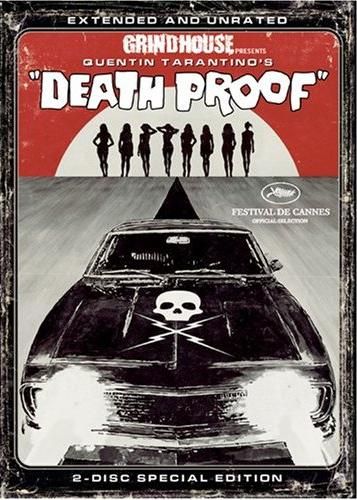
So, let's cut to the chase: do I prefer Death Proof a la Grindhouse, or stand alone? Having just finished watching the new cut not 90 minutes ago, my initial impressions are telling me the former, although, seeing as it took me two viewings to come around to the shorter version so as it is, such is a view that could very well change. But my sense is that leaner is better in this case. QT is, among many things, an incredible structuralist filmmaker; from Reservoir Dogs to both Kill Bills, I believe he knows how to provide a film with exactly what it needs, beginning to end, at any given moment, from his tiny, surprising character reveals to whatever hook or melody is required to compliment the mood at hand. So many of these choices defy the usual expectations that it suggests a higher force being channeled, one that even Quentin is unaware of (the same is true of all great artists, to some extent). That his work exists, at least superficially, in the realm of "entertainment" has been a hindrance to their appreciation, methinks; the language is different from what we expect of greatness, but the words remain the same. Though they're blatant regarding their many direct influences and inspirations, Tarantino's films aren't just remixes of films past - they're conversations within the culture, between past and present, breaking down the barriers between the screen, the audience, and the maker.

I'll certainly be revisiting Death Proof 2.0 again in the future, but moments of it felt less than constructive at this first meeting, a rarity for its director. When Stuntman Mike (Kurt Russell) stalks Abernathy (Rosario Dawson) and her sleepy feet in a restored scene now opening the second act, it seems but a pandering set-up for her destruction of his face with her bitchy boots at the film's end. This sequence is interesting, though, in its functioning as another one of Tarantino's stylistic reflections on his own work; the scene begins as a black-and-white reel that later and quite abruptly shifts to color, as if restoring itself mid-process (whereas Kill Bill: Volume 1 was forced to censor itself via the color shift during the Crazy 88 fight scene). Though my thoughts are that additional qualities of the film will ferret themselves out over time, it is an altogether different animal, both in its length and in its being removed from the schlocky (though immensely fun) Planet Terror as the opening act. It is my hope that fans will treat it as such, rather than as a "real" version meant to replace the shorter cut altogether. Both are valuable unto themselves, but even more so with the other in hand.

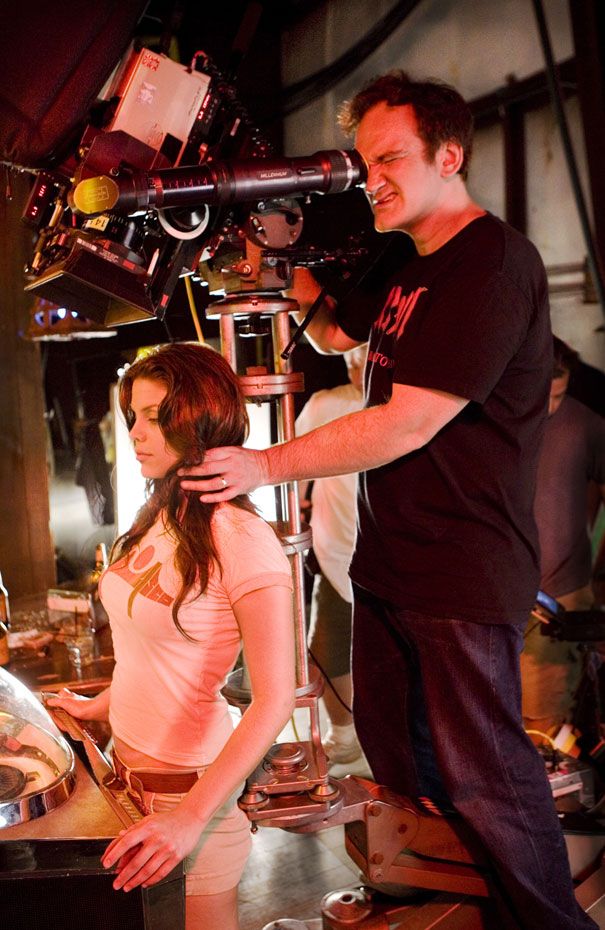
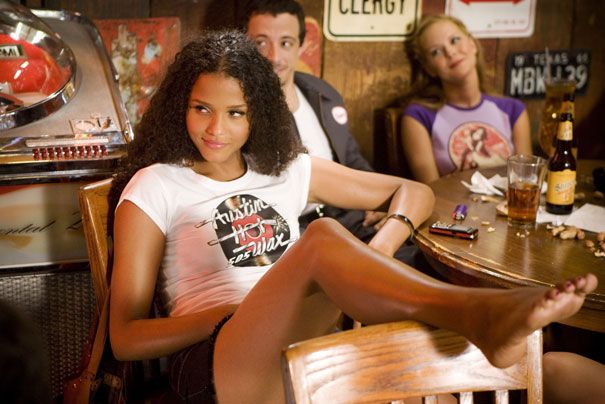
At a base level, nothing that was removed from the 2-hour cut was necessary, per se, either plotwise or thematically, although much of it is a great deal of fun. The best of the new footage is, without a doubt, Butterfly's lapdance as requested by Stuntman Mike; a sexy, restrained number that better humanizes both our instinctive killer and doomed prey before the terrifying moment of truth. Here, I think, it is obvious just how much Quentin loves and respects women, even if he only knows how to express it through politically incorrect expressions of pop culture. Its absence helped Grindhouse pacing wise but its presence here aids in the dimensionality of these characters, a quality to Tarantino's work that I believe he rarely gets due credit for. Films are his life and actors are part of his most intimate family, and his camera is not unlike a loved one nurturing them, savoring their growth and achievements.

What else is new? I detected some fresh dialogue amidst the Jungle Julia and company's nuttering in the opening scenes (it should be stated here that all my comments are based on memory - no notes were taken during my viewing of the film), while a daytime scene after their arrival to the first club depicts Mike watching from a distance, planning his attack in the shadows. Scenes such as this are cool but, I believe, unnecessary in that they externalize what was previously implied through exchanges and pacing. Arlene (Vanessa Ferlito) and her whiny would-be boyfriend discuss their make out plans outside Warren's bar, whereas the previously existing scene of their coming back inside already told us everything we need to know. It's a testament to Quentin's knack for characterization that I find myself enjoying even frivolous time with these individuals, but sometimes a little mystery in the margins is preferable to the overall experience.
Shorter or longer, though, I still believe that Death Proof is indicative of a new phase in Quentin's artistic career, though I suspect it is one we won't be able to truly appreciate except in retrospect. His past cinematic and cultural navigations have contained their own form of profundity as achieved through a reflexive self-analysis (a point on which I disagree with many of my fellows), as well as a distinct, although implicit, sense of morality that has carried over into Death Proof's scathing genre deconstruction. These all remain in the same voice and form but something within seems even more explosive than in those films prior. Is this some new level of auterism only to be revealed with time and additional entries on his resume? Or is this simply the same old Quentin, but with additional years behind him? Either way, Death Proof doesn't simply comment on its genre inspirations - it adds to their very legacy.

May 27, 2007

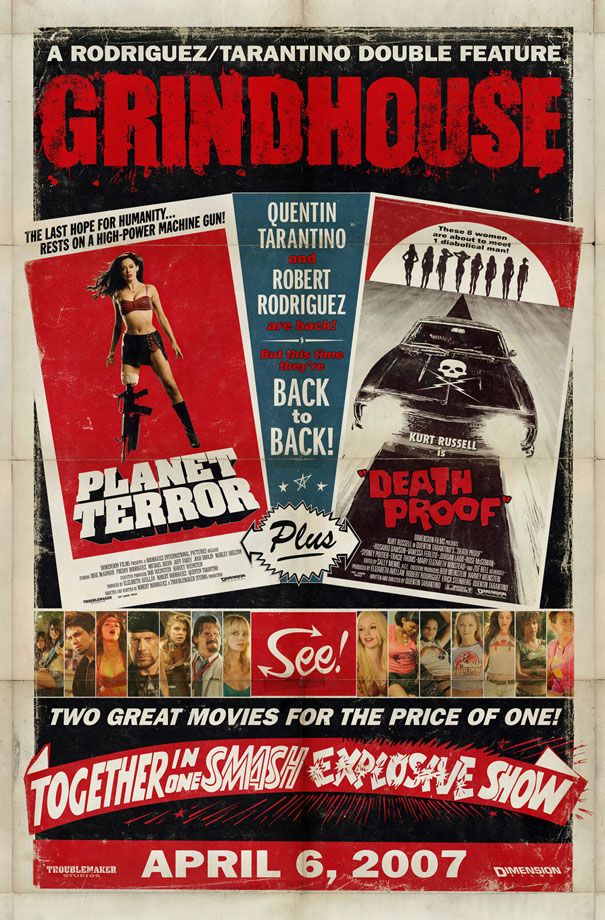
Grindhouse Revisited

A much-needed second go-around with the double-feature mishmash Grindhouse has been both affirming and reaffirming; the latter in that I still think that Planet Terror is a heluva lotta fun, and the former in that my initial - yet untrusted - skepticism towards Death Proof has been unseated. I walked out of the screening feeling without closure, and were it not for the constraints of time and money, I'd have been back in line for the very next showing.

I enjoyed Planet Terror more than Tarantino's contribution on my initial viewing (more on that later), and while I am an admittedly unabashed fan of many things with the zombie genre (a late night Sci-Fi channel viewing of Night of the Living Dead at age eight can be blamed/thanked for that), it is no unreasonable amount of fanboy bias that swayed my opinion. In my eyes, Rodriguez has crafted a loving homage to the down-and-dirty sleaze and gore of Carpenter, Romero, Fulci, and even a little bit of Cameron, guileless in its execution and aiming only to please a carnal cinematic instinct that hungers for visceral satisfaction. Some have called it postmodern but I disagree; frankly, it gives the film too much credit in the wrong ways, as it is a feature proud of and forward about its largely superficial fun.

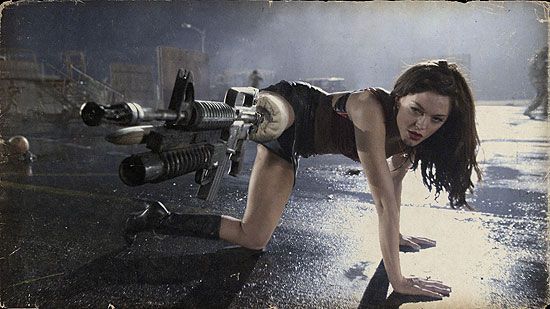
Many have derided the film for the very qualities it aims to fulfill: stupid, overblown, corny entertainment. The phallic imagery of Rose McGowan's machine-gun leg is so deliberately imbedded in fanboy iconography that it seems impossible to take it seriously and, subsequently, impossible to be disappointed by its lack of seriousness. Nary a moment of the proceedings isn't tinged with exaggeration, and while I believe Tarantino to be a far greater artist when it comes to lining his cinematic and pop culture channelings with profundity, Rodriguez is something of a master at to-the-point entertainment. He knows his genre conventions like the back of his hand, and plows through them with a knowing and learned efficiency, tapping into the set-up/payoff narrative structures that guides so much B-movie fare whilst also pairing archetypal characters with the actors most capable of imbuing them with humanistic traits. The movie winks, we wink back, and everyone wins. Granted, some will ultimately see this as bullshit - a view that I don't agree with but I recognize as stemming from personal preferences. Still, while many critics regularly lap up both the serious and the stupid (think Dawn of the Dead and its remake, respectively), why, then, not the seriously stupid as well?

Death Proof is as complimentary as companion piece as I think could have been devised for this double feature, an even more surprising trait because it stands entirely on its own so well. Attentive viewers (here is another way in which repeated viewings help) will notice more than a few instances of cross-over between this and Planet Terror, just as at least one character therein has previously appeared in one of Tarantino's former works. To me, this speaks to cinema as being a self-constructed world unto itself, one as teeming with possibilities and chance encounters not unlike our own reality, the individual movies we see representing but a fraction of the events that take place within its own portrayed reality - they're just what happened to unfold while the camera was rolling.

Since my initial, mind-blowing first viewing of Pulp Fiction four years ago, I've always found Tarantino's films to be unabashedly serious and, yes, moral, even as they partake in cartoonish violence, bloodshed, and rape (among other pleasantries). Tarantino's primal entertainment instincts feel driven by a serious code of morality and honor regarding how we go about our lives with others, even if he himself isn't fully aware of its guiding hand. Sin is the key word here - his film's criminally-driven underpinnings generally serve to expose some character flaw that comes back to haunt their initial perpetrators. The necessity of (and harm caused by) violence, the need for redemption, and paying comeuppance for past deeds are all primary themes throughout his work, and I believe Quentin truly, utterly cares about each and every one of his characters and the paths they work out for themselves in his pop culture carnival, recognizing the inherent humor, sadness, and excitement that blossoms out of the many ways in which we routinely manage to fuck ourselves sideways. Maybe he has learned everything from the movies - a quality that certainly adds to his geekiness, for sure, but it's not as if he's trying to convince us otherwise.

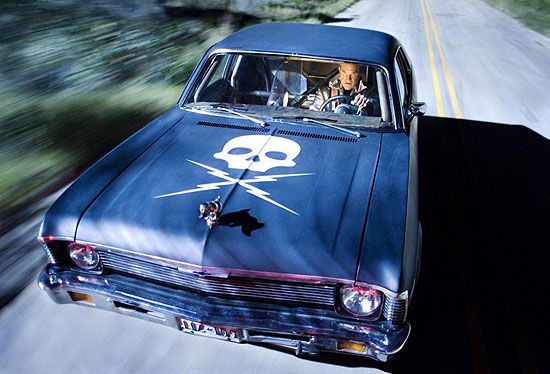
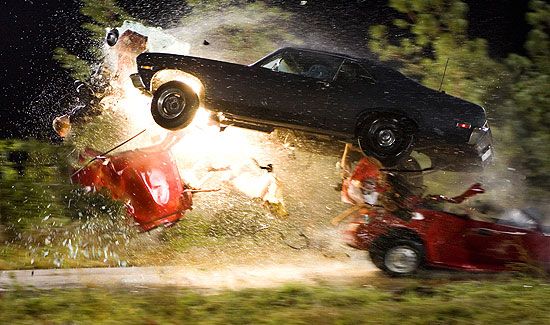
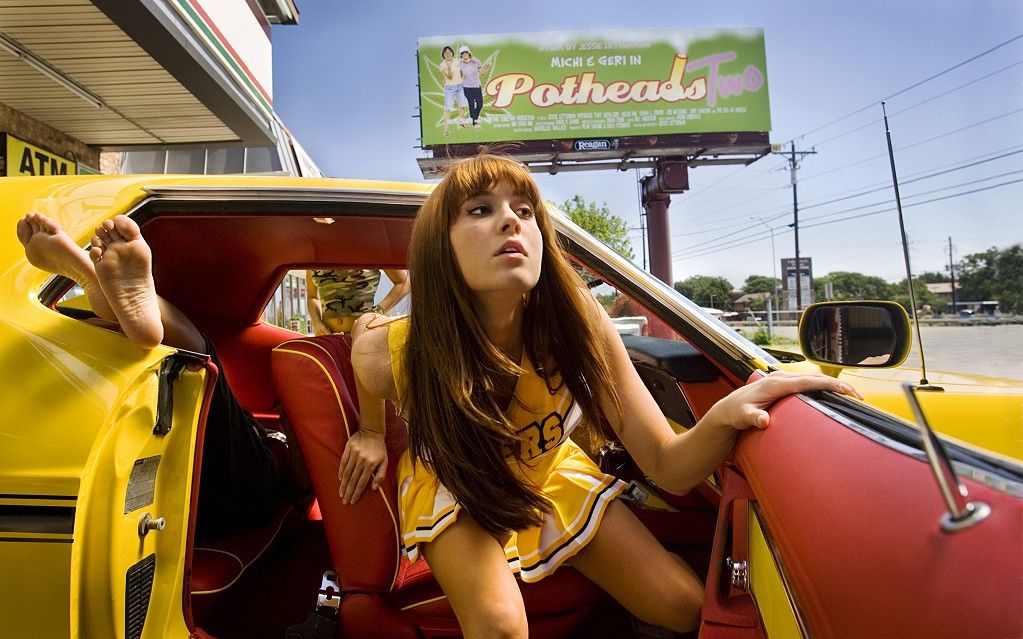
Death Proof confronts us with the subjectivity of violence, internal versus external natures, and the very role the audience plays in legitimizing these elements of cinema. Kurt Russell's villianous Stuntman Mike is like Hannibal Lector jacked up on Cronenberg's Crash - twisted metal, broken glass, and the broken bodies of beautiful women get him off. Seemingly nice enough to the unknowing observer, and it is only when he satiates the internal craving of his libido that he exposes his true self. Likewise, we the audience bear part of the burden in this staged bloodletting: during the build-up to the film's spectacular centerpiece of vehicular homicide, we want to see the wreckage, we're excited to see the mayhem unfold, we crave the visceral rush of watching death happen - specifically, death from a distance, with us safe on the sidelines. But only then does the film repeat the collision four times, each focusing on the death of one of the innocent young women inside. What was once "them" has now become "us," as we're confronted with the familiar faces we've come to know and the utter brutality of their expiration. This is the first half of the film's brilliant genre subversion.

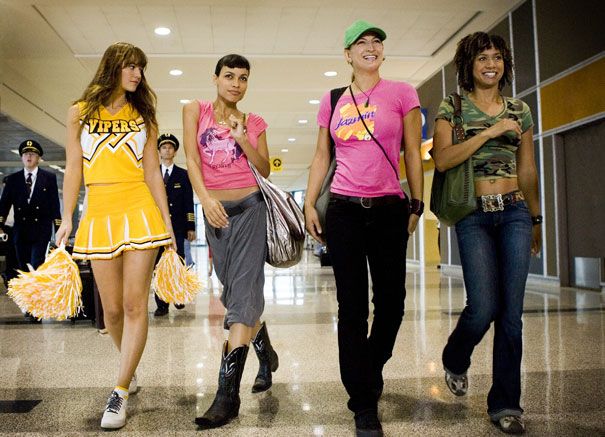
Also key here is an understanding of Quentin's fine female cast and their binary, structured roles. Jungle Julia's posse's faux, bitchy attitudes are an affront to deeper emotional currents and genuine humanistic feelings - feelings we see silently bruised throughout the evening leading up to their death (in short, they're tough cookies, but sweet nonetheless). Zoe Bell's Vanishing Point-obsessed movie crew gang, on the other hand, are greedily self-centered, and while it's certainly no stretch that anyone might want revenge on a speeding, psychopathic motorist who attempts to run them off the road, one gets the sense that this gang has been waiting for a legitimate reason to straight up kick someone's ass - and after having already shot Stuntman Mike, no less (it also doesn't help their case that they left one of their own behind with a creepy fellow who seems to have stepped straight out of Wolf Creek, a film specifically referenced in the climactic car chase).

When Stuntman Mike finally succumbs to the revenge-thirsty rampage, the film has reached an apex of self-criticism. Mike may or may not be crazy, yet we pity his (apparent) demise because of the film's intended role reversal, his humanity having been emphasized in contrast to his would-be victim's superficial indulgences at the cost of others. Mike lies in the vein of a great many movie monsters, as he is only aiming to satisfy his inherent needs in an unaccepting and, for him, incompatible world; he is evil, but he is honest and self-aware of his role, whereas his would-be victims are in denial of their true nature, an untrue to their own when the going gets tough. Amidst all this, the film asks us to develop our own moral opinions on the portrayed events while it emulates the basic genre means of manipulating our moral perceptions, successfully working within the genre without falling to its perceived shortcomings.

That I borderline disliked Death Proof on first viewing can be chalked up to, very simply, a bad first viewing. Perhaps it was the dissimilarity from Planet Terror that threw me off, perhaps it was a jarring bathroom break between the two films, or Jeremiah Kipp's astute pan in his review at Slant Magazine. Dialogue scenes that initially felt drawn out revealed themselves as brilliantly deliberate in staging character traits and digging out a specific narrative groove, while Tarantino's apparent indulgences (examples coming to mind include a thirty-second shot of Jungle Julia whipping her hair to "Baby, It's You", as well as the camera's routine ogling of her feet) became finely woven elements of his synaptic plot devices. Whatever the reason for my initially "not getting it," it is a frequency I am happy to have finally tuned in to. Planet Terror kicks ass, but its skimpy emotional staying power is a necessary trade-off considering its intentions; Death Proof might be a masterpiece, and is possibly my second-favorite of Tarantino's entire catalog after Pulp Fiction.

Planet Terror: B+
Death Proof: A