Sep 16, 2007

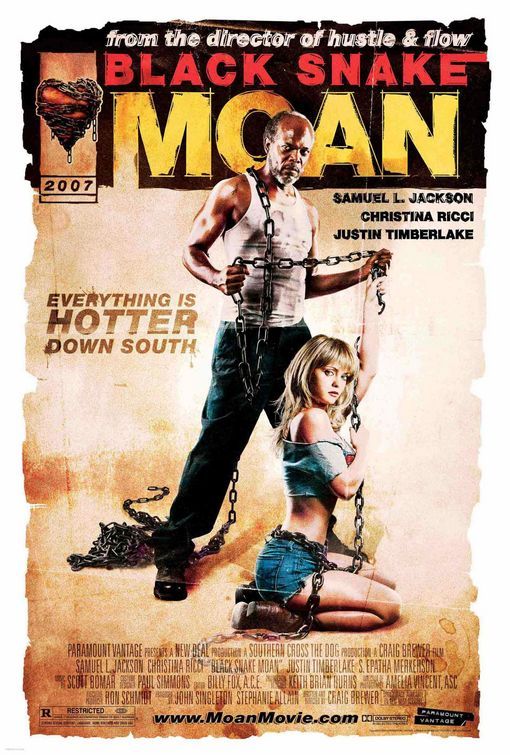
Black Snake Moan (2007): A-

Religion hangs over the lives of the souls in Black Snake Moan - not so much as a specific theology, but as a guiding force of truth in the name of which one can righteously seek to better themselves. This is the primary manner in which the film exemplifies the morality central to its story and themes, a necessary component in justifying its dealing with so many seemingly immoral subjects and events. A true exploitation film - albeit one with a passionately pumping heart - it is a pristine example of masterful storytelling infused with technical know-how and assured ethos. Make no mistake, Black Snake Moan doesn't "make up" for its being soaked to the gills with sex and blood; these are components as necessary to it as hymns to a church (and, incidentally, itself). Director Brewer's previous and much lauded (though unseen by me) Hustle & Flow used its hard-out-here-for-a-pimp storyline as a launching pad for rags-to-riches turmoil. Black Snake Moan swaps the rappers culture for that of the home fried blues, the film sharing with its soundtrack of choice a deep desire to exorcise the sin in its heart so as to find the rays of salvation. There are no acts of divine intervention in the film, but there is a God most definitely present in its framework.

This knitty-gritty exploitation drama doesn't front. Its sleazy, scuzzy nature comes not from a forward desire to push the standards of taste but a been-there sense of the ways of the world. Rae (Christina Ricci) is a formerly abused nymphomaniac in remission after her boyfriend Ronnie (a strong Justin Timberlake) leaves for deploy to Iraq. Meanwhile, the older Lazarus (Samuel L. Jackson) has just learned of his wife's affair with his own brother, embittered and alone. She seeks to drown her sorrows in drugs and sex (Lazarus, amusingly, destroys his wife's rose garden with a tractor), ultimately ending up beaten and raped on the side of a road, left for dead, only to be discovered by Lazarus in the morning. Nursing Rae back to health, he learns of her reputation and uncontrollable urges, and takes it upon himself to better her situation even in the face of local attitudes and racial taboos. Like the film itself, they defy convention in working towards some form of betterment, their flaws not justified but accepted as inherent to their beings. Black Snake Moan knows the troublesome baggage many are forced to carry and it loves them all the more for it.

Here, the sex is hot but it's anchored down by a genuine sense of humanity laced with spirituality, with Brewer astonishingly evoking his character's physical and emotional plights via a controlled color palate, subjective sound design and delirious suggestive visual framing. Rae aims to fill some internal void via her constant rutting while Lazarus' picking of his guitar is unto itself an act of soulful lust, the two ultimately taking on an unlikely father/daughter relationship not unlike the central device of Million Dollar Baby. Black Snake Moan is mournful but vibrant, hopeful and yet reserved; Brewer gives his characters (and the audience) the satisfaction of having made some semblance out of life's trials but not without the reminder that additional bumps in the road lie ahead. Barefoot and half-naked for most of the film, Ricci is a revelation, shining not only through her impressive physique but in using it as an expressive devise (evoking her character's uncontrollable impulses via a fearless series of convulsions and moanings) - we forget how much skin she's showing in light of how strongly Rae's tormented soul shines through. Such is the nature of Brewer's film altogether. From the joyous to the desolate, it is a work that knows how to roll with life's punches.

Sep 15, 2007

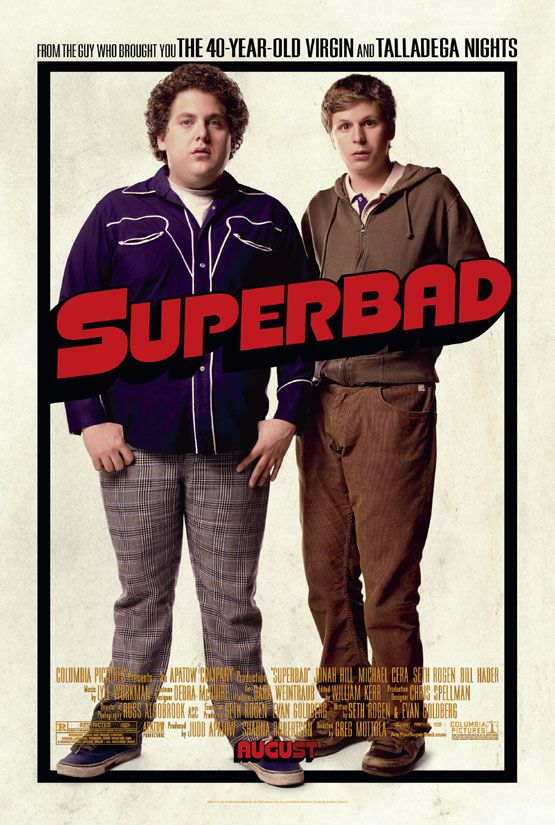
Superbad (2007): B+

Forget American Pie - Superbad is the modern teen sex comedy. The film reverses the escapist fantasy of the drunk teen comedy, taking its character's idiosyncrasies and defects head-on as a means of uncovering the humanity within, as opposed to burying it beneath loads of uncomfortable innuendo and shallow bumblefuckery. The plot is threadbare and all the better for it; longtime friends Seth (Jonah Hill) and Evan (Michael Cera) attempt to go all out during what is to be one of their last nights of high school partying together, loading up on alcohol and attempting to lose their virginity in their pursuit of personal worth and acceptance in a ruthless social environment. Hints of misogyny and selfishness abound in their efforts towards sexual gratification, but Superbad is a film that understands the vain struggle of the outsider high school lifestyle and the excessive focus laid upon otherwise superficial concerns; it knows that such male-centric behavior can be absolutely hilarious from an outsider's perspective (no more so here than in a montage of personified dick drawings, culminating in a brilliant Dr. Strangelove parody: a sketch of a Major Kong penis riding what was already cinema's greatest phallic symbol), but it also has the insight to know that these things are funny because they represent the way we were rather than the way we ought to be. Whereas its genre predecessors cheer with the guy who scores and mock the guy who goes home alone at night, Superbad has the audacity to look for the deeper feelings expressing themselves through these sexual frivolities, male and female alike. Seth, Evan, and their dweebish underling Fogell (played by Christopher Mintz-Plasse, later dubbed "McLovin" thanks to the so-stupid-it's-brilliant running gag of his poorly envisioned fake ID) ultimately get more than they bargained for during their would-be escapist escapades, and with their misadventures charmingly bookended by (and occasionally crossing paths with) those of Slater (Seth Rogen) and Michaels (Bill Hader) - two juvenile cops in a perpetual state of arrested development - such going-ons come to represent an eternal act of learning. Seth Rogen and Evan Goldberg's screenplay - first drafted when the pair was but fourteen years old - tears down the clichés of the genre and in doing so resurrects one all but dead at the hands of a decade's worth of Old School-like comedies, and its keen sense of self-criticism makes it the superbaddest one of all.

Away From Her (2007): B+

The pangs induced by the onset of Alzheimer's disease - for both the victim as well as their onlooking loved ones - make up the basis of Away From Her's central dramatic foundation, and it is one that actress-turned-director Sarah Polley examines with an assured poise and formal - yet feeling - emotional insight. After nearly fifty years of marriage, Grant (Gordon Pinsent) and Fiona (Julie Christie) find themselves at a point where their living arrangements will no longer prove sufficient in caring for her incurable and increasingly controlling disorder, and while her moving to a nearby facility for the mentally impaired is indeed the best medical decision to be made, the policy that prevents new patients from receiving visitors for the first month of their stay proves to be a nearly unsurpassable obstacle in their already strained relationship. Polley communicates her character's emotional rigors with a cool and controlled visual palate, light on indicative musical scoring or overt explanations of emotional undercurrents but heavy on a deliberate "prettiness," a style that initially activated this critic's gag reflex but ultimately revealed itself as a newfound means of ferreting out the textures of human experience present within the narrative; in this way, Away From Her is something of an antithesis to the fake fuzziness of any Hallmark movie of the week. The film stays largely with Grant and his trials following Fiona's worsening condition, and it is from this angle that the film becomes less explicitly about Alzheimer's than about any scenario in which the definition of love is put to the ultimate test; Grant's past is smeared by act(s) of infidelity but his commitment to his wife during this most testing of experiences proves to be his having channeled that regret into something wholly productive (in what may be the film's most telling sequence, Grant finds himself in the most unlikely of interactions, one that crosses gaps of age, gender and culture in a sublime moment of holiness). Polley knows this material well, and though her sincerity is occasionally peppered with an attitude of superiority, the former greatly outweighs the latter. In the end, though, it is the cast who proves to be the most affecting; Gordon Pinsent is wounded in all the right ways by this most selfish of diseases, but it is Julie Christie who is most revelatory - her performance is practically invisible amidst the fabric of the film. Together, they illustrate the soul inherent in life's trials and the triumph that can be salvaged from even the most seemingly absolute desolation.

Sep 4, 2007

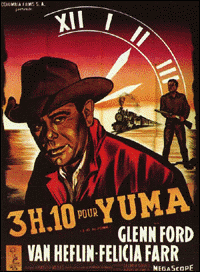
3:10 to Yuma (1957): B-

Before its underwhelming second half, Delmer Daves' classic western 3:10 to Yuma appears to be heading for that special cinematic designation of being About Everything. Early exposition concerns outlaw Ben Wade (Glenn Ford) and his posse's robbery of a stagecoach that results in the death of its driver. Standing by but unable to help for sheer lack of man or firepower is Dan Evans (Van Heflin), a local and honest rancher whose family is suffering from drought and seclusion. Luck, however, sees the local authorities able to arrest Ben Wade in a rare instance of his being alone, and tired of being unable to provide for his wife and two sons, Dan volunteers to help transport the convict to prison for the sterling payment of fifty dollars. Charles Lawton Jr.'s impeccable cinematography frames these characters as essentially lost beings in the existential wasteland of the desert, a series of graceful pans and tilts emphasizing the expansiveness of country in comparison to the meager human outcroppings, while Welles' screenplay touches on the desperation of these souls to live, love, and be loved with a profound sublimity.

Though nary a moment of the film strikes an unpleasant chord from beginning to end, the generally abrupt shift in tone from the first to the second half lessens the cohesiveness of the overall experience, abandoning the accruing potency of its spiritual undertones for a more streamlined and far less interesting action storyline. Dan's moral challenges in bringing a murderer to justice against overwhelming odds - so as to prove his existence as having been truly worth something - should signify his having overcome the desolation that has so long plagued his soul, and though his ultimate decision to act is a significant one to his character, the sense of purpose in his motives feels unnaturally mandated by external forces (namely, the screenwriter), betraying much of what has already transpired. Similarly, Ben Wade's character arc ultimately proves little more than a gimmicky, underdeveloped necessity to the final series of events; while Van Heflin's sympathetic performance is strong enough to largely mask over his character's inconsistencies, Glenn Ford's performance never goes beyond pandering to audiences who would have otherwise scoffed at his playing against type. Similarly, 3:10 to Yuma flirts with a deeper greatness, and though masterful in stretches, it ultimately mistakes feel-good qualities for truly satisfying ones.

Sep 2, 2007

Halloween (2007): C+

Remakes, as a whole, have never gotten my goat. To this viewer, cinema is less about individual stories than about our individual modes of sharing them, and so it is often the case that a number of voices will each have their own interpretations to contribute to a specific tale, all of them worthy of equal consideration and regard (to allow those instances where the film in question is made purely for money to speak for the whole is nothing short of foolhardy, and yet this is the trend amongst both the critical and public movie going bodies). Few films, if any, can qualify for the title of "definitive", though our gut reaction as fans of certain titles might be to assign that very label. Therefore, as a matter of principle - and as a declared, unwavering fan of John Carpenter's original 1978 masterpiece - this new version of Halloween has as much a right to exist as any other, original or remake.

That being said, the film just isn't very good. Instead of a taut, minimalist thriller in which tension builds most during periods of silence an only slivers are known regarding the main villain, this new film spends considerable time developing the young Michael Myers before sending him off to oversee the slaughterhouse, his killing streaks motivated by an abusive home environment and the endless taunts of school bullies. The question, then, isn't whether or not the film improves upon or even lives up to the original - a near impossibility, in this case - but whether or not it stands up unto itself. Unlike the brilliant genre deconstructions of The Devil's Rejects, this Halloween only intermittently taps into the sleaze that defines its brand of grindhouse terror, making for an uneven and unsatisfying experience, despite its scattered moments of potency. When Halloween scores, its ferocity is formidable, but too often does its overzealousness upset the scenery. The opening white trash scenes are downright hilarious but fail to convince of their emotional brutality on an organic level; the blunt naturalism of the 1978 performances has been replaced by an excess of gimmicky acting, as if to compliment Zombie's louder-is-scarier dynamics, which come so hard and fast that they barely have time to simmer into the mind. From its matter-of-fact opening titles, the film is as aggressive as they come in the genre. Here, though, it would appear as if it were attempting to compensate for something.

Zombie must be given props for his extensive reinvention of the original film, a daring but necessary act given the breadth of its influence. Nonetheless, in attempting to distance his own creation from Carpenter's, he's left it without a identifiable voice of its own, defined less by its own qualities than those it lacks in relation to its predecessor. Zombie's respect for the story is considerable, but his decision to humanize Myers is ultimately a counterproductive one; we're watching less of an evil psychopath than an enraged hunk (imagine the Geico caveman crossed with The Terminator) whose motivations feel incomplete and, ultimately (spoilers ahead) - given a late act of mercy - slightly unbelievable. Halloween 2007 externalizes all that was internal in the original, in effect forgetting that the scariest of evils are those we can't see in the flesh. Despite its better efforts, this film fails in inflicting fear onto the soul.

Aug 31, 2007

The Bourne Ultimatum (2007): C

Cinema of late has been plagued by an epidemic of absolutism – what you see is what you get (no need to exercise your imagination during the show). Such has long been the case with condescendingly force-fed narratives that assume no sentient life to be present in the audience, but more recently have styles themselves been forgetting just how much an active audience is capable of contributing to the viewing experience. Paul Greengrass, for all of his genuinely good, pro-human intentions, has long been near the top of this pile with his trademark “shakicam” style – a deliberate choice meant to simulate reality, echoing television trends and assuming the real world to be a non-stop rollercoaster one is likely to fall off of if they’re not strapped in. The intended effect is one of greater involvement for the viewer, but instead, the reckless excessiveness of it all erects an impassable emotional barrier.

Condolences to viewers physically affected by his faux-verité – I was thankfully not among them. A better word to describe his queasy persistence would be annoying, like a forum user who lays on the caps lock key as if to bolster the strength of their argument. Like virtually any style, it is one effective when meted out properly; the openings of both Saving Private Ryan and 28 Weeks Later incorporated such jittery cinematography on a purely organic level, henceforth knowing when to hold a steady shot and when to lessen the distance to the visceral action. Greengrass’ constant indulgence masks even his best showcasings moot. The Blair Witch Project used a similar aesthetic but on purely logical and necessary grounds. The Bourne Ultimatum operates externally, not internally, and in doing so mistakes confusion for titillation; it slice-n-dices its action so much that it’s impossible to tell how much of worth was actually there to begin with. Zzzzzzzzz.

Even so, it must be said that the film is a competent one and a noticeable improvement over the intolerable Bourne Supremacy, though one gets the notion that the story has all but sputtered out its gears by this third entry – not a problem unto itself, but a damning one given the emotional void of the previous film and the shallow excitement this one rides upon. Damon is an effective enough action hero, deserving of a more self-reflexive film to work in (here, David Strathairn takes top acting chops as the villainous CIA agent Noah Vosen), though with this film the almost-nonstop action only seems to be staying off the obvious and the inevitable. The ultimate conclusion is neither surprising nor clever, except perhaps to anyone who found V for Vendetta’s puerile governmental misgivings total mind-blowing. Greengrass’ gimmicky sequels don’t bring us closer to Bourne by humanizing him – they do it by means of lobotomizing our own better instincts.

Aug 27, 2007

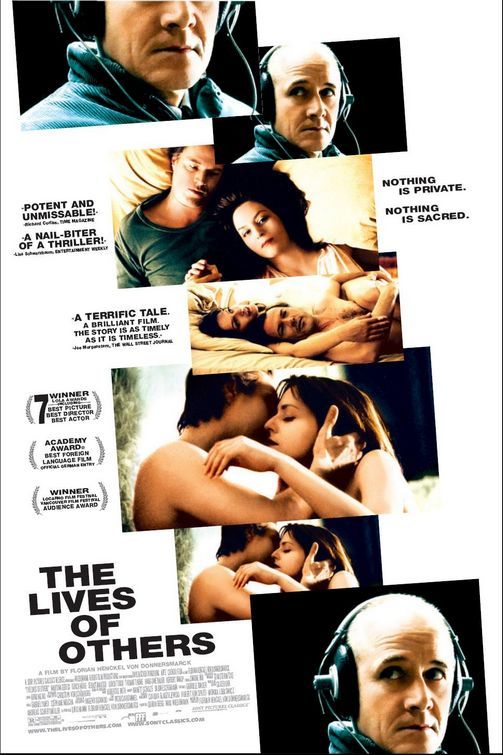
The Lives of Others (2006): C+

The Lives of Others aims to flatter its audience – a quality typical for a film whose emotional posturing is only skin deep. Well meaning though it is, Florian Henckel von Donnersmarck’s Oscar-winner compulsively hand-holds the viewer through a guided history tour of 80’s East Germany, where the oppressive government has made it its goal “to know everything” and even the slightest of dissenters are subjected to endless interrogations and customized forms of psychological torture. Gerd Wiesler (Ulrich Mühe) is an example-setting Stasi office: by the book, firm, consistent, and unforgiving. However, his monitoring of a suspected playwright (Sebastian Koch) and his girlfriend (Martina Gedeck ) begins to erode his rigid exterior, as he sees the human cost levied by the system he has so firmly supported. Mühe’s performance is a fine one but the part aches for dimension; such as it is, the ambiguous motivation of his swaying allegiance isn’t so much rooted in a sense of implicit humanity as it is a mere plot gimmick needed to achieve the film’s sermonizing goals. Both Wiesler’s character and the bulk of the plot are painted in little more than the broadest of strokes, thus freeing the audience from having to truly come to terms with the social-political conflicts at the film’s center. Spielberg’s Schindler’s List is overrated but the film probes its material beyond our day-to-day notions of good and bad, a necessity in coming to terms with the role of evil in our world. Aesthetically and historically, though, The Lives of Others is pure vanilla – Donnersmarck presents us with a potentially thrilling plot but virtually all the emotional strings have been detached, instead opting to spell out its central conflicts for us in condescending expositional form, all the way through the disastrous, intolerably force-fed coda. Such is only exacerbated by Hagen Bogdanski’s point-and-shoot cinematography, suffocatingly blocked and hermetically sealing any emotional rawness beneath the film’s style-free highbrow exterior. There’s no change of mood, no shift of tone throughout; the film wants to offend no one, and in doing so has totally deprived itself of personality or feeling (one scene in particular, in which a moment of great tragedy transpires, unfolds so plainly that it suggests a botched Three Stooges gag). The film’s success over Pan’s Labyrinth at the 2007 Oscars is obvious in retrospect, less because of its historical subject matter than it’s total lack of stylistic intrigue – its pandering dryness self-righteously masquerades as highbrow importance. The film isn’t as hysterical as The Sea Inside, another recent Foreign Language winner, yet it remains an unfortunate reminder of the Academy’s oft-gutless elitism.